


The future of work schedules isn’t broken because people want flexibility. It’s not working because most schedules were never designed for the work teams actually do now.
Hybrid work, remote work, working from home, and asynchronous collaboration - none of those broke on their own. What keeps failing is that they’re still based on old calendar logic. So HR teams keep dragging it forward. The solution? More meetings. More messages. Longer delays. Work still gets done, but just not as quickly as it should.
If this feels familiar, it’s not a culture issue. It’s a design problem. And it’s fixable-once you stop treating schedules like placeholders and start treating them like systems.
What the “Future of Work Schedule” Actually Refers To Now
Most people, when they talk about the future of modern workplace schedules, aren’t only talking about flexibility. Many organizations already have flexible work arrangements. The real shift is subtler. It’s about how work actually flows through a team once you stop anchoring everything to hours, desks, and attendance.
That’s where most definitions of workplace flexibility fall short. They describe arrangements, not systems. A flexible work schedule isn’t just about when people show up. It’s how decisions move, where work stalls, and how often teams must pause and realign to keep things moving.
Why Traditional Schedules Are Failing Modern Teams
Traditional schedules worked when work was predictable. Same place. Same hours. Same people around the table. If something stalled, you walked over and fixed it. Time and coordination were basically the same thing.

This approach no longer works with hybrid setups, remote work, or employees working from home. Teams are spread across time zones, countries, and cultures. They all depend on asynchronous collaboration.
Research shared through Harvard Business School showed that time zones are a hidden drag on remote teams. Even a one-hour schedule gap resulted in a 19 percent drop in communication opportunities. On the other hand, a Gallup survey found that when organizations introduce asynchronous collaboration, remote and hybrid employees feel more connected and experience less burnout than their on-site counterparts.
Here’s the thing: most schedules still lock time before intent. The result? Meetings get booked before priorities are clear. Availability gets treated as progress. Then the week fills up, reality changes, and everyone spends their energy reshuffling instead of moving work forward. It feels busy because it is. It just isn’t effective.
Many modern teams are busy but not making progress. The problem isn’t flexibility. It’s an outdated scheduling process that no longer aligns with how work flows through people, projects, and decisions.
This is where many leadership teams must learn to diagnose what’s really breaking down. Seeing how timing, flow, and decision-making interact inside teams often reveals more than another policy review.
The 4-Day Workweek: Signal, Symptom, or Shortcut?
Search the internet for “workplace of the future,” and you’ll discover a common theme: the 4-day work week with no pay cut. Many view this as the solution to scheduling strain and low employee retention.

Large-scale trials show positive results when companies reduce weekly hours to 32. Employees reported lower burnout, better mental health, and similar self-reported productivity. In one study of 141 companies across six countries, 90 percent chose to retain the model after the trial.
The reality is more than just giving everyone Friday off. Companies had to spend weeks restructuring workflows for the reduced work schedule to work. In other words, the system had to change to make the new work model successful.
That’s why so many pilots fail. Organizations adopt the four-day work week as a policy decision. Then they pile on more work during those days to ensure productivity doesn’t dip. But when the underlying system doesn’t change, pressure builds, and they resort to a five-day working week.
Before changing schedules at scale, teams need a way to stress-test how work moves under pressure.
That’s why the debate keeps resurfacing. The question isn’t whether four days is better than five. It’s whether the schedule is doing real work—or just holding space while everything else strains around it.
The Forces Reshaping the Future of Work Schedules
The need for flexible work schedules happened gradually—one small change at a time. Technology has enabled people to work from home or anywhere. Cloud computing made real-time asynchronous collaboration possible. But those changes exposed weakness in schedules that were never designed for variation.
1. Hybrid Work Became Popular Before Schedules Caught Up
Hybrid working arrangements didn’t start as a strategy. They were a response to changing workplace habits. Teams needed flexibility. Organizations needed continuity. Everyone moved forward, and the rest was supposed to fall into place later. It didn’t, at least not neatly.
The “later” part is where things went sideways. Teams were scattered across the country and stopped sharing the same hours. Some employees worked from home, others were in different time zones, but schedules stayed the same. Coordination that used to happen by accident suddenly required effort. Decisions got delayed. Small handoffs stretched out. Everyone was busy, but things took longer.
Hybrid didn’t fail. It worked exactly as designed. The problem is that schedules never changed to match it, and most teams are still trying to fill that gap with more coordination rather than different timing.
And even that explanation isn’t perfect. Some teams adjusted faster than others. Some barely noticed the drag. Which is part of the problem—the schedule stopped being a neutral backdrop and started shaping outcomes unevenly.
2. Knowledge Work Stopped Moving in Straight Lines
The way decisions are taken in the modern workplace also has shaped scheduling and workforce planning. Most schedules still operate on the premise that work moves from task to task in a clean sequence. Finish one thing, start the next. That model is fine when roles are fixed, and only a few people make decisions.
Teamwork models differ greatly from how people collaborated ten years ago. Now, projects move back and forth. Decisions depend on input from multiple functions. Work gets reviewed, revised, and reworked midstream. Progress comes in bursts, not steps.
The problem is that schedules never adjusted to that reality. Time is still booked as if work flows predictably, even though it rarely does. When something changes, teams don’t change the schedule—they add meetings, check-ins, and follow-ups to keep things aligned.
Nothing breaks outright. Work still gets done. It just takes longer, with more coordination effort than anyone expected.
3. Technology Increased Speed—but Also Fragmentation
Technology is a powerful force that is changing the future of work schedules for good. The reality is that tasks that once took days now take hours. Employees are an instant DM away. Drafts circulate instantly, and decisions happen sooner.
Artificial intelligence has just added more pressure to that speed. With generative AI adoption, teams can analyze large chunks of data in an instant, meaning feedback loops are shortened. The downside is that more work is circulating at the same time.
But schedules are still stuck on fixed blocks, predictable sequencing, and shared availability. Simply put, they weren’t built for this pace.
So teams compensate. They check in earlier. They stay available longer. They add quick calls and “just to align” meetings to keep things from slipping. Not because it’s efficient—but because the work keeps arriving before the schedule has room for it.
Nothing breaks outright. That’s why it’s hard to spot. But everything starts to feel compressed, noisier, and harder to manage than it used to.
4. Time Became a Scarcer Resource Than Headcount
Time is what teams run out of first now, not people. Headcount stayed flat. Budgets tightened. But the amount of coordination, decision-making, and follow-up work kept climbing.
What suffers isn’t effort. It’s focus. People switch tasks constantly. Context gets lost. Days fill up with small interruptions that don’t look serious on their own but add up fast.
This is where exhaustion creeps in. Not because people are working longer hours, but because the schedule never gives them space to finish anything properly. Everything competes for attention at once.
Most teams don’t talk about this as a scheduling issue. They just feel worn down and slightly behind all the time. But the problem usually sits on the calendar, not with the people doing the work.
5. Expectations Around Work Have Changed
What employees expect from management has shifted in the last few years. Now, work schedules are one of the biggest places where tension shows up first. Employees don’t want 9–5 office hours. They don’t want to respond to important emails at midnight. They want clarity about matters and workplace flexibility on how to get there.
Newer employees are more concerned about work-life integration in their jobs. This could mean a full-time work-from-home setup. It could mean result-only work where output is measured, rather than the hours spent. They also prefer working asynchronously, collaborating digitally, and managing their own time with flexible hours.
Any schedule that still rewards presence over progress will cause friction in the workplace fast.
What Purpose-Led Scheduling Actually Looks Like in Practice
Employee priorities form the basis of purpose-led scheduling. It designs work time around purpose rather than creating time slots for employees to fill. This way, it aligns employee preferences, well-being, and needs with operational tasks.
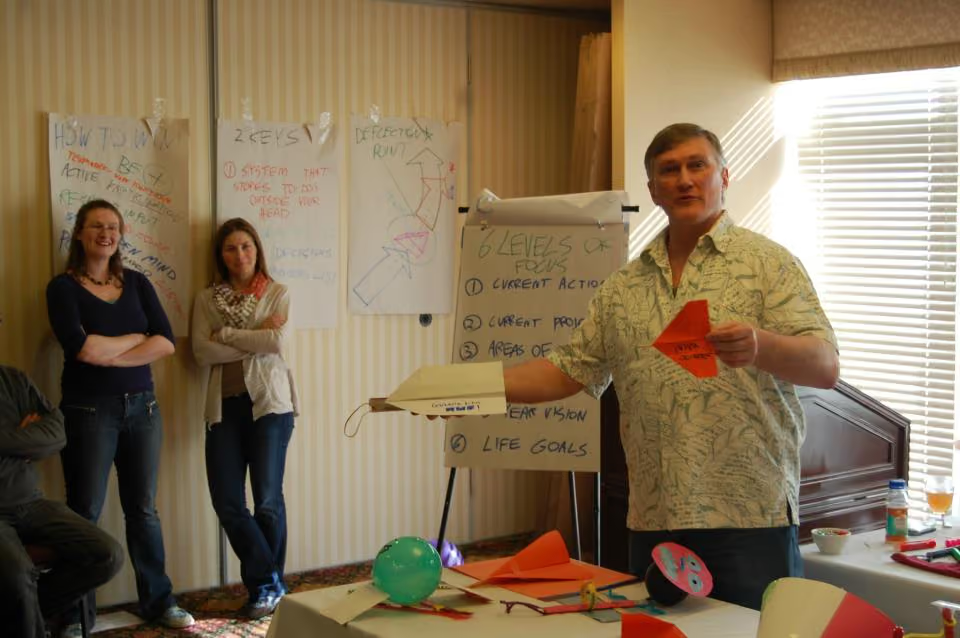
In practice, the focus shifts from hours logged to specific outcomes. Flexible work schedules stop rewarding presence for its own sake and start supporting the work that needs to get done. While recognizing personal constraints, it ensures that low-value activity doesn’t constantly interrupt critical work.
Purpose-led scheduling shows up on calendars. Priorities are protected time. Meetings take place only if there’s a clear need. Important work isn’t constantly rescheduled.
This type of planning works because purpose-led teams prioritize schedule visibility. First, weekly and monthly workflows are defined—when decisions are made, when collaboration is necessary, and when deep work occurs. Then, flexibility follows. Without these flexible work schedules, everyone just works different hours, and momentum vanishes.
This is the moment that trips up most organizations. They introduce flexibility without intent. Employees are offered “create-your-own schedules” options. Without clarity about timing, priorities, or decision windows, nothing productive will happen.
Strategy only matters if it changes how time is used. Purpose-led scheduling is what makes that translation happen.
FullTilt helps teams experience purpose-led scheduling rather than debating it.
How to tell if schedules are purpose-led (or just flexible):
- Do priorities show up on the calendar? If everything is movable, nothing is actually important.
- Are there clear times when decisions happen? Or do they drift until the right people happen to be free?
- Is focus time protected, or constantly sacrificed? If deep work always loses to meetings, the schedule isn’t doing its job.
- Do teams know when collaboration is expected—and when it isn’t? Flexibility without shared timing usually turns into friction.
- Does the calendar reflect outcomes, not presence? If being “available” still matters more than making progress, the system hasn’t changed.
- When work feels overloaded, does the schedule get questioned first? Or do teams default to working longer and harder?
Over time, this creates more stable agile team rhythms, where work moves predictably, even when hours stay flexible.
Where HR Teams Can Start—Without Breaking Everything
Redesigning future work schedules doesn’t start with policy changes. If flexible schedules are outcome-driven, it’s vital to begin by examining how time is used week to week. Employee hours come after that.
Let’s face it, most teams know where the problems exist. Meetings are scheduled out of habit. Work that spills into evenings. Decisions are left because no one is quite sure when they’re supposed to happen. Those are scheduling signals, not performance issues.
A good first step is to map one typical week and ask a few simple questions.
- What work actually moves the needle?
- What time is spent coordinating instead of progressing?
- Where does work stall because timing is unclear?
You don’t need perfect answers, but you’ll notice patterns showing up fast.
From there, small changes matter more than big announcements.
- Protect decision windows
- Cancelling recurring meetings that no longer serve a purpose.
- Agree on when asynchronous work is the default and when real-time collaboration is necessary.
These adjustments don’t disrupt operations, but they do change how work flows and protect agile team rhythms.
The goal isn’t to redesign everything at once. It’s to make the schedule start doing some of the work that people have been compensating for manually.
How to Decide What Should Be Synchronous vs Asynchronous
The biggest challenge when planning future work schedules is deciding when to bring employees together. A general rule is this: real-time is vital when timing matters. Here’s how.
Asynchronous work suits updates, reviews, and tasks that benefit from thinking time. We’re talking writing, planning, routine check-ins, and analysis. Employees prefer responding in their own window.
Synchronous time should be treated as sacred. Only go there when absolutely necessary. Use it for decisions, workflows, conflict resolution, or other moments where shared in-person contact makes a tangible difference.
Deciding on asynchronous collaboration and synchronous collaboration avoids the situation where everything is urgent and time is wasted, or nothing is urgent and productivity drifts.
How to Tell If Flexible Work Schedules Are Working
Flexible schedules often feel successful early on. Employees love the freedom. Fewer meetings to attend. Employee morale picks up. What isn’t there to like?
But early wins don’t mean that new work schedules will boost the employee experience and productivity in the long run. To understand that, it’s crucial to look past activity and focus on workflow.
Throughput vs Activity: Is Work Actually Finishing Faster?
The first signal—work is getting completed more cleanly than before. It’s not about whether calendars look lighter, but about whether projects close with less delay.
Are your teams still busy, but delivery timelines haven’t improved? That is usually a sign that the schedule has shifted effort without improving flow. Workplace flexibility hasn’t been factored in when decisions, reviews, or handoffs actually happen. The good news is that it’s an easy fix.
Decision Latency: How Long Work Waits for Time or People
An effective flexible work schedule ensures that decisions happen closer to when the information is ready, not when everyone “has a moment.”
Work typically stalls because teams never find the right moment to make crucial decisions. It rarely happens because they disagree.
Look for patterns where decisions take days to get a meeting, approval, or an alignment call. If flexibility increased but decisions slowed, the schedule isn’t supporting how authority and timing really work.
Coordination Drag: Where Meetings Are Masking Timing Problems
Another sign that a new flexible work schedule is delivering is that team leaders rarely need to realign people once the workflow begins.
When schedules support how work flows, coordination happens upfront. Roles are clear. Decision windows are understood. People know when input is needed and when employee autonomy is allowed.
Do teams need more coordination to complete the same work? Are “quick syncs” added midweek to fix timing issues? These are signs that scheduling is compensating for poor timing instead of preventing friction.
In those cases, flexibility hasn’t reduced effort—it’s shifted it into meetings, messages, and follow-ups that exist only to keep work aligned.
One of the fastest ways to surface coordination drag is to watch how teams operate under time pressure in custom-designed team building activities.
How HR Can Start Without Breaking Everything
Redesigning work schedules doesn’t require a company-wide rollout or bold policy change. In most cases, adjusting the system before tweaking employee hours is the safest starting point.
HR teams can begin by looking at one team, one workflow, or one recurring pain point. Here are a few ideas:
- Where does work routinely slow down once it’s already in motion?
- Which decisions consistently wait for a meeting instead of happening when the information is ready?
- Where do teams add check-ins or syncs after work has begun?
- Which handoffs depend on availability rather than clear timing?
- What work spills into evenings or late weeks because timing wasn’t planned upfront?
- Where are managers stepping in to realign people midstream?
These questions usually surface timing problems, not performance gaps—and that’s where schedules need attention first.
Small changes often have the biggest impact. Protecting decision windows. Cancelling meetings that exist out of habit. Agreeing on when asynchronous work is the default and when real-time collaboration is truly needed. These shifts reduce friction without disrupting operations.
The key is to bring managers along early. When leaders understand that the goal is smoother flow—not less control—they’re more willing to experiment. Starting small builds confidence and gives teams evidence before anything scales.
The objective isn’t to announce that now employees only work Monday through Thursday. It’s to implement a scheduling system that prioritizes workflows and employee autonomy.
Where the Future of Work Schedules Is Headed Next
The next shift in work schedules won’t come from another policy change. It will come from how flexibly schedules align with employee needs.

The biggest shift in work schedules has already happened—the hybrid era. Hybrid working models. These are no longer experiments. In the modern workplace, working remotely, at least for some time in the week, is normal, and schedules assume flexibility by default.
What else can we expect about flexible work schedules in the future? Here are a few trends to look out for:
- Outcomes Matter More Than Hours: Scheduling is shifting away from time logged toward work completed. This puts pressure on calendars to support progress, not presence, and forces clarity around priorities, ownership, and decision timing.
- Shorter Workweeks Are a Design Test, Not a Silver Bullet: Four-day workweeks keep resurfacing because they expose inefficiencies in how we use time. When they work, it’s because workflows and schedules were redesigned—not because a day was removed.
- Well-being Is Tied to Flow, Not Fewer Hours: Burnout increasingly comes from fragmented time and constant context switching. Schedules that protect focus and reduce rework do more for well-being than flexibility alone. This includes flex-time, asynchronous collaboration, and digital fluency.
- Technology Accelerates Work—And Reveals Weak Timing: Faster tools, AI-driven scheduling, and constant connectivity compress timelines. Schedules that don’t adapt end up overloading teams, forcing them to stay available longer just to keep up.
The future of work schedules isn’t about choosing the right policy or copying the latest trends. It’s about recognizing employee needs and ensuring that time supports workflow. When schedules align with purpose, teams don’t need to compensate with constant coordination, longer hours, or more meetings.
That’s where many organizations get stuck. They know something isn’t working, but they struggle to translate strategy into time, or intent into day-to-day behavior. Redesigning schedules isn’t just an HR exercise—it’s a team challenge.
At FullTilt Team Development, we help organizations turn these ideas into lived experiences. Through hands-on team design and facilitated challenges, leaders quickly see how timing, flow, and decision-making shape outcomes.
If your schedules feel busy but brittle, it might be time to assess them differently. Let’s see what happens when work is designed around purpose rather than just availability.