

Cross-functional team structure sounds clean on paper. On the org chart, it even looks modern. But what many team leaders don’t get is this: if cross-functional collaboration is working, why are decisions still dragging three meetings longer than they should?
Leaders share the same story. They’ve got the right people in the room. Goals are aligned. The conversation feels productive. Then, three weeks later, the project stalls. Marketing waits on product. Product waits on engineering. And engineering wants “one more review.” Everyone is busy, yet progress drifts.
Cross-functional collaboration rarely fails suddenly. It slows down when ownership is unclear. As teams scale, this gradual slowdown turns into higher costs.
Let’s unpack where the architecture actually breaks.
Why Do Cross-Functional Teams Fail?
Most breakdowns in cross-functional work aren’t caused by conflict. Work stalls when incentives compete, no one seems to own the project, and decision authority is unclear. What happens is that teams stay busy, but progress slows because their structure is based on talk rather than accountability.
If you watch long enough, a pattern appears. Teams agree in principle, then protect what they’re measured on. That’s where the drag begins.
Teams Protect Their Own Targets
Cross-functional work starts to break down when teams don’t share goals and priorities. They may agree in a meeting and establish goals. But their performance reviews, bonuses, and budget control stay with their own departments.
You’ll see how it plays out in day-to-day work. Marketing wants to launch. Engineering hesitates—stability is on the line, and they know it. Finance comes in later with questions about cost. The discussion doesn’t explode. It stalls. Decisions get pushed back to the next meeting.
The continual revisiting, meetings, and reviews keep pushing the timeline back, even though everyone’s busy.
Collaboration Without Ownership Creates Drift
Cross-functional failures often start without anyone realizing. The meeting feels productive. Decisions are discussed, refined, and adjusted. Everyone agrees to move forward. But what happens if no one is responsible for the shared outcome?
At first, the work moves forward. Everyone is clear on their tasks. But as time passes, slides are updated, emails are sent, and it becomes unclear who is accountable. Then the questions return. One team thought approval was final. Another assumed it was provisional.
The decision comes back to the table. More context. More voices. No one is obstructing the project. But no one is carrying it either.
Shared responsibility means no one owns it, and cross-functional teams will fail.
Power Imbalance Inside the Structure
Cross-functional teams begin to fracture if one or two teams carry more weight than the others. The issue is that the imbalance isn’t always explicit. Everyone is invited to the meeting. Everyone gives input. But when the call is made, decisions tend to follow the same line of authority.
In time, you’ll notice patterns. Engineering raises a concern, and the decision pauses. Sales pushes for a feature, and the roadmap shifts. Operations flags execution risk, and it gets noted—but not prioritized. No one announces a veto. It just happens quietly.
The result is that some teams adapt, others become more insistent, and some disengage entirely. The team may be cross-functional in name, but in practice, efforts move in multiple directions.
Collaboration vs Coordination vs Ownership (They Are Not the Same)

Assuming that collaboration alone is sufficient for a cross-functional team structure is a mistake. It is also incorrect to use these terms interchangeably when teams work across departments.
- Collaboration improves thinking.
- Coordination improves flow.
- Ownership clarifies who carries the decision.
Cross-functional Collaboration Is Shared Thinking
Collaboration is essential because it uncovers issues before decisions are made. For example, engineering flags stability risks, finance highlights margin impacts, and sales surfaces customer demand. That cross-checking and collaboration between departments shape the proposal before anyone commits to it.
Coordination Is Workflow Sequencing
Coordination defines the workflow: who builds first, who reviews, and what must be approved before the next team begins. Clear sequencing reduces delay caused by missed handoffs. It keeps momentum once direction has been set.
Ownership Is Decision Accountability
Ownership is the most critical element of cross-functional teams. It clarifies who decides after input, assigns risk to one person, and prevents decisions from cycling back under pressure.
Cross-Functional Team Structure Models (And Their Tradeoffs)
Team structure models become vital when projects span multiple departments. They define reporting lines, decision-making processes, who approves handoffs, and ownership. The structure ensures that, as inter-departmental demands grow, teamwork is less about hierarchy and more about clarity.
Here are examples of six typical cross-functional team structures.
Functional Structure With Cross-Functional Projects
Functions remain intact, and teams report to their functional leaders. Depending on the project size and scope, specialists are pulled in as needed. A senior team leader usually has ownership and makes the final call. This structure is hierarchy-based.
Tradeoffs at scale:
- People split time across competing priorities.
- Functional leaders quietly control resource access.
- Project urgency weakens inside departmental workload.
Matrix Structures
People report to both a functional manager and a project or product lead. Day-to-day work follows the project direction, but performance reviews usually stay inside the function. Authority is shared on paper and negotiated in practice.
Tradeoffs at scale:
- Conflicting priorities push decisions upward.
- Performance reviews influence which leader “wins.”
- Employees spend time negotiating direction.
Dedicated Project Structure
Teams are assembled full-time around a defined initiative. Members step out of their functions and focus solely on delivery until the project ends. Authority is concentrated within the project team.
Tradeoffs at scale:
- Functional continuity weakens during long initiatives.
- Knowledge reintegration becomes difficult afterward.
- High performers get pulled repeatedly into special teams.
Network or Fluid Structure
Teams are formed around work rather than fixed reporting lines. Roles in the team shift depending on the level of expertise required. Authority is lighter and often informal, relying on trust and shared norms.
Tradeoffs at scale:
- Decision authority becomes harder to trace.
- Informal influence outweighs formal role clarity.
- Conflict resolution depends heavily on personalities.
Autonomous Squads or Pods
Small, self-contained teams are responsible for the end-to-end outcome of a project or product. Most required skills sit inside the team, reducing the need for input from external sources. Direction is often set at the product level rather than by function.
Tradeoffs at scale:
- Alignment across squads becomes a coordination burden.
- Standards drift without strong integration mechanisms.
- Shared infrastructure decisions create friction.
Process-Based Structure
End-to-end workflows rather than departments define the structure of this workflow model. The focus shifts to throughput and flow across stages, such as order-to-cash or acquire-to-retain. Functional expertise supports the process rather than defining it.
Tradeoffs at scale:
- Deep specialization can erode over time.
- Process owners compete with functional leaders.
- Changes in one stage ripple unpredictably across others.
Scaling Cross-Functional Teams Without Losing Accountability
The problem with creating successful cross-functional teams is that they quietly fail as project or team sizes increase. Decision paths that worked for five people no longer work for fifteen or thirty people. What held at fifty breaks down at a hundred. The breakdown is structural, not cultural.
At this size, senior leaders are no longer present in every decision—they simply can’t be. Teams begin resolving tradeoffs within their own groups first. Conflicts surface later, often after work has already progressed.
What Breaks at 30–50 People
Maintaining informal alignment becomes impossible when 30 or more people collaborate across several teams. At the start, someone could turn in their chair to resolve a question. By the time 30 or 40 people are involved, misunderstandings creep in, and decision pathways become muddled.
Here’s a typical real-life scenario. One team agrees to ship a feature this quarter. Another team assumes the dependency will land next quarter. Both believe they are working to plan. The mismatch appears when integration work begins.
Product adjusts priorities mid-cycle to respond to a revenue opportunity. Engineering continues building against the previous scope. By the time both sides compare notes, work has already moved in different directions.
No one has ignored the roadmap. They are following different versions of it.
What Breaks at 100+ People
Decisions are rarely made in the same room when the combined number of employees across cross-functional teams reaches 100 or more. If your team structure hasn’t scaled beyond 30, all your processes become clunky and ineffective.
To illustrate. A proposal moves from a working group to a department lead, then to a cross-functional review. Each time, changes are required before approving. The document grows. More meetings are scheduled. And before long, the entire process has stalled.
KPI Conflict at Scale
As organizations grow, different teams are measured on different outcomes. Sales is rewarded for closing deals this quarter. Customer success is measured by renewals next year. Engineering is evaluated on system stability. Product is tracked on feature delivery.
With so many competing outcomes, it’s challenging to keep cross-functional work on track. For example, a revenue target may push a launch forward. However, engineering may not be able to complete testing in time. Customer success flags risk to retention if quality drops. Each team references its own scorecard.
The same can happen with budget reviews. One department prioritizes headcount because its forecast depends on it. Another requests funding for a new initiative tied to growth targets. Approval depends on which metric carries more weight in that quarter.
Roadmaps get adjusted to reflect whichever measure is most urgent at the time. Teams revisit decisions when leadership changes emphasis. The work itself doesn’t stop. The direction shifts around it.
How AI Increases Cross-Functional Friction
Streamlining cross-functional work with Artificial Intelligence tools is a double-edged sword. On the one hand, it’s possible to analyze data faster, automate processes, and improve accuracy across the board. The downside? Drafts are produced faster than teams can deal with. Also, AI doesn’t fix ownership or structural issues.
Here are three ways AI actually amplifies friction in cross-functional processes.
AI Multiplies Requests Faster Than Decisions
AI tools make it easier to generate ideas, drafts, forecasts, and feature concepts. Marketing submits more campaign variants. Product explores additional roadmap options. Sales proposes new customer use cases. The volume of requests increases.
The failure occurs when decision capacity doesn’t expand at the same rate. Work accumulates faster than it can be cleared. Review meetings fill. Approval times lengthen. Teams wait for confirmation before moving forward.
Before you know it, AI has put the brakes on work processes, rather than helped to speed things up.
AI Exposes Weak Ownership Faster
AI makes it easier for multiple teams to act on the same idea simultaneously. Marketing drafts messaging. Product refines positioning. Sales prepares outreach. The problem? No one confirms who owns the final version.
For example, two teams could ship similar materials because the approval responsibility is unclear. Or outputs sit in review while team leaders decide who signs off.
With AI producing work faster, the need for clear ownership becomes even more vital.
AI Does Not Fix Structural Ambiguity
Many leaders introduce AI solutions to solve speed problems. So drafting improves, analysis accelerates, and teams start producing higher-quality work in less time. This visible output suggests momentum.
What often gets forgotten is the decision paths behind those outputs. In other words: the cross-functional team structure. If approval rights were unclear beforehand, they will be glaringly obvious after AI kicks in. If accountability is loosely shared, automation doesn’t tighten it.
AI can increase throughput, but it cannot assign authority. When the foundation is undefined, additional speed only makes the structural gaps more visible.
The Architecture That Makes Cross-Functional Teams Work
Cross-functional teams don’t start working because people try harder. They work when decision lines are clear, authority matches responsibility, and tradeoffs are resolved at the right level. The difference isn’t attitude. It’s structure.
Here are solutions to the eight reasons why cross-functional work processes typically fail.
No Clear Decision Owner → Assign Accountability

In many cases, the problem with cross-functional work isn’t disagreement. It’s that no one has been explicitly given the final call. Teams assume it will “emerge.” It doesn’t. Someone has to own it, and that has to be stated before the work starts. Not implied. Not shared. Named.
That also means the person deciding can’t be dependent on someone else to release time or approve the timeline. If they’re accountable, they need the authority to close the loop.
That means clarifying three things before work begins:
- Who gathers input.
- Who decides.
- When the decision is locked.
FullTilt Team Development designed the Authentic Leadership session to train people to take ownership.
The team building activity has participants completing a task multiple times. Each time, they must adjust their approach. The focus stays on management under pressure—who steps forward, who hesitates, who protects consensus. Leadership isn’t theoretical; it’s practiced in real time through repeated execution and visible decision responsibility.
If your teams revisit the same decisions, the issue is rarely effort. It’s ownership. Try Authentic Leadership at your next team building event and make the decision line visible.
Delivery Leads Without Resource Control → Align Authority with Capacity
.avif)
A delivery lead sets a deadline. The team agrees to the plan. Two days later, a functional manager reallocates one of the engineers to another priority. The deadline stays the same.
The delivery lead cannot move the timeline without approval. The functional manager cannot move the priority without affecting the project. Work slows while the two leaders align.
To prevent this, capacity must be committed at the same level as the scope is approved. If a delivery lead owns the outcome, the same role must control how much time is protected for it. That agreement has to be explicit before work begins.
In Elevated Raceway, teams must design and build a raceway system using typical office materials. Participants depend on others to complete connected sections before the final race. When one team shifts focus or delays handoff, the entire track is affected. The pacing issue becomes visible immediately.
If authority over scope and authority over people sit in different places, the delay shows up in the workflow.
Book the Elevated Raceway for your next team building event and help improve cross-functional workflows.
Metrics That Compete → Define Tradeoff Rules in Advance
Cross-functional work stalls when teams pull in different directions. Here’s what happens. Sales pushes for release before quarter-end. Engineering holds the build for additional testing. Customer success flags risk to renewals. Each team defends the number it is measured on.
The argument repeats because no rule exists for settling it. One month revenue wins. The next month quality does. The decision shifts with whoever speaks.
Before work begins, leadership must state which metric carries priority when they collide. Not in principle. In writing. If speed and stability conflict, who has the final call? If growth threatens retention, which measure holds? That rule must be in place before the pressure arrives.
The Cross-Boundary Communication team building activity helps teams communicate clearly and break down silos. Participants practice giving and receiving feedback under pressure through structured exercises. They experience how unclear communication standards create confusion.
Escalation as Default → Clarify Decision Boundaries at Each Level
Cross-functional teams fail when routine decisions are escalated because no one is sure who is authorized to close them.
Work stalls when leadership announces a new priority but leaves reporting lines, capacity, and decision rights unchanged. So managers spend time juggling tradeoffs that should have been resolved. The same conflicts appear in weekly leadership reviews.
This happens when decision limits aren’t defined. Teams don’t know what they can close themselves, so they escalate to avoid risk. Leaders respond case by case. The pattern repeats.
Each level needs explicit authority: what can be decided locally, what must move up, and what should never. If those lines aren’t written down, escalation becomes habit.
In the Clear and Productive Feedback Module, participants practice structured, direct feedback tied to performance standards. They learn to resolve issues at the point of impact rather than passing them up.
Book the Clear and Productive Feedback Module and reduce unnecessary escalation inside your cross-functional teams.
New Priorities Without Structural Change → Reassign Ownership Before Announcing Urgency

Cross-functional work fails when leadership adds a new priority without changing ownership or workload.
What happens is that teams keep working on existing commitments while being asked to accelerate a new initiative. There is no shift in priorities or deadlines, creating friction and tension in the workplace.
Before announcing urgency, leadership must decide which work stops, which timelines shift, and who now controls the new initiative. If authority over scope changes, control over capacity must change with it. That decision must be made before execution begins.
FullTilt Teams designed 8 Productive Practices to help leaders and employees work through structured planning and prioritization exercises. When competing demands are introduced, teams must explicitly choose which advances and which pauses to pursue. The impact of unclear priorities becomes immediate.
Book 8 Productive Practices for your next corporate event and ensure urgency is supported by structural clarity.
Expanding Approval Layers → Reduce Review Points to Essential Sign-Offs

Cross-functional projects slow down as more people are involved in decision-making. This usually happens as organizations expand and must scale. At the start, it’s two or three people approving decisions. Later, entire departments.
Problems surface when an organization naturally expands into more departments. In time, review roles are added and never removed. Not every reviewer carries decision authority, but their feedback delays progress.
A proposal starts with the working team. It then moves to a functional head. Then to a steering group. Then, finance asks for adjustments. Then risk requests clarification. Each layer schedules its own meeting. The content changes slightly each time. Delivery waits for the final signature.
In the Scavenger Hunt, teams move through timed challenges and cannot advance until each task is completed and confirmed. Teams quickly learn that unnecessary steps require extra validation, which slows progress and creates tension.
Include a Scavenger Hunt in your next team event to help improve coordination, teamwork, and communication skills.
Informal Coordination at Scale → Formalize Cross-Team Handoffs
Cross-functional teams run into problems when coordination relies on informal conversations rather than defined handoffs.
This is often an issue startups face. It’s easy to clarify work over the same desk or by sending a quick message. Usually, two or three people are “wearing” multiple hats. As headcount grows, not everyone is in the same meetings. One team assumes a task is complete. The receiving team expects additional detail. Work pauses while clarification happens.
To prevent this, every cross-team transfer must include defined inputs, defined outputs, and a named owner on both sides. Handoff criteria must be written before work begins. If a task changes mid-cycle, the receiving team must acknowledge the change before execution continues.
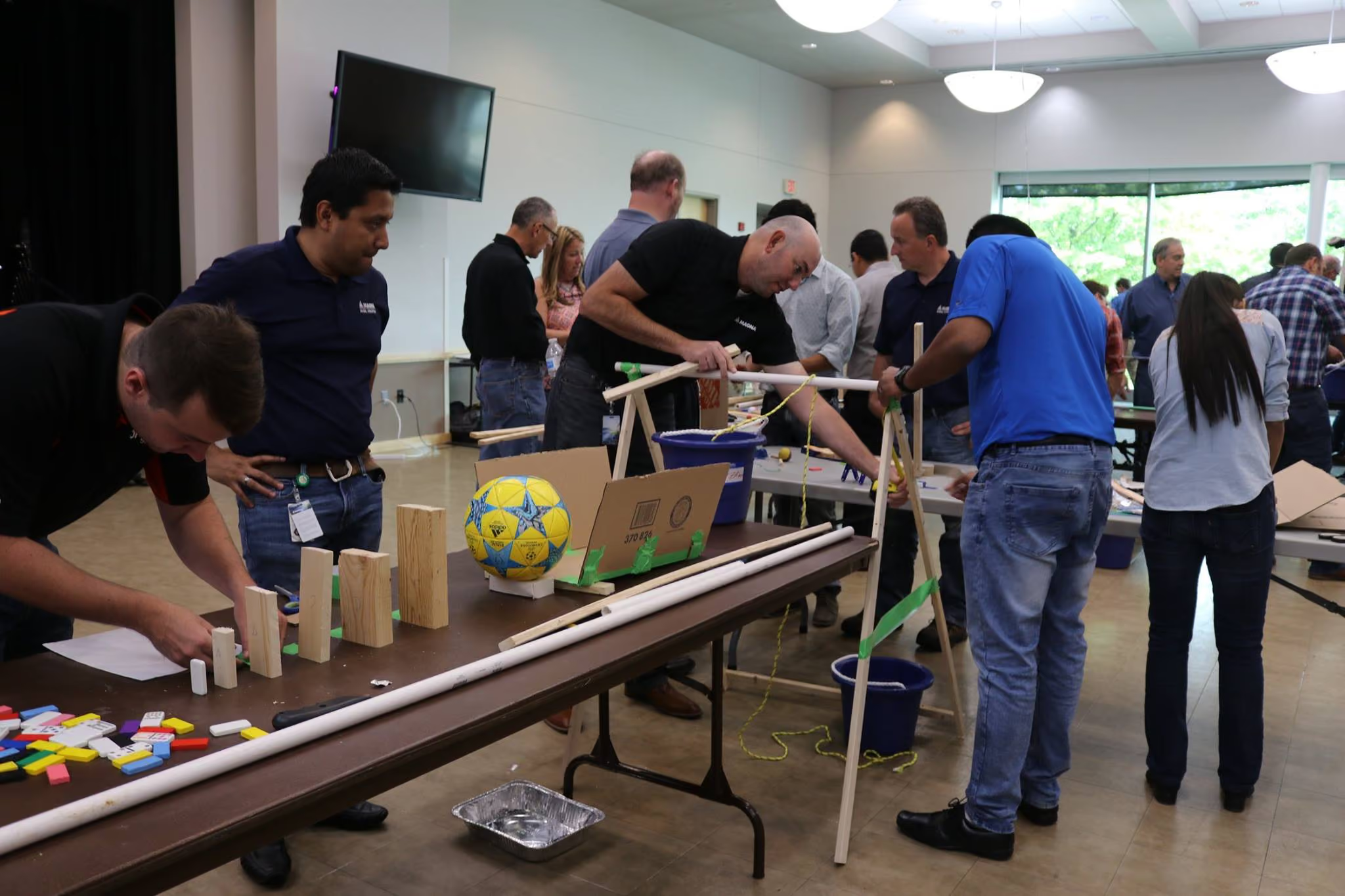
The Domino Effect Challenge is a useful team building activity to help organizations scale and adjust. Teams design and build a structure inspired by a Rube Goldberg machine. The goal is to create a continuous chain reaction. Each group controls a segment, but the outcome depends on precise handoffs.
Learn more about how to incorporate the Domino Effect Challenge in a corporate offsite or half-day team building event.
Tools Without Accountability → Define Ownership Before Increasing Output
If cross-functional teams fail, it is rarely because people refuse to collaborate. It is because decision rights, resource control, and review boundaries were never formally defined—a common problem when organizations scale production.
When new tools are introduced, output increases immediately. Teams generate more proposals, reports, drafts, and data than before. The volume rises faster than the review capacity can handle.
Approval responsibility often stays undefined. Multiple managers comment. No one closes. Work proceeds based on partial agreement or outdated versions because the final sign-off point was never named.
To correct this, ownership must be defined before tools are rolled out. For every output, one role approves it. One role controls version changes. One role confirms when the work is final. If production speed increases, the decision path must be shortened and assigned.
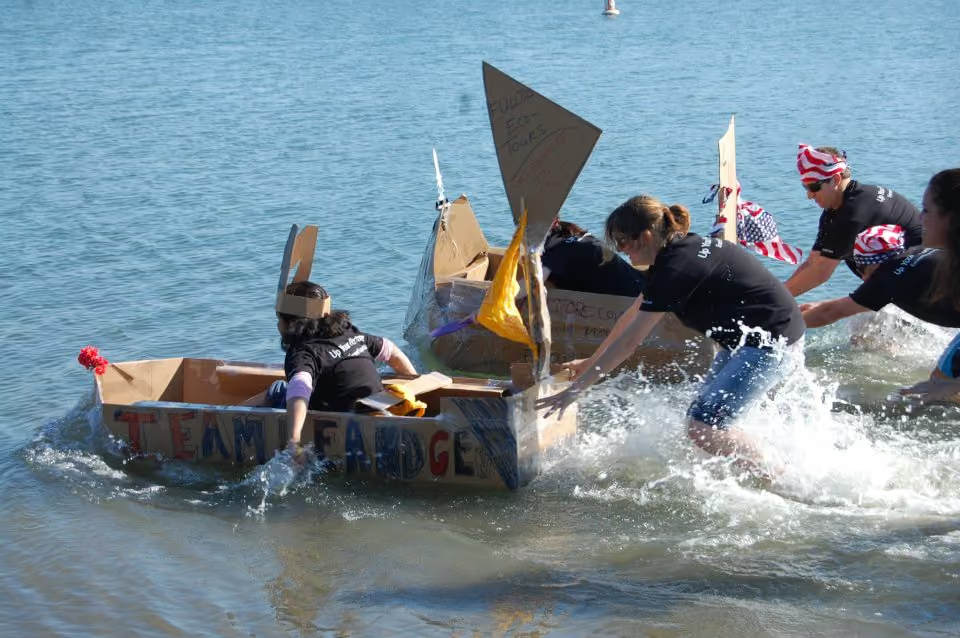
The Cardboard Boat Build is a fun team event that helps employees take ownership and work cohesively as a group. Cutting cardboard pieces, taping them together, and quickly creating a boat that can carry one passenger helps participants take ownership. They learn the importance of teamwork—sink or swim.
Discover how the Cardboard Boat Build challenge can add a fun, experiential element to your next indoor or outdoor team building event.
Fixing Cross-Functional Collaboration at the System Level
Cross-functional teams do not improve because people try harder. They improve when reporting lines, decision authority, and approval limits are deliberately designed. Ownership must be named. Capacity must match responsibility. Tradeoffs must be settled before pressure builds.
If collaboration keeps slowing, adding more meetings will not fix it. Introducing new tools will not fix it. Running another alignment workshop will not fix it. The system has to change.
FullTilt works with leadership teams to make those changes visible and practical. Through structured team development programs, leaders see where authority is unclear, where handoffs break down, and where decision paths are longer than they should be. The work is not theoretical. It exposes the mechanics.
Cross-functional execution improves when structure supports it. If your organization is ready to address collaboration at the system level, contact FullTilt today to help you design a team architecture so decisions move, handoffs close, and teams deliver.