

The best team building games for meetings are short (5–15 minutes), require no materials, and create genuine interaction rather than task completion. Below are 30 of them organized by format — in-person, virtual, hybrid, and large group — so you can run one at the start of any meeting today.
Why Team Building Games in Meetings Work
Most meetings start badly. People arrive distracted, half-present, still mentally in the last conversation or the email they were about to send. A well-chosen game — run at the top of the meeting, before the agenda — resets that.
The mechanism is attention. A game that requires active response — answering, guessing, moving, deciding — pulls participants into the present moment in a way that a welcome slide and a review of the agenda simply doesn't. Once people are present, the meeting actually starts from a shared baseline.
The second benefit is relational. Team members who laugh together, solve something together, or reveal something genuine about themselves before a meeting begin that meeting with more goodwill toward each other. Researchers call this psychological safety — the single most consistent predictor of team performance in Google's Project Aristotle research and in Amy Edmondson's work at Harvard Business School.
If you prefer question-based openers to games, our 150 icebreaker questions for work covers every format and group size with ready-to-use questions. For structured activities that go slightly longer, our guide to quick team building activities has 40 options from 5 to 15 minutes.
The key constraint for meeting games is time. They work when they take 5 to 15 minutes, require no materials or pre-work, and have a clear beginning and end. When they run long, they become the meeting — which creates the exact resentment you were trying to avoid. All 30 games below are built with this in mind.
In-Person Team Building Games for Meetings

These require physical presence but no advance preparation. All you need is a room and a group.
1. Human Bingo
Before the meeting, create a 3×3 or 4×4 grid with characteristics in each square: "has worked in a different industry," "speaks more than two languages," "has read a book in the last month," "has been with the company more than 5 years." Participants circulate and find colleagues who match — one name per square, no duplicates.
Time: 8–10 min | Group: 10–50
Why it works: Forces brief personal conversations with colleagues people might not interact with otherwise. High energy, no competition pressure, genuinely fun.
2. Marshmallow Name Game
One marshmallow (or any small object) per person. Someone says a colleague's name and tosses them the object. That person must say another name and toss before catching their own. Add a second object once the pattern is established.
Time: 5 min | Group: 6–20
Why it works: Gets people on their feet, ensures everyone learns names, and generates laughter through failure. Perfect for onboarding new team members into an established group.
3. Storytelling Chain
One person starts a story with one sentence. The next person adds a sentence. Continue around the room — each person must connect logically to the previous sentence. The story ends when it reaches the person who started it.
Time: 5–8 min | Group: 6–15
Why it works: Active listening is required to continue the story coherently. It's impossible to be on your phone during this activity. Unexpected narrative directions generate genuine laughter.
4. Silent Line-Up
Ask the group to arrange themselves in a line by a chosen variable — birth month, years at the company, number of cities lived in — without speaking. Gestures only. Reveal where everyone actually is once complete.
Time: 5 min | Group: 10–40
Why it works: Generates non-verbal communication and brief one-on-one interactions across the whole group. The reveal creates energy and instant conversation.
5. Paper Tower Challenge
Teams of 3–5 build the tallest freestanding structure using only what's available in the room: paper, pens, notebooks, sticky notes. Ten minutes to build. Measure and compare.
Time: 12–15 min | Group: 6–30 (split into teams)
Why it works: Under time pressure with ambiguous constraints, teams reveal their actual operating patterns — who leads, who defers, how decisions get made. The debrief connects directly to team dynamics. This format is a core part of experiential team building — learning through doing rather than being told.
6. Rock Paper Scissors Tournament
Everyone plays the person next to them. Losers become enthusiastic supporters of the person who beat them — following them and cheering loudly. Winners keep playing until one champion remains with the entire room cheering behind them.
Time: 5 min | Group: Any
Why it works: Physically simple, instantly inclusive, generates disproportionate energy and laughter. Excellent for waking up a mid-afternoon meeting that's losing momentum.
7. Would You Rather (Work Edition)
Facilitator presents a work-based dilemma. Everyone picks a side simultaneously — move to the left wall for option A, right wall for option B. Spend 30 seconds hearing from one person on each side, then reveal another dilemma.
Time: 5–8 min | Group: Any
Why it works: Simultaneously engages the whole room, generates movement and conversation, and reveals how differently people think about familiar workplace tradeoffs. Scenarios like "Would you rather have a brilliant colleague who's impossible to work with, or a mediocre one who's a pleasure?" spark real discussion about team values.
8. Category Sprint
Name a category. Every person in turn names something in that category — no repeats, no pausing more than 3 seconds. Anyone who hesitates or repeats is out. Good categories: things you find in an office, things that can be both a noun and a verb, famous leaders.
Time: 3–5 min | Group: 6–20
Why it works: Fast-paced, lightly competitive, completely nonthreatening. Gets the group alert and laughing before a demanding agenda.
9. The Map
Display a world or country map. Each person marks where they grew up, where they've lived, or where they'd move tomorrow if they could. Brief explanation optional.
Time: 8–10 min | Group: 8–25
Why it works: Creates instant, genuine conversation. People discover unexpected connections — colleagues from the same city, same country, same childhood geography — that never come up in work context.
10. Coin Logo
Each person empties their pockets or bag and uses whatever objects they have — keys, phone, pens, receipts — to create a logo that represents themselves or their role. Share with the group.
Time: 8 min | Group: 6–20
Why it works: Reveals personality and creativity with zero materials needed beyond what people already carry. The sharing moment generates questions and connection that carry into the meeting itself.
Virtual Team Building Games for Meetings
Designed for Zoom, Teams, Meet, or any video platform. No breakout rooms required unless specified.
11. Zoom Scavenger Hunt (60 Seconds)
Call out an item. Everyone has 60 seconds to find and hold it up to camera. Good prompts: something from your childhood, something older than 10 years, something that tells us who you are, something you're proud of.
Time: 5 min (5 rounds) | Group: Any
Why it works: Gets people away from their desk, reveals personality through objects, and generates real conversation. No prep required whatsoever.
12. Name That Background
Everyone sets a virtual background before the meeting that represents something about them — a place, a film, a memory, something random. They don't explain it. The group guesses. Reveal at the end.
Time: 8–10 min | Group: 6–15
Why it works: Creative, visual, and requires the group to actually pay attention to each other rather than their second screen. The guesses are usually as interesting as the answers.
13. Typing Speed Race
Use a free typing test site (typeracer.com, 10fastfingers.com). Everyone opens it simultaneously, runs one race, and posts their WPM in chat. No shame — celebrate outliers at both ends.
Time: 5 min | Group: Any
Why it works: Real competition, real outcome, zero stakes. Generates laughter and casual banter, and requires nothing from the facilitator after the initial instruction.
14. Guess the Workspace
Each person takes a photo of a small, specific corner of their workspace — not the full setup. Post to chat. The group guesses whose is whose.
Time: 5–8 min | Group: 6–15
Why it works: Remote teams often have no idea what each other's working environments actually look like. This creates instant personal connection through the thing people spend most of their day in.
15. Virtual Pictionary
Use skribbl.io — free, browser-based, no account required. One person draws a word, the rest guess in chat. Run 5 rounds. For remote teams that struggle with engagement, this and other virtual team building games can become a reliable weekly ritual without requiring any planning overhead.
Time: 10–15 min | Group: 4–20
Why it works: Everyone knows the format. The virtual version works identically to the in-person version. Generates disproportionate laughter relative to setup effort.
16. Two Truths and a Lie (Chat Poll)
Each person posts their three statements in chat simultaneously. Use an anonymous poll (Mentimeter, Slido) or chat votes to guess. Reveal one person per round.
Time: 8–10 min (for 5–6 people) | Group: Up to 20
Why it works: The virtual format actually removes some social pressure of the in-person version. People can't see everyone looking at them while they decide what to reveal.
17. Word Association Chain
Facilitator says a word. Next person in the gallery says the first associated word that comes to mind. Continue around the call. No repeats. Anyone who hesitates more than 3 seconds starts a new chain.
Time: 5 min | Group: Any
Why it works: Fast, zero-prep, impossible to check your email during, and generates genuinely surprising associations that become running references for the team.
18. The 30-Second Expert
Each person has 30 seconds to explain something they know unusually well — any topic, work-related or not. Beekeeper, competitive swimmer, sourdough obsessive, amateur astronomer. Timer enforced strictly.
Time: 8 min for teams of 10 | Group: Up to 15
Why it works: Every person on your team is an expert at something that has nothing to do with their job title. This activity surfaces that — and it's consistently the source of the most surprising and memorable meeting moments.
19. Company Trivia (Culture Edition)
Facilitator prepares 5–8 trivia questions about the company — founding year, first customer, a notable milestone, values in order. Post in chat, everyone answers simultaneously.
Time: 10–12 min | Group: Any
Why it works: Creates collective knowledge of shared history, which is one of the building blocks of team identity. New employees learn context; long-tenured employees feel their institutional knowledge acknowledged.
20. Emoji Meeting Recap
At the end (not the start) of a meeting: each person posts three emojis in chat that summarise their experience of the meeting. No explanation required — but the facilitator can ask about one or two.
Time: 2 min | Group: Any
Why it works: Gives the facilitator honest qualitative feedback on the meeting in real time. Reveals more than a survey because the constraint forces prioritisation and prevents diplomatic non-answers.
Hybrid Team Building Games (In-Person + Remote)
Hybrid is the hardest format. These are designed to avoid the common trap of in-person participants having a significantly richer experience than remote ones.
21. Shared Slide Deck
Before the meeting, create a shared deck with one blank slide per person. Each person fills their slide with three images that represent something about them — current project, outside life, goal for the year. Everyone presents their slide for 60 seconds.
Time: 10–15 min for 8–10 people | Group: 6–15
Why it works: Everyone has the identical experience regardless of location — the slide deck is the equaliser. Remote participants aren't secondary to in-room participants.
22. Live Simultaneous Poll
Use Slido, Mentimeter, or Poll Everywhere. Everyone — in the room and on camera — answers via their phone or laptop simultaneously. Display results live on screen for both groups.
Time: 3–5 min | Group: Any
Why it works: Simultaneous response on a shared screen creates a single unified experience regardless of physical location. It's also the fastest way to get honest data from a mixed group.
23. Story Spine (Hybrid Version)
Post the template in chat: "Once upon a time... Every day... Until one day... Because of that... Because of that... Until finally... Ever since then..." Each person contributes one line — in-room and on-call participants alternating.
Time: 8 min | Group: 8–20
Why it works: Equal participation regardless of location. The alternating structure prevents in-room voices from dominating, which is the core challenge of hybrid facilitation.
24. Digital Sticky Note Storm
Use a free collaborative whiteboard (Miro, Jamboard, FigJam). Everyone posts sticky notes in response to a prompt: "What's one thing this team does exceptionally well?" or "What's one thing we've never discussed that we probably should?" Group silently, then discuss.
Time: 8–10 min | Group: Any
Why it works: Everyone contributes simultaneously and anonymously if preferred. Remote and in-room participants have identical experiences. The output is something the team can keep and return to. For teams wanting to build on what surfaces here, team building activities focused on collaboration take the same themes into a deeper structured experience.
25. Cross-Location Pairs
Pair team members deliberately across in-room and remote — one from each. Each pair has 3 minutes to interview each other with one question: "What's something about your work you think the team doesn't fully appreciate?" Share one insight from each pair.
Time: 8–10 min | Group: Any even number
Why it works: Cross-location pairing explicitly breaks the in-person/remote divide. The interview format gives both participants equal talking time. The question generates substantive responses rather than small talk.
Team Building Games for Large Group Meetings
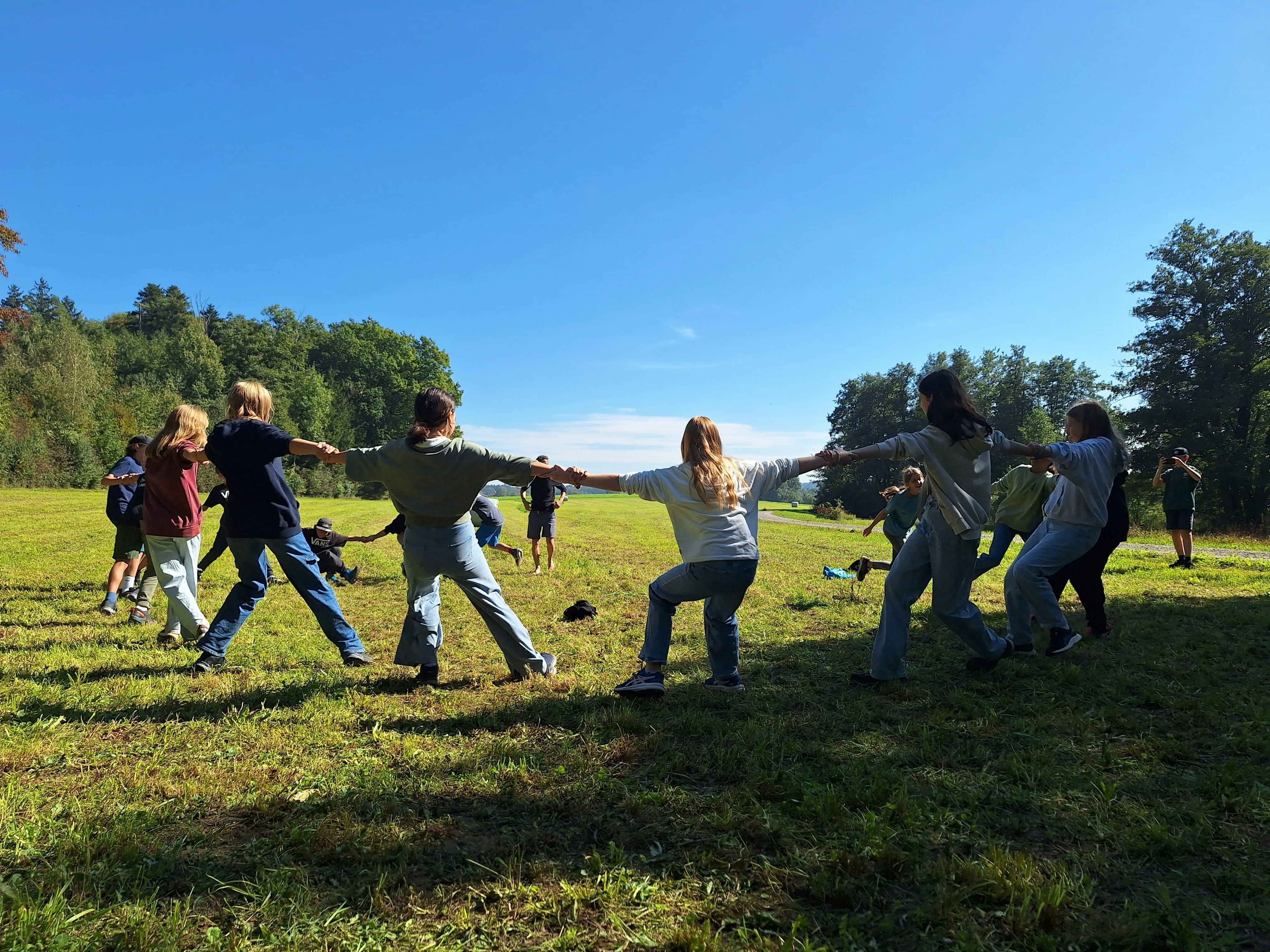
For all-hands, conferences, or company-wide meetings — where individual games don't scale.
26. Speed Networking Round
In a large room, participants have 90 seconds to exchange names and one fact with someone they've never spoken to. Signal ends the round. Repeat three times. For virtual large groups, use breakout rooms with automatic 90-second rotation.
Time: 8–10 min | Group: 30–500
Why it works: Creates real connections in a structured format. Every person leaves having met three new colleagues. Full Tilt's large group team building programs use this kind of structured social architecture to build connection at any scale.
27. Live Pulse Check
Post one question via Mentimeter: "How energised are you about our strategy right now? 1–10." Display results live. Acknowledge what you see honestly: "A lot of 6s and 7s — that's worth understanding. Let's come back to that."
Time: 3 min | Group: Any
Why it works: Gives leaders real data instead of the curated version that typically reaches the front of the room. Signals that honest feedback is welcome — which is itself a psychological safety intervention.
28. Photo Mosaic
Before the event, ask everyone to submit a photo that represents something about their work, their life, or their hopes for the next year. Display on a mosaic screen at the start. Let people identify themselves.
Time: 5 min | Group: 50–1,000
Why it works: Creates a visible representation of the full group's humanity before business content begins. Particularly powerful at annual events where people rarely see the full scale of their organisation.
29. Department Trivia Battle
Mixed teams of 5–8 compete on a short trivia quiz about company history, culture, values, and industry. Use Kahoot or Mentimeter. Ten questions, real-time leaderboard.
Time: 12–15 min | Group: 30–500
Why it works: Competitive format generates energy in large groups. Mixed-department teams create cross-functional connections. Company-specific questions reinforce institutional knowledge.
30. The Commitment Wall
At the close of any large event: each person writes on a digital or physical wall one thing they commit to doing differently as a result of today. Display publicly. Follow up in 30 days.
Time: 5 min | Group: Any
Why it works: Public commitment is commitment more likely to be kept. This activity converts a passive audience into active participants — and gives you something concrete to measure. For the underlying principles of what makes team building events effective at scale, our guide on event organisation covers the full planning framework.
The One Rule That Makes Any Game Worth Running
Every game on this list has one thing in common: it only produces lasting value if someone closes the loop between the experience and the work.
One sentence. That's all it takes.
"What just happened there — where nobody wanted to decide on the story direction — is exactly what's been happening in our project planning. Let's talk about why."
"The fact that nobody in this room knew Sarah had been a competitive archer for 12 years is a reminder of how much we don't know about each other — and how that gap affects how we collaborate."
"That poll result tells me something I didn't know. Half the room isn't clear on the priority. Let's address that before we continue."
The bridge between the game and the real work is what separates team development from entertainment. It takes 15 seconds. It's the most important thing you do.
Building this debrief habit is also the reason quick games and micro team building moments compound into something significant over time — the reflection layer accumulates alongside the experience layer, and after a few months you have a team that actually thinks differently about how they work together.
When Meeting Games Aren't the Answer
Games work as ongoing maintenance for healthy teams. They keep communication alive, build the relational bank account, and create the psychological safety that makes everything else easier.
They don't rebuild broken trust. They don't align a leadership team that's privately pulling in different directions. They don't fix communication systems that are structurally broken. And they are not a substitute for the kind of intentional team building work that creates lasting behavioural change.
When those are the real challenges, the conversation shifts from "what game should we run?" to "what does this team actually need?" That's a consulting-level question — and it deserves a consulting-level answer.
Full Tilt Teams works with corporate groups across North America — from indoor team building events to full organizational development engagements. We facilitate experiences for groups of 10 to 2,000+ in-person, virtually, and in hybrid formats. Let's build something that actually moves your team.
Frequently Asked Questions
What are the best team building games for work meetings?
The best team building games for meetings are short (5–15 minutes), require no materials or advance preparation, and create genuine interaction between participants. They work best when the format matches the meeting type — the in-person games in this article require physical presence, the virtual games use tools already available on any video call, and the hybrid games are designed to equalise the experience regardless of location. If you prefer question-based openers, our full library of icebreaker questions for work has 150 options organised by context and group size.
What team building games work for virtual meetings?
The most effective virtual meeting games use tools already available: camera, chat, and participants' immediate environment. Zoom Scavenger Hunt, Virtual Pictionary via skribbl.io, and the 30-Second Expert consistently produce the most engagement because they require active participation from everyone simultaneously — which is the core challenge of holding attention on a video call. All three are free and require zero pre-work from the facilitator.
How long should a team building game in a meeting last?
Five to 15 minutes. Games shorter than 5 minutes often feel rushed and don't generate meaningful interaction. Games longer than 15 minutes start to feel like the meeting itself, which creates resentment when the actual agenda is full. The sweet spot is 8–12 minutes: enough to generate genuine engagement, short enough to leave the agenda intact. For a broader range of activities in this time window, see our guide to quick team building activities.
What team building games work for large groups of 50 or more?
For large groups, games requiring individual responses don't scale. The most effective large-group formats use simultaneous response via polling tools, structured pairs with speed networking, or physical movement like silent line-up or stand-if. Department Trivia Battle works for groups up to 500 with the right technology. For purpose-built large group team building programs, Full Tilt designs facilitated experiences for groups from 50 to 2,000+ participants.
What is the best team building game for a new team?
For teams meeting for the first time, the best games create connection without requiring personal disclosure. Human Bingo, The Map, and the 30-Second Expert all work because they reveal genuine personality through low-pressure prompts. Avoid games that require high trust or vulnerability — like the Failure Toast — until the team has had a few interactions together. The new team icebreaker questions in our pillar article also pair well with these games for new teams.
How do I choose the right team building game for my meeting?
Match the game to three variables: your format (in-person, virtual, or hybrid), your group size, and where your team is in its relationship. New teams need connection activities. Established teams benefit from games that reveal something new or challenge a comfortable norm. Large groups need simultaneous-response formats. For hybrid meetings, choose a game that provides equal experience regardless of location — otherwise you risk deepening the remote/in-person divide rather than bridging it. If you're not sure where your team is, a team building consulting conversation is the fastest way to get an honest read.
Full Tilt Teams designs corporate team building programs and professional development training for groups from 10 to 2,000+ across North America. From our most popular team building activities to full consulting engagements, we build programs around what your team actually needs. Start here.