

A reorganization usually starts with good intentions. Leaders want faster decisions, clearer ownership, more agile teams, and better cross-functional collaboration. New team architecture models get rolled out, aligned to modern org design thinking. On paper, everything looks sharper. In practice, the work doesn’t get simpler. The friction appears in a different place.
When team collaboration frameworks don’t match how work actually flows through the organization, problems surface later. Not right away. Decisions drag. Meetings stretch. Teams wait on each other more than before. No one’s slacking. That’s the frustrating part. Progress slows anyway.
This is where collaboration architecture starts to matter. It shows how team structures behave under pressure. Why some setups stop working as organizations grow. And how leaders can make choices that bring speed, clarity, and accountability back into the work.
What Collaboration Architecture Means in Practice
Most collaboration problems don’t show up as problems at first. They show up as extra meetings. Longer email threads. Another person added “just in case.” More people are being pulled into making decisions that used to be simple. The irony is that everyone’s busy, but progress stalls.
That’s where collaboration architecture lives. Not in values statements or workshops, but in the structure underneath the work. The way teams connect. Where decisions land. Who needs whom before anything can move forward.
Collaboration architecture vs collaboration tools
Many HR leaders believe that adding a few collaboration tools will fix teamwork and communication problems. They buy messaging apps, group project boards, and dashboards. But without the right structure, these tools often make existing problems even worse.
Tools on their own can never fix underlying collaboration issues. Here’s what happens: If decisions bounce between teams, tools will only make it faster. If roles and responsibilities are unclear, collaboration tools will only muddy the issue.
Collaboration architecture sets the rules of the game. Tools just make the consequences visible. Get the framework right, and tools become an asset.
Why team structure determines collaboration outcomes
Projects usually run smoothly when only one team owns the project. Decisions are quick. Updates are short. It’s clear who owns the work. Then a reorg happens. Now the same work touches three teams. Nothing moves without a check-in. More people are in the loop. The way forward isn’t obvious anymore.
A simple decision must now wait for the weekly update. One team needs context. Another needs a sign-off. A third wants visibility before committing resources. Everyone’s trying to be responsible. The structure just turned a straight line into a loop.
That’s why team structure changes collaboration outcomes. Not because people behave differently, but because the setup quietly decides how many steps it takes before work can move.
Why Traditional Collaboration Frameworks Stop Working
Typical frameworks for smooth teamwork are built for stability. They are usually rigid and structured, and they use top-down communication. That’s fine when an organization stays the same shape. The problem isn’t in the framework, but when the organization grows, takes on new roles, or goals shift.
The limits of functional and siloed collaboration
Siloed teams work fine when tasks stay within the team. Everyone’s clear on their role and who’s accountable. Trouble starts when one piece of a project depends on another team’s priorities or timing. No one feels responsible for the gap between them, and the waiting game begins.
In a best-case scenario, the project stalls, and frustration creeps in. In a worst-case scenario, teams start blaming each other and even refuse to cooperate.
Why cross-functional collaboration breaks at scale
Cross-functional teams work early on because everyone can stay close to the work. As organizations grow, those same employees get pulled into multiple priorities. Decisions wait for availability. There’s no strategic planning, so what once felt efficient now becomes more meetings, scheduling, and coordination.
The Core Collaboration Models for Teams
Most organizations rely on a handful of collaboration setups, whether they name them or not. Each one solves a specific problem. Each one creates new friction somewhere else. This section breaks down the core collaboration architecture models leaders keep returning to—and what really happens when each one meets real work.
Functional collaboration model
Teams that collaborate with others within the same department use a functional collaboration model. Each team focuses on its own responsibilities. Decisions sit with the team leader or project manager. Work moves forward quickly because everyone’s on “the same page”—same priorities, goals, and skills.
This model works best when tasks remain within a single department. Project management is simple. Communication is straightforward. Teams don’t need constant coordination with others to make progress.
For example, a marketing campaign is planned, reviewed, and approved entirely by the marketing team. Designers, content writers, and campaign managers collaborate. The sales team isn’t involved. The product development team isn’t involved. The work stays inside the function (department).
Problems with this model arise when projects can’t stay within a single department. If the campaign needs pricing input from sales or product changes, the functional model no longer works efficiently.
Note: Many sources use the phrase “functional collaboration,” but it’s often applied inconsistently. In practice, the real distinction is between work owned inside a single function and work shared across multiple functions. That takes us to the next model—cross-functional collaboration.
Cross-functional team collaboration model
As its name suggests, cross-functional cooperation involves different departments working together. A large project may include people from sales, marketing, engineering, product development, or operations. They must collaborate toward a single goal.
Coordination is the greatest challenge with cross-functional collaboration. Decisions are shared, goals can change, and teams must stay in sync.
Cross-functional collaboration works best when outcomes depend on multiple skill sets simultaneously. Projects move faster because handoffs are reduced. Trade-offs are discussed early rather than deferred. Teams don’t need to wait for another department to finish before they can move forward.
Here’s a real-life example. A product launch team might include marketing, product, sales, and operations. Everyone plans together. Timelines are aligned. Issues get resolved in real time because the right people are already involved. The work no longer sits in one department—it’s shared.
When organizations grow, cross-functional collaboration models often suffer. Employees may sit on multiple teams. Priorities compete. Decision-making slows. What once worked as a sleek, smooth collaboration tool suddenly feels like “driving with the brakes on.”
Matrix collaboration model
Organizations where teams work under two or more lines of authority use the matrix collaboration model. Employees belong to a functional department, but also contribute to cross-functional projects. It could be that they report to a functional manager and a project, product, or program lead at the same time.
Project collaboration using the matrix model works best when organizations must share specialized skills across multiple initiatives. Expertise stays centralized, but project progress is achieved without role duplication. It gives team leaders flexibility to achieve the best results.
For example, a designer reports to the design manager for career development and skills growth. At the same time, they cooperate with a product management team that sets priorities and project deadlines.
Problems with the matrix collaboration model arise when priorities conflict. Different departments could want different outcomes from the same person. It becomes difficult for the employee to prioritize. Decision-making slows because alignment is required before progress can continue.
The matrix model allows organizations to scale expertise and run multiple initiatives simultaneously, if decision-making rules and coordination are clear.
Networked or product-aligned model
Teams organized around a product or service collaborate on a network or product-aligned model. Team members don’t report back to a function; instead, they take full ownership of the outcome. The team includes the necessary skills to plan, build, and deliver the outcome without constant handoffs.
This collaboration model works best when teams remain stable over time, and outcomes are clearly defined. Decision-making is streamlined because all members have shared responsibilities. Collaboration happens naturally, and there is less dependency on other teams.
The problem with the networked collaboration model is that bottlenecks can develop. For example, if several teams need the same specialties at the same time.
That’s the trade-off of the networked or product-aligned model. It offers speed, autonomy, and clearer ownership, but it requires strong coordination between teams and well-designed support systems to scale effectively.
Collaboration Architecture as a System (Why Models Don’t Operate Alone)
Most organizations don’t rely on a single collaboration model. Functional teams, cross-functional projects, matrix reporting, and product teams can all operate at once. The challenge isn’t picking the right model. It’s understanding how those models interact when real work moves across the organization.
MOCA (Modern Collaboration Architecture) is a helpful framework for determining the best structure for cross-functional organizations. Team leaders can use it to see how different collaboration models overlap, connect, and sometimes get in each other’s way.
MOCA (Modern Collaboration Architecture)
MOCA is not a team structure or a collaboration strategy. It’s a way of understanding collaboration as a system, especially where people, processes, tools, and information overlap. MOCA helps leaders see where collaboration works smoothly—and where it quietly breaks down.
Instead of asking, “Which team model should we use?”, MOCA asks, “How does work actually flow across everything we’ve already built?”
MOCA looks at collaboration across four interconnected areas.
1. People and teams
This focuses on who collaborates with whom, and why. It examines team boundaries, roles, responsibilities, and decision-making authority. MOCA helps surface where ownership is clear—and where work falls between teams because responsibility isn’t.
2. Processes and workflows
This looks at how work moves from start to finish. Not how it’s documented, but how it actually happens. Where approvals slow things down. Where handoffs break. Where work loops back unnecessarily.
3. Technology and collaboration tools
This covers the platforms teams use to communicate, plan, and deliver work. MOCA doesn’t treat tools as the solution. It looks at how tools either support or expose existing structural issues.
4. Information and data
This focuses on how information is shared and accessed. Who has visibility. Who doesn’t. Where teams rely on outdated or incomplete data to make decisions.
AI-Enabled Collaboration Architecture (Decision Support Layer)
AI is a useful tool for helping leaders design scalable team structures. Not by replacing judgment or setting strategy, but by making it easier to see where modern org design starts to strain—especially as cross-functional teams multiply and dependencies stack up. Used well, AI supports better structural decisions before collaboration slows down.
Instead of guessing where collaboration is breaking down, AI looks at signals already present in the organization.
AI-driven workforce planning for collaboration design
Capacity, load, and dependency are the primary factors affecting AI-driven workforce planning. Analyzing these factors helps leaders see where people are stretched across too many initiatives. They also highlight where critical skills are becoming bottlenecks and where teams rely too heavily on a few individuals.
This is especially useful in matrix and cross-functional setups, where overload often shows up late—after delivery slows.
Using AI to model org design and team effectiveness
AI can also be used to model different structural scenarios. Leaders can test what happens if teams are reorganized, responsibilities shift, or dependencies change. The goal isn’t to predict—it’s to compare.
These models help answer practical questions.
- What happens if this team takes on one more dependency?
- Where does decision-making slow if we add another layer?
- Which structure reduces coordination without increasing risk?
What AI is good at—and what it isn’t
The benefit of using AI to model org design and team effectiveness is that it highlights patterns across people, processes, tools, and information. It shows where collaboration drag builds up over time. It’s not good at deciding what structure should exist. That still requires judgment, context, and leadership.
Used alongside MOCA, AI helps leaders move from intuition to evidence—without pretending collaboration can be automated.
How to Choose the Right Collaboration Model
Most organizations don’t choose a collaboration model upfront. They inherit one. Typically, collaboration models develop based on how the company started—who joined early and what kind of work mattered at the time. The problem is that work changes long before structure does.
When work can stay inside one team
Some work fits cleanly inside a single function. Decisions stay local. Ownership is obvious. Teams move quickly because they don’t need to wait on others. In these cases, adding more collaboration usually creates friction rather than speed.
When work depends on several teams moving together
Other work can’t move unless multiple teams stay aligned. Timelines overlap. Decisions affect more than one group. When this happens, structures designed for isolated work start to slow everything down. Progress depends less on effort and more on coordination.
When growth changes how collaboration behaves
A structure that works at a small scale often breaks quietly as the organization grows. Cross-functional setups that once felt efficient begin competing for the same people. Alignment takes longer. Decisions wait. The structure hasn’t failed—it’s just operating outside the conditions for which it was built.
What leaders usually misdiagnose
This is where missed deadlines get blamed on execution. Or communication. Or commitment. In reality, the collaboration model no longer matches how work flows. The symptoms show up in people, but the cause lies in the structure.
Choosing the right collaboration model isn’t about finding a perfect answer. It’s about noticing when the old one has stopped helping.
Scaling Collaboration Without Losing Speed or Accountability
The issue most organizations face is that no one notices collaboration slowing down at first. Everyone stays busy, projects get finished, and it still feels like there’s progress. Then someone notices that decisions start taking longer, there are more meetings, and accountability gets fuzzy.
What’s happened is simple: cross-functional collaboration models haven’t scaled with the company’s growth.
Where coordination costs quietly build up
Extra check-ins, delayed decisions, and an extra review all mean one thing—higher costs. A breakdown in collaboration models for teams starts to eat into the company’s revenue. What used to be a brief check-in becomes a standing meeting. But each step feels reasonable, necessary even.
The result is that, over time, teams spend more energy and companies spend more money keeping work aligned than moving it forward.
Why growth changes how decisions get made
Small organizations usually don’t have any issues with collaboration. Decisions happen close to work. Run into a problem? You ask the person at the next desk. As headcount grows, decisions travel farther, maybe to a different floor or even a different building.
Decisions now require expanded explanation. More voices chip in. What used to be a quick call to a colleague you know has turned into a scheduled discussion involving several departments and half an afternoon.
Nothing broke. The system just outgrew the way decisions were designed to flow.
Enterprise Collaboration Strategy
An enterprise collaboration strategy defines the few collaboration rules that apply across the whole organization. It doesn’t replace team-level models. It sets boundaries that prevent teams from working at cross-purposes as work scales up.
This layer becomes necessary when multiple teams depend on each other to deliver shared outcomes. At that point, leaving collaboration decisions entirely to teams creates friction at the seams—handoffs, decision ownership, escalation, and timing.
A useful enterprise strategy focuses only on those pressure points. It clarifies who owns decisions in shared work, when teams must align, and how conflicts get resolved. Teams keep flexibility in their work. The enterprise sets consistency where work overlaps.
That consistency is what restores speed and accountability at scale.
Diagnosing Collaboration Architecture Problems
Not every slowdown is a collaboration issue. But when structure is the problem, the signals tend to repeat—regardless of industry, team size, or strategy.
How misaligned collaboration shows up day to day
You’ll often see several of these at the same time:
- Projects that technically have owners, but still stall between teams
- Decisions that keep getting deferred because “the right people weren’t in the room”
- Teams spending more time aligning work than doing it
- Meetings added to manage dependencies instead of removing them
- Escalations happening more often, but resolving fewer problems
None of these feels dramatic on their own. Together, they point to structural friction.
Common structural patterns that signal misalignment
Across organizations, collaboration architecture issues tend to surface in familiar ways:
- The same individuals become involved in every critical decision
- Teams wait on approvals that don’t clearly belong to anyone
- Work slows whenever it crosses departmental boundaries
- Accountability shifts depending on who’s asked
- Reorganizations improve clarity in one area and create confusion in another
These patterns don’t mean teams are underperforming. They usually mean that the way collaboration is structured no longer matches how work flows through the organization.
Redesigning Collaboration Architecture
Most of the time, redesigning collaboration architecture isn’t about changing teams. The bigger question is: has the structure failed, or has it simply not scaled in line with the company’s growth?
When to redesign collaboration—and when not to
Redesign is usually necessary when the same coordination issues repeatedly occur across various projects and teams. Maybe it’s delays, more handoffs, unclear ownership that keep affecting multiple teams. If so, the issue is the team architecture model, not a local problem.
If problems are contained within a specific team or workflow, redesigning the architecture isn’t the solution. It’s crucial to tighten boundaries, provide greater clarity in decision-making, or ensure more defined handoffs. This means the collaboration model stays intact.
How organizations shift models without disrupting work
When redesigning the team collaboration framework, how it occurs is more important than the model itself. Sudden shifts create confusion. Gradual transition without clarity creates drift. It’s vital to maintain accountability as collaboration patterns evolve.
Take the move from functional to cross-functional teams. The mistake leaders make is changing reporting lines before changing how work actually flows. Marketing, product, and delivery get grouped, but decisions still route back through functional managers. Everyone’s now in the same room, yet still waiting on the same approvals.
The smoother transitions start smaller. One shared outcome. Clear decision ownership. Teams keep their functional homes, but commit to making certain decisions together, in real time. Over time, those collaboration habits stick. Only then does the structure catch up.
Work doesn’t stall because the org chart changed. It stalls when people aren’t sure what they still own while everything else is moving.
Turning Team Collaboration Architecture Models Into Lived Experience
Designing better cross-functional collaboration practices lays the foundation for success. But team members still need practice working within these conditions. This is especially true when collaboration crosses departments, boundaries, roles, and expectations.
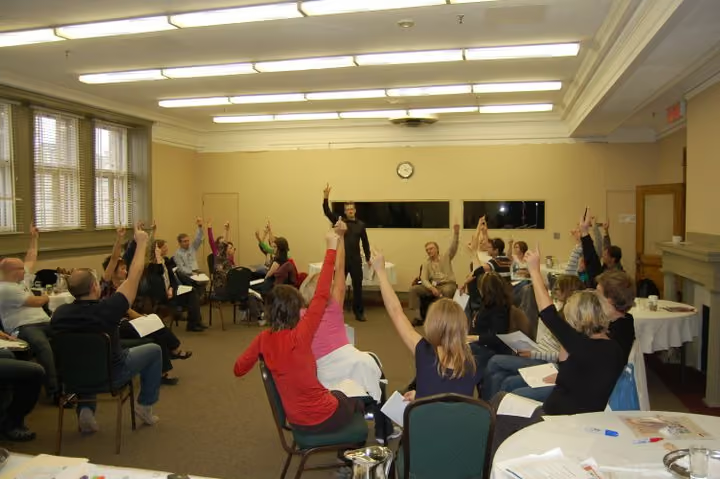
That’s where experiential team building earns its place. This is useful for scaling cross-functional teams or switching to other collaboration models.
FullTilt Team Development uses hands-on, facilitated experiences that help teams build the behaviors modern org design depends on:
- Cross-Boundary Communication
Designed for teams that rely on handoffs and shared decisions. These experiences help teams practice moving work across boundaries without delays, confusion, or escalation.
Explore activities that strengthen cross-team communication.
- 360-Degree Behavioral Awareness
Helps teams see how individual behavior impacts others across roles and functions—especially in matrix and cross-functional environments.
See how behavioral insight activities support a collaborative culture at scale.
- Clear and Productive Feedback
Focused on how feedback flows when accountability is shared. Teams practice giving and receiving feedback that keeps work moving instead of creating friction.
Find experiences that improve feedback and alignment.
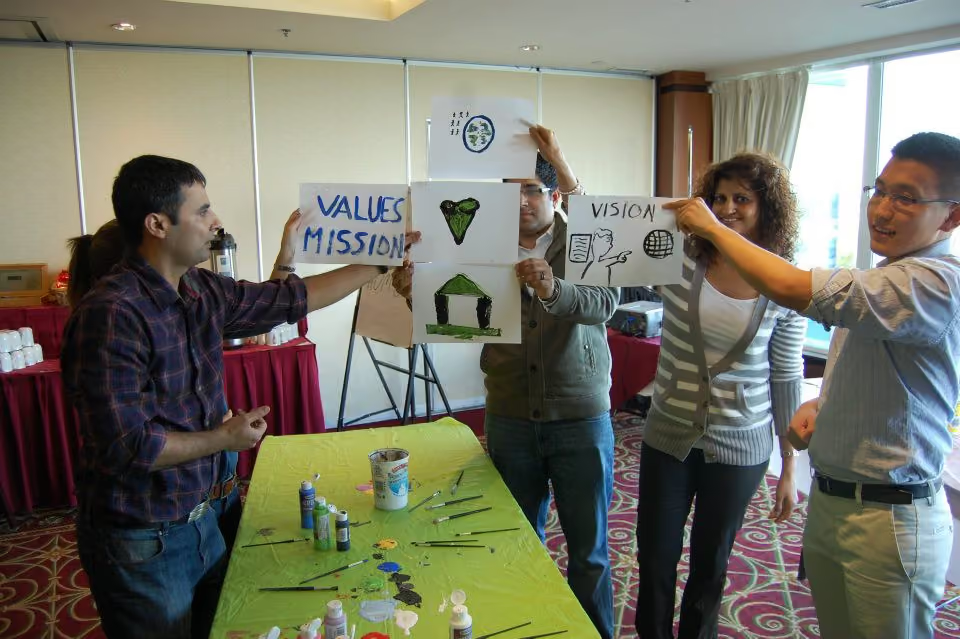
- Mission and Values in Action
Brings mission and values out of slide decks and into real decision-making moments. Teams experience what those values look like under pressure.
View activities that connect values to everyday collaboration.
These experiences work best when they’re aligned with the collaboration architecture you’re intentionally designing—not as one-offs, but as part of how teams learn to operate together.
Build Collaboration That Can Carry the Work
Collaboration breaks when structure lags behind how work actually moves. Teams don’t slow down because they lack effort. They slow because decisions stretch, ownership blurs, and coordination quietly takes over.
FullTilt Team Development helps teams turn collaboration design into real-world behavior. Explore our team building activities, pressure-test how your teams work together, and reinforce collaboration that actually holds up when the work gets hard.