

The minimum effective cadence for team building that produces compounding cultural outcomes is quarterly for facilitated programs, monthly for structured touchpoints, and weekly for micro-moments. Annual-only team building produces temporary energy without lasting behavioral change. The right frequency for your specific team depends on four variables: team health baseline, rate of change in team composition, business pressure intensity, and the magnitude of any active transition (RTO, merger, leadership change). This article gives you the decision framework.
Why This Question Is Harder Than It Looks

"How often should we do team building?" sounds like a logistics question. It is actually a strategy question.
The logistics version has a simple answer: quarterly. The strategy version requires knowing what your team actually needs, what problems you're solving, what resources you have, and what sustainable looks like inside your organization's culture.
The reason most team building programs underperform is not that they chose the wrong activity. It is that they ran the right activity too infrequently. A single excellent team building event is the equivalent of a single excellent workout. It produces results in the session. It produces no lasting change in physical condition. The benefit of that workout exists only as compounding — which requires doing it again before the gains from the first one fully erode.
Team dynamics work the same way. Trust, psychological safety, cross-functional familiarity, communication norms — these are not states that events produce. They are habits that consistent investment builds and inconsistent investment allows to decay.
The most common scheduling decision in corporate team building — one annual event, usually in December, usually a party — produces exactly the cultural outcomes you'd expect from an annual workout: temporary energy, no lasting change.
This article gives you the decision framework for how often your specific team needs team building investment, what forms that investment should take across a year, and what the research says about the relationship between frequency and outcome. For the full month-by-month planning system, see our complete annual team building calendar.
The Compounding Principle: Why Frequency Beats Intensity
The behavioral science on this is unambiguous.
Research from organizational psychology on team cohesion and group development consistently shows that the quality of team dynamics is determined less by the intensity of any single intervention and more by the frequency of positive structured interaction over time. Teams that have brief, regular shared experiences outperform teams that have occasional large experiences — even when the total time invested is identical.
The mechanism is relationship compounding. Every genuine interaction between team members builds a small amount of relational capital — trust, familiarity, a sense of shared history. This capital accumulates with repetition. It also decays without it.
Gallup's State of the Global Workplace research found that teams with weekly recognition and structured touchpoints show engagement levels roughly 3x higher than teams with only occasional recognition. The frequency is the variable. The format matters less.
Outback Team Building's 2025 data (1,506 events delivered across North America) found a consistent pattern: organizations delivering two or fewer team building experiences per year showed minimal improvement in engagement and retention metrics compared to their baseline. Organizations delivering four or more showed measurable compounding improvements across quarters. The conclusion: two events per year maintains the status quo. Four or more per year creates genuine cultural improvement.
This is why the continuous team building framework consistently outperforms event-based approaches — not because the activities are better, but because the frequency is right.
The Four-Cadence Model
The right question is not "how often should we do team building?" It is "what kind of team building, and how often?" These are four different answers to four different cadence levels.
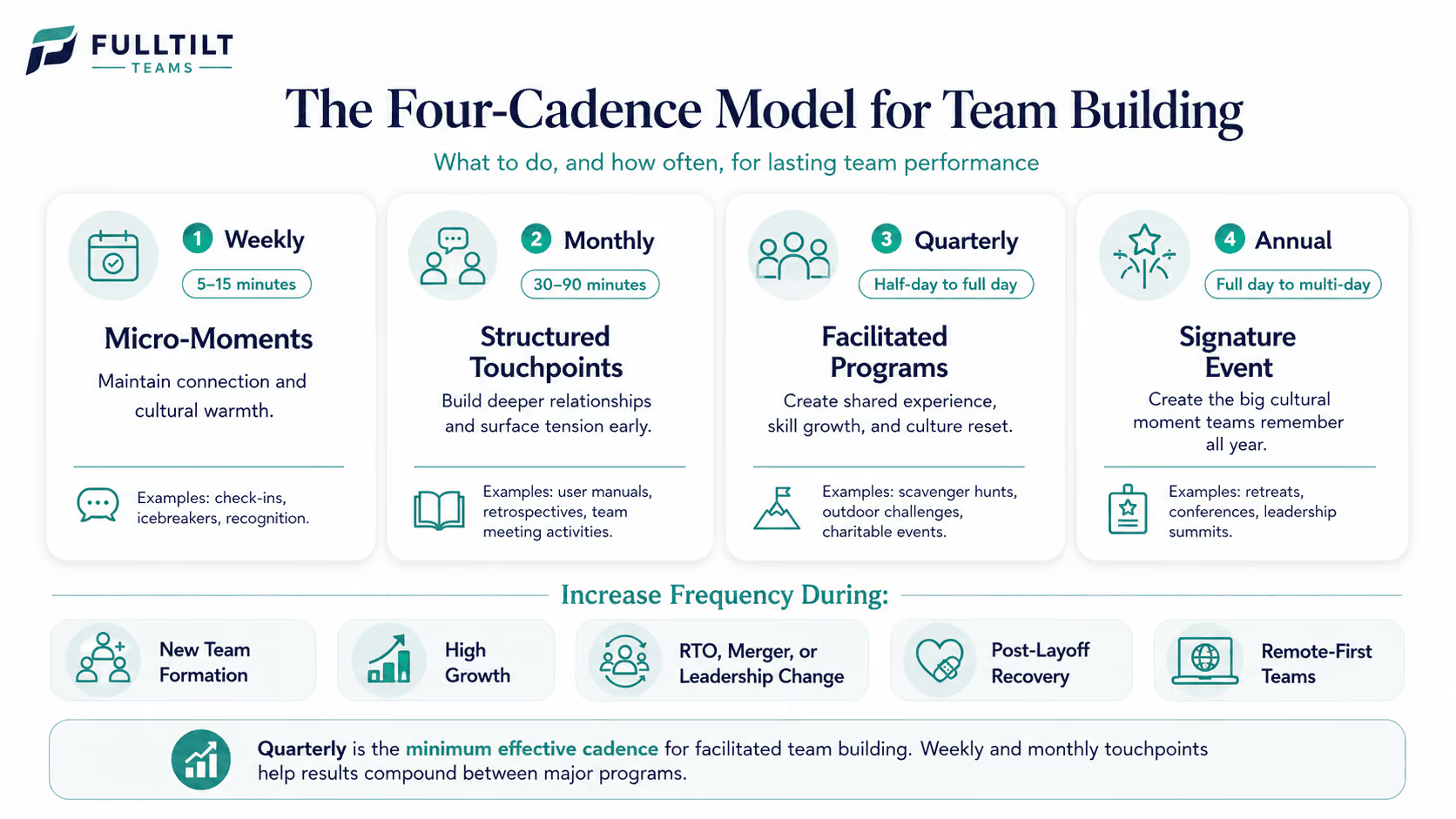
Cadence 1: Weekly (5–15 minutes)
Purpose: Ambient connection. Habit maintenance. Cultural signaling.What it looks like: A single icebreaker question at the start of a meeting. A check-in ritual ("one word for where you're at today"). A peer appreciation shout-out. A 60-second team challenge. None of these require preparation or cost.Why weekly: Weekly micro-moments are the primary mechanism by which team culture is maintained between larger investments. They signal to team members that connection is valued as a constant, not an occasional event. They keep the relational warmth alive in the periods between programs.Resource: 150 icebreaker questions for work and 40 quick team building activities give you years of weekly material.
Cadence 2: Monthly (30–90 minutes)
Purpose: Relationship building. Deeper connection than micro-moments allow. Early identification of emerging tension.What it looks like: A structured team activity embedded in an existing team meeting or added as a brief standalone session. The User Manual session, peer recognition round, structured retrospective, or facilitated team challenge. Can be run internally by a team lead with minimal preparation.Why monthly: Monthly touchpoints create the relational depth that weekly micro-moments can't reach while maintaining a frequency that prevents significant drift. Teams that skip the monthly cadence and rely only on weekly micro-moments and quarterly programs often experience significant relationship erosion in the six-week gaps between programs.Resource: 30 team building games for meetings covers the full monthly touchpoint library.
Cadence 3: Quarterly (Half-day to full day)
Purpose: Significant shared experience. Skill development. Observable team dynamics. Culture reset.What it looks like: A professionally facilitated team building program. Outdoor challenge, city scavenger hunt, charitable event, assessment workshop, leadership program. This is the cadence level where you engage Full Tilt Teams or equivalent professional facilitation.Why quarterly: Quarterly is the minimum compounding cadence for facilitated programs. The research consistently shows that teams receiving four facilitated experiences per year show meaningfully better outcomes than those receiving two. Below quarterly, each event is largely re-establishing ground lost since the last one rather than building on it.Resource: Full Tilt's complete team building events catalog covers every format for every group size and goal.
Cadence 4: Annual (Full day to multi-day)
Purpose: Organizational story-making. Cross-functional connection at scale. Culture landmark. Leadership alignment.What it looks like: Company retreat, annual conference, city-wide program, leadership summit. This is the event that becomes part of organizational mythology — the one people reference in their first month when they explain the company to a friend.Why annual: The annual signature event does something quarterly programs cannot: it creates the collective experience that defines organizational identity for the year. It is the cultural moment that makes all the other investments legible — the shared peak that gives meaning to the weekly micro-moments and the quarterly programs.Resource: Planning a company retreat: the ultimate guide covers the full planning framework for annual signature events.
How to Determine the Right Frequency for Your Team
Four variables determine where your team sits on the frequency spectrum.
Variable 1: Team Health Baseline
A team with high trust, psychological safety, and established collaborative norms needs less frequent investment to maintain its health. A team with low trust, recent conflict, or significant friction needs more frequent investment to build the foundation that healthy teams maintain.
Simple self-assessment: On a scale of 1–10, how would you rate each of these?
- Team members genuinely know each other beyond their job functions
- It feels safe to disagree or raise a concern in team meetings
- Cross-functional collaboration happens naturally and frequently
- People feel recognized and valued for their contributions
Average below 6: you need more frequent investment than the quarterly minimum.Average above 8: the quarterly minimum with consistent monthly touchpoints is likely sufficient.
Variable 2: Rate of Team Composition Change
Teams with high turnover or frequent new hires need more frequent team building investment, because each new member resets the team's relational baseline to some degree. Tuckman's model is still the most accurate map here: every new addition pushes the team back toward forming and storming. Teams with 20%+ annual turnover should plan for monthly structured touchpoints at minimum and should consider a short welcome program for each new hire cohort.
Variable 3: Business Pressure Intensity
Counterintuitively, high-pressure periods are when team building is most valuable — not when it should be paused. Teams under pressure revert to their least-functional dynamics. Psychological safety erodes. Cross-team communication breaks down. Individual contribution overrides collaborative behavior. Maintaining team building investment during high-pressure quarters produces significantly better performance outcomes than pausing it.
This is also the most common mistake organizations make: canceling team building during Q4 because "everyone is too busy." The busyness is exactly why the investment is needed.
Variable 4: Active Transition Magnitude
If your organization is navigating a significant transition — return to office mandate, merger or acquisition, major restructuring, leadership change — the standard cadence is not sufficient. Transition periods require supplementary investment on top of the quarterly baseline.
For RTO transitions specifically, the 30-60-90 day RTO team building framework runs alongside the standard annual calendar rather than replacing it. See also the 30 activities specifically designed for RTO contexts for the supplementary activity library.
For teams navigating rebuilding culture after remote work, the culture rebuild program runs alongside the annual cadence for the first 12 months.
Frequency by Situation: When to Do More
These are the situations where the quarterly minimum is not sufficient and you need to increase investment frequency.
New team formation
New teams — whether from scratch, post-merger, or post-restructuring — need monthly facilitated touchpoints in their first 90 days, not quarterly programs. The relationship deficit is too large to address at quarterly intervals. After 90 days of consistent investment, transition to the standard quarterly cadence.
Post-layoff or survivor syndrome
When a team loses colleagues to layoffs, the remaining members experience a well-documented psychological phenomenon called "survivor syndrome" — a combination of guilt, anxiety, role confusion, and distrust of leadership. This is one of the highest-risk moments for additional attrition among high performers. Monthly facilitated sessions in the 90 days following a layoff event are among the highest-ROI team building investments available.
Post-conflict or trust rupture
When a significant conflict, breach of trust, or interpersonal breakdown has occurred within a team, the standard cadence is not designed to address it. This requires a team building consulting engagement — a diagnostic-first, multi-session program that addresses the root cause before any activity-based work begins. Frequency of activities alone cannot substitute for the structured conflict resolution and trust rebuilding that these situations require.
High-growth phase
Organizations in rapid growth are continuously adding new team members, expanding teams, and creating new cross-functional dependencies. These conditions erode team cohesion faster than the quarterly cadence can rebuild it. Monthly structured touchpoints, a dedicated onboarding team building component for each new hire cohort, and quarterly cross-departmental programs are the minimum for high-growth organizations.
Remote-first teams with no physical anchor
For fully remote teams with no in-person touchpoints, the absence of ambient connection means that deliberate investment must replace what co-location provides naturally. Monthly facilitated virtual sessions are the minimum for remote-first teams. Weekly micro-moments are non-negotiable. And at least two in-person gatherings per year — retreats, offsites, or regional meetups — should be budgeted as essential infrastructure.
The Diminishing Returns Problem: When More Is Too Much
The compounding principle has a ceiling. Above a certain frequency of facilitated team building, returns diminish and resistance builds.
The warning signs that you've crossed into oversaturation:
Participation quality drops. When team building feels mandatory and frequent, people show up in body but not in spirit. Responses become performative. The psychological safety that makes team building valuable disappears.
The activities feel formulaic. When teams have experienced too many of the same format too frequently, the novelty that makes experiences memorable disappears. Activities that should generate genuine connection become anticipated routines that people mentally check out of.
Team building becomes associated with stress, not relief. When events are added on top of already overwhelming schedules, they stop feeling like investments in connection and start feeling like additional demands. This is the most damaging outcome — team building that makes team morale worse.
The right ceiling: Most teams reach saturation at two facilitated programs per quarter. Monthly facilitated programs are the maximum before diminishing returns begin for most team configurations. The exception: new team formation and active crisis situations, where higher frequency is appropriate for 60–90 days before returning to standard cadence.
The rotation principle: One of the most effective ways to prevent saturation is format rotation. Teams that experience the same format quarterly become bored and disengaged. Teams that rotate between outdoor challenges, charitable programs, assessment workshops, and indoor problem-solving programs maintain genuine engagement across the year. Full Tilt's most popular programs are designed for annual rotation — so each quarterly program feels genuinely different from the last.
How to Sustain a High-Frequency Team Building Program
The most common reason annual team building plans fail is not budget — it is operational sustainability. The quarterly program that was enthusiastically planned in January becomes the event nobody has time to organize by September.
Three things that make a high-frequency program sustainable:
Schedule before the year starts. Every quarterly program, every monthly touchpoint, every weekly ritual — locked into calendars before January 1. Events that live on a wishlist don't get done. Events that have a venue, a date, and a facilitator brief already submitted do. The annual planning calendar in our complete team building calendar guide is specifically structured for pre-year-start scheduling.
Separate the weekly and monthly execution from the quarterly and annual planning. Weekly micro-moments should require zero planning — a bank of activities and questions that team leads rotate through without preparation. Monthly touchpoints should require minimal planning — a provided structure that a team lead can run with one hour of preparation. Quarterly programs and annual events are where professional facilitation and advance planning investment is appropriate.
Measure and report. Programs that have visible ROI data survive budget cycles. Programs that are described as "good for morale" don't. Commit to measuring the four metrics in Section 8 of the annual calendar guide and reporting them to leadership quarterly. Data protects budgets.
Frequently Asked Questions
How often should teams do team building activities?
The minimum effective cadence for compounding cultural results: quarterly for facilitated programs, monthly for structured touchpoints, weekly for micro-moments. Teams that invest at this frequency consistently show better engagement, retention, and collaboration outcomes than those investing at lower frequency. Annual-only team building produces temporary energy without lasting behavioral change.
Is quarterly team building enough?
Quarterly facilitated programs, combined with monthly structured touchpoints and weekly micro-moments, is sufficient for most healthy teams. For teams in active transitions (RTO, merger, high growth, post-layoff), quarterly alone is not enough — supplementary monthly facilitated sessions are needed during the transition period, typically 90 days.
How often should you do team building for remote teams?
Remote teams need more frequent investment than in-person teams because they lack the ambient connection that physical proximity provides. The recommended cadence for remote teams: weekly micro-moments (mandatory, not optional), monthly facilitated virtual sessions, quarterly virtual programs, and a minimum of two in-person gatherings per year. The frequency compensates for the absence of spontaneous connection that in-office environments generate naturally.
What is the best frequency for leadership team building?
Leadership teams benefit most from quarterly facilitated sessions (same cadence as frontline teams) plus an annual leadership alignment offsite. The argument for additional frequency with leadership teams: the quality of collaboration at the leadership level directly determines organizational performance at every level below. A leadership team that meets for intensive team building twice a year instead of once will produce measurably different strategic alignment outcomes. See Full Tilt's leadership development programs for what high-frequency leadership team building looks like in practice.
How do you keep team building from feeling forced or repetitive?
Two principles: format rotation and genuine integration. Format rotation means each quarterly program uses a different format (outdoor challenge, charitable event, indoor problem-solving, assessment workshop) so no program feels like a repeat of the last one. Genuine integration means each program is connected to something real in the team's current work situation — not a generic activity applied to a generic team. The debrief that connects the experience to actual team dynamics is what makes activities feel relevant rather than mandatory. For teams that have experienced recurring team building that felt forced, our guide to avoiding team building activities everyone hates covers the design principles that prevent this.
Should we do team building when the team is really busy?
Yes — but in a scaled-down form. High-pressure periods are when team connection is most at risk and therefore most valuable to protect. During peak workload quarters, shift from half-day facilitated programs to embedded monthly touchpoints and consistent weekly micro-moments. Don't cancel entirely — maintain the habit with lower time investment. Reserve the full-day programs for the shoulder months on either side of the peak.
Full Tilt Teams designs and facilitates team building programs at every cadence level — from weekly ritual material to annual signature events — for groups of 10 to 2,000+ across North America. Talk to us about building your annual plan. →