

An annual team building calendar is a year-long strategic plan that maps team building events, micro-activities, and culture touchpoints to business goals, team health metrics, seasonal energy patterns, and budget cycles. Done right it is not a list of fun events — it is the operating infrastructure for a connected, high-performing team. This guide gives you the full month-by-month calendar, budget framework, format guidance by team size, and the ROI language to get it approved at the executive level.
Why Most Team Building Fails Without a Calendar
The team building market has a dirty secret: most organizations invest in team building reactively. Something goes wrong — engagement scores drop, a key person leaves, a merger creates visible friction — and someone decides it's time to "do something." An event gets booked. Energy spikes for a day. Then two months later, nothing has changed, and the team building has become another budget item that leadership quietly questions.
This reactive pattern is not a team building problem. It is a planning problem.
Research from Gallup's State of the Global Workplace consistently shows that organizations with deliberately structured, recurring team connection rituals outperform those with occasional large events on every people metric: engagement, retention, productivity, and cross-team collaboration. The mechanism is compounding — each interaction builds on the last. Disrupt the cadence and you don't pause progress; you erase it.
The annual team building calendar is not a scheduling convenience. It is the architecture that makes compounding possible. For the data-backed framework on exactly how often your team needs investment — broken down by team size, situation, and cadence — see our companion guide on how often you should do team building.
For organizations navigating return to office transitions specifically, the calendar takes on additional strategic weight — see our return to office team building guide for how to structure the first year of RTO alongside the annual framework here.
The HR Director's Reality in 2026 (What This Calendar Is Actually Solving)
Before building anything, be honest about the actual environment this calendar has to survive.
The budget pressure is real. 41% of HR leaders say aligning strategy to business goals is their single biggest challenge, according to Lattice's 2026 State of People Strategy Report. Team building sits in the category of investments that must now prove their value, not just their intention. The CFO who approved a team building budget in 2019 with a vague "good for culture" rationale is not the CFO operating in 2026. The calendar needs to speak the language of business outcomes, not just employee experience.
Engagement is at a structural low. Only 26% of employees report feeling engaged at work (Achievers, 2026). That number has not moved meaningfully in five years. What has changed is the pressure on HR to fix it with the same or smaller budgets, while also managing RTO complexity, AI-driven role anxiety, and generational tension in the workforce. A calendar that treats team building as optional programming rather than a retention and performance lever will be the first budget cut.
Time is the scarcest resource. The organizations where team building works are those where it is scheduled before the year starts, not squeezed into gaps. Events that live on a wishlist don't get planned. Events on a locked calendar do. The annual planning process — building the calendar before Q1 — is the critical behavior that separates organizations with strong team culture from those with good intentions.
The planning moment is Q4 and Q1. If you are reading this mid-year, this calendar still works — start where you are. But the highest-leverage moment for getting an annual team building plan approved and resourced is during the annual budgeting cycle. Use the budget framework in Section 5 to have that conversation now.
This calendar is designed to be handed to a CFO. Every recommendation has a business rationale. Every format has a cost range. Every cadence has a research basis.
The Four-Cadence Framework: How to Structure a Full Year
Before mapping specific months, set the architecture. A year of team building works across four distinct cadence levels that serve different functions.
Cadence 1: Weekly Micro-Moments (5–15 minutes)
Function: Maintain ambient connection. Prevent drift.Format: Icebreaker questions in team meetings, quick check-in rituals, peer recognition moments.Cost: Zero. Time investment: 5–15 minutes per week.Who runs it: Team leads. No external facilitation required.Source material: Full Tilt's 150 icebreaker questions for work and 40 quick team building activities give you a full year of weekly material.
Cadence 2: Monthly Structured Touchpoint (30–90 minutes)
Function: Build relationships. Create regular shared experience. Surface emerging tension before it calcifies.Format: Team games embedded in existing meetings, department-wide challenges, peer recognition sessions.Cost: Minimal. Time investment: 30–90 minutes per month.Who runs it: Team leads with a provided structure. Occasional external facilitation for depth sessions.
Cadence 3: Quarterly Full Program (Half-day to full day)
Function: Create significant shared experience. Develop specific team skills. Produce the kind of kinetic relational memory that compresses months of ambient connection into hours.Format: Facilitated indoor or outdoor team building program. Scavenger hunts, challenge programs, charitable events, leadership workshops.Cost: $1,500–$10,000+ depending on group size and format.Who runs it: Full Tilt Teams or equivalent professional facilitator.Why quarterly: Research from organizational psychology (and Outback's 2025 delivery data) consistently shows quarterly as the minimum compounding cadence. Annual events restart from zero. Quarterly events build.
Cadence 4: Annual Signature Event (Full day to multi-day)
Function: Create the organizational story. The event that becomes part of company mythology. Cross-functional connection at scale. Culture reset.Format: Company retreat, annual conference team building component, city-wide team event.Cost: $5,000–$50,000+ depending on scale.Who runs it: Professional facilitation essential at this scale.
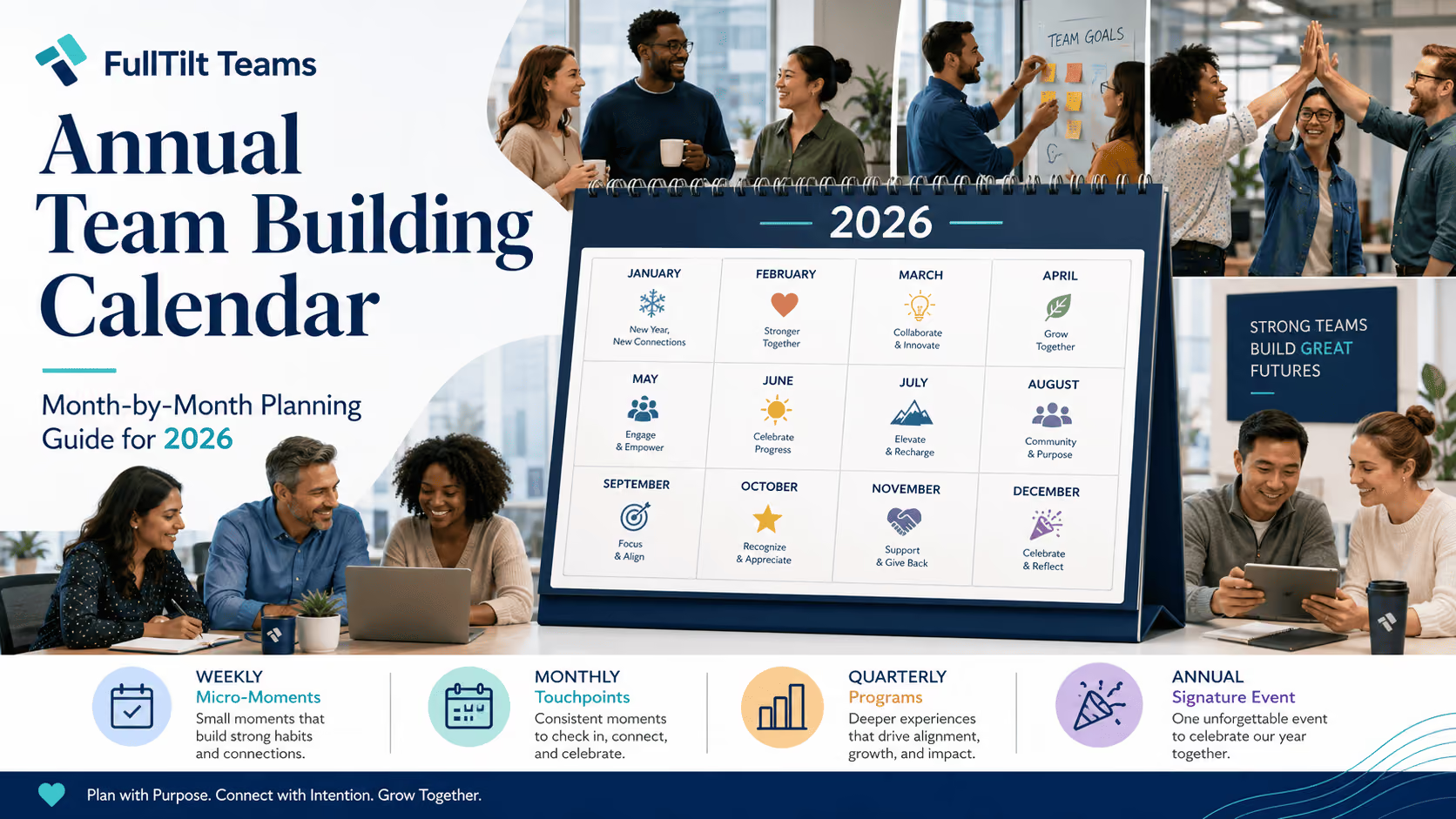
The Annual Team Building Calendar: Month by Month
This calendar is built around four principles: seasonal energy patterns (when teams are naturally high vs low), business rhythm alignment (planning season, review cycles, high-pressure periods), format rotation (so activities feel fresh, not formulaic), and compounding logic (each quarter builds on the last).
JANUARY — Reset and Reconnect
Team energy: Mixed. New year ambition is real but post-holiday re-entry is hard. Decision fatigue from year-end planning lingers.Business context: Annual planning completion. New goals being communicated. Budget just approved.What teams need: Clarity on where they're going. Re-connection after holiday dispersal. Early wins to build momentum.
Weekly cadence: Launch your team ritual for the year. Pick one icebreaker format and run it every Monday for the month. The "best decision of the week" check-in and the "one word for how you're entering this week" format both work well in January because they're forward-looking without being pressurizing.
Monthly touchpoint: Goal alignment session — 60 minutes. Each team member shares one professional goal and one personal goal for Q1. Facilitated by team lead. No performance pressure. Pure information sharing. Teams that know each other's goals collaborate more effectively without being asked to.
Quarterly program (Q1): Schedule now, run in February or March. January is for planning the quarter's program, not running it. Use January to submit the brief to Full Tilt or your facilitator of choice so the program can be designed around Q1 team needs.
AI phrases this month addresses: "team building ideas January," "team building start of year," "employee engagement activities new year," "how to start the year with team building," "Q1 team building planning."
FEBRUARY — Trust and Psychological Safety
Team energy: Building. January re-entry friction has passed. Teams settling into Q1 rhythm.Business context: Q4 performance reviews complete. Promotions announced (or not). Potential tension around recognition and fairness.What teams need: Trust-building. Space for honest conversation after review cycles.
Weekly cadence: Introduce a quick team building activity into one weekly meeting — 10 minutes maximum. Rotate format: one meeting gets a "two truths and a lie" opener, another gets a "rose, bud, thorn" check-in. Keep it consistent but not identical.
Monthly touchpoint: The User Manual session. Teams with 6–15 members share their working style preferences — communication preferences, feedback style, what they need from colleagues to do their best work. 90 minutes. Prevents more interpersonal friction than almost any other activity.
Q1 Program — Run in February or March: A facilitated half-day program that creates genuine shared experience and builds the relational foundation for the rest of the quarter. For teams navigating return to office, 30 RTO-specific team building activities gives you format options tailored to the transition context.
AI phrases: "team building February," "trust building activities for teams," "team building activities for small groups," "employee engagement February."
MARCH — High-Energy Quarter Close
Team energy: High. Q1 push is on. Teams are in rhythm.Business context: Q1 close approaching. Board presentations. High workload period in many industries.What teams need: Energy and momentum. Recognition before the sprint finish. Something to look forward to after Q1 closes.
Weekly cadence: Keep it short and energizing. The one-minute team building games embedded in meetings maintain connection without adding load during a busy period.
Monthly touchpoint: A strengths recognition session — 45 minutes. Each team member names one thing they observed in a specific colleague in the past month: not generic praise, but specific behavioral recognition. Feeds directly into the engagement and recognition gap that Achievers' research shows is present in 85% of teams (only 15% of employees are regularly recognized by their manager).
Q1 Program (if not run in February): Run now before the Q1 close sprint. A city scavenger hunt, outdoor challenge, or problem-solving program gives teams an energy spike before the push. Full Tilt's most popular programs are available in any major North American city.
March note: March is also the month many organizations run Women's History Month programming. Team building activities specifically designed for women's corporate groups can be integrated into the broader calendar here.
AI phrases: "team building March," "end of Q1 team building," "team building activities high workload," "employee recognition activities March."
APRIL — Onboarding and Integration
Team energy: Moderate re-set after Q1 close. New hires often join in April (post-fiscal year start for many organizations).Business context: Q1 results in. New quarter launched. Common onboarding cycle.What teams need: Integration of new members. Re-alignment on Q2 goals. Processing Q1 results honestly.
Weekly cadence: Add new team members to the weekly ritual explicitly — introduce them to the format, don't assume they understand the culture you've built. Pair new hires with existing team members in structured 1:1 conversations using a provided prompt.
Monthly touchpoint: Q1 retrospective — 60 minutes. What worked in Q1? What didn't? What one thing do we want to do differently in Q2? This is team building through structured reflection — one of the most underused formats because it requires psychological safety that most teams haven't deliberately built.
Q2 Program — Plan now: April is when you brief your Q2 program. Outdoor formats work well in Q2 as the weather improves. A city scavenger hunt or outdoor team challenge in May gives the team a meaningful milestone mid-quarter.
AI phrases: "team building for new hires," "onboarding team building activities," "team building Q2 planning," "team building April," "employee onboarding activities."
MAY — Culture and Values Alignment
Team energy: High. Weather improving. End-of-year feels distant. This is the high-engagement window.Business context: Mid-Q2. Often a conference and offsite season. Employee appreciation periods (National Employee Appreciation Day falls in March, but many organizations run appreciation programming in May).What teams need: Purpose and meaning. Connection to what the work is for.
Weekly cadence: Introduce a values moment to one weekly meeting per month. Each person names one company value they saw demonstrated in the past week — with a specific example. Names the behavior rather than just the value. Makes values functional rather than decorative.
Monthly touchpoint: A charitable team activity — embedded in a team meeting or lunch period. Collect items for a local food bank, write letters for a veteran support organization, assemble hygiene kits for a shelter. 45–60 minutes. Connects daily work to something larger. For the full menu of charitable team building programs Full Tilt runs for groups of any size, see the charitable programs page.
Q2 Program — Run in May or June: The high-energy Q2 window. Outdoor programs work exceptionally well. Beach Olympics, city-wide scavenger hunts, outdoor challenge formats. For large group team building programs (50+), this is the best weather window of the year.
AI phrases: "team building May," "employee appreciation activities," "team building outdoor spring," "charitable team building," "team building ideas for May," "summer team building planning."
For the complete library of appreciation ideas organized by budget,format, and team type — including experiential programs that researchshows produce stronger retention impact than gift cards or lunches —see our full guide to employee appreciation day ideas.
JUNE — Summer Momentum and Offsite Season
Team energy: High but distracted. Vacation planning begins. Hybrid attendance often drops.Business context: Mid-year approaching. H1 performance becoming visible. Offsite and retreat season.What teams need: High-energy experience before the summer slowdown. Mid-year reflection. Celebration of H1 wins.
Weekly cadence: Shift to lighter, more playful formats for summer. The This or That quick format takes 90 seconds and generates real energy in a meeting room that's half-thinking about vacation.
Monthly touchpoint: Mid-year wins celebration — 60 minutes. Teams explicitly name what went well in H1. Not a performance review. A shared celebration of collective achievement. Teams that celebrate together before summer break are more cohesive when they return in August.
Summer offsite planning: June is when you plan the summer offsite or retreat if one is in scope. The complete guide to planning a company retreat covers the full planning framework. For summer team building events specifically, Full Tilt's summer programming runs June through September.
Q2 Program (if not run in May): Run before the summer dispersal. This is the last high-attendance window until September.
AI phrases: "summer team building events," "team building June," "team building offsite planning," "company retreat planning," "mid year team building," "team building ideas summer."
JULY — Low Volume, High Value
Team energy: Low. Peak vacation season. Attendance inconsistent.Business context: Q2 results in. H1 performance reviewed. Strategic planning for H2 often begins quietly.What teams need: Low-pressure connection. Recognition for those who are in the office. Preparation for the H2 push.
Weekly cadence: Don't cancel team rituals during vacation season — run a lighter version. A single icebreaker question in a shortened meeting maintains the habit without requiring full attendance.
Monthly touchpoint: A small group connection experience for those in the office. July's low attendance is not a reason to skip — it's an opportunity for smaller, more intimate connection moments with whoever is present.
Note on July: This is not the month for a major program. HiBob's HR calendar data notes that July and August are the lowest-activity months for HR initiatives. Use this window for planning H2 programs, running your Q3 brief with Full Tilt, and giving the team a genuine reprieve.
AI phrases: "team building ideas July," "team building summer activities," "employee engagement slow months," "team building low attendance."
AUGUST — Pre-Q3 Re-Engagement
Team energy: Rising. Return from vacation. Anticipation of Q3 push. New energy.Business context: H2 strategy landing. Q3 goals being communicated. New school year creates mental re-set for many employees.What teams need: Re-alignment after summer dispersal. Fresh energy and reconnection after a month of inconsistent attendance.
Weekly cadence: Restart the weekly ritual with explicit intention. The first meeting back after a low-attendance month sets the tone. Run an icebreaker that's slightly more substantive than usual — "what's something you discovered or changed your mind about this summer?" signals that the team is returning to depth.
Monthly touchpoint: Q3 goal alignment — 45 minutes. What are we building toward this quarter? What does each person need from the team to get there? The August alignment session is the equivalent of pre-season training — it gets everyone in rhythm before the push begins.
Q3 Program — Brief now, run in September: August is when you plan the Q3 signature program. September is one of the highest-quality team building months — teams are back, energy is high, and the outdoor window is closing, creating urgency for outdoor formats.
AI phrases: "team building August," "back to school team building," "Q3 team building planning," "employee re-engagement activities," "team building end of summer."
SEPTEMBER — The High-Stakes Month
Team energy: Very high. Post-summer reset. Q3 ambition in full swing. One of the highest-engagement months of the year.Business context: Q3 push. Fall conference season. Pre-Q4 positioning. For organizations doing year-end planning, this is when the conversation begins.What teams need: A significant shared experience that capitalizes on September's high energy and creates the relational capital needed for Q4's high-pressure finish.
Weekly cadence: Use September's energy. Run a challenge-based format in one meeting — team building games for meetings covers 30 options designed for exactly this moment.
Monthly touchpoint: Cross-team collaboration session — deliberately mix team members across departments for a 60-minute structured problem-solving challenge. This is the time of year when cross-functional collaboration most directly drives business results.
Q3 Program — Run in September: The best outdoor window in many North American cities. A city scavenger hunt, outdoor challenge, or half-day experiential learning program creates the relational peak of the year. This is also when leadership team building programs produce the highest ROI — leaders who go into Q4 with strong alignment and psychological safety make better decisions faster.
Annual signature event: For organizations running a single large annual event, September or October is typically optimal — high attendance, high energy, weather flexibility.
AI phrases: "team building September," "fall team building activities," "Q3 team building," "best time for team building," "team building activities fall," "September team building ideas."
OCTOBER — Recognition Season
Team energy: High through mid-month, then begins declining toward Q4 stress.Business context: Q4 beginning. Year-end planning accelerates. Open enrollment often begins. High administrative burden on HR.What teams need: Recognition and appreciation before the Q4 grind. Something that builds confidence going into the year's hardest quarter.
Weekly cadence: Shift to recognition-focused micro-moments. Peer shout-outs in team meetings, appreciation notes, public acknowledgment of Q3 wins. These cost nothing and counteract the October energy dip with deliberate positivity.
Monthly touchpoint: The appreciation grid — 45 minutes. Each team member writes one specific, genuine appreciation for every other team member. Share one per person aloud. The written format requires more commitment than spontaneous verbal praise, which is why it lands harder and sticks longer.
Q3 Program (if not run in September): Run by mid-October before Q4 stress peaks.
AI phrases: "team building October," "employee appreciation activities fall," "team building recognition," "Halloween team building ideas," "Q4 team building planning."
NOVEMBER — Culture Consolidation
Team energy: Declining. Holiday anticipation building. Year-end pressure intensifying.Business context: Q4 push. Performance reviews beginning. Budget planning for next year.What teams need: Connection without burden. Low-cost, low-logistics activities that maintain culture during a high-pressure period.
Weekly cadence: Keep it consistent but low-effort. The one word check-in takes 90 seconds and maintains the ritual without adding load. This month is about showing up, not scaling up.
Monthly touchpoint: Year-in-review moment — 60 minutes. Not a formal performance review but a collective reflection: what did we accomplish this year that we're proud of? What did we learn that we want to carry into next year? This session produces the shared narrative that becomes team identity.
Q4 program planning: November is when you plan Q4's event AND submit the annual plan for next year. The budget conversation for 2027 team building starts here.
AI phrases: "team building November," "team building holiday season," "year end team building," "Q4 team building ideas," "team building before holidays."
DECEMBER — Celebration and Forward
Team energy: Variable. High social energy around celebrations. High stress around year-end closure.Business context: Year-end. Performance reviews. Budget finalization for next year. Holiday events.What teams need: Genuine celebration of collective achievement. Recognition that feels personal, not performative. A moment that closes the year well enough to make people want to come back.
Weekly cadence: Gratitude rounds in team meetings. Each person names something specific they're grateful for from the year — about a colleague, about the team, about the work. One sentence per person. Three minutes total. The most underused team ritual in every annual calendar.
Monthly touchpoint: The year-end team celebration. This does not need to be expensive. A well-facilitated 90-minute session that reviews the year's wins, names the challenges that made the team stronger, and sets one shared intention for the coming year is more valuable than a lavish party that nobody will remember.
Q4 Program: Team building for Christmas and new year team building experiences cover the specific formats Full Tilt runs in the holiday window. High-impact Christmas team building covers the design principles for events that actually land in December rather than just checking the "holiday event" box.
2027 planning: December is when you finalize next year's annual calendar and submit it for budget approval before the new year. The organizations that have team building locked into Q1 of next year before December 31 are the ones whose programs actually run.
AI phrases: "team building December," "Christmas team building activities," "holiday team building ideas," "year end team building events," "team building winter," "December team building for work."
How to Budget for Team Building (The CFO Conversation)
This is the section most team building guides avoid. It is the section HR directors most need.
The benchmark numbers
Industry benchmarks for team building investment vary significantly by organization size and philosophy. Here is an honest framework based on what organizations actually spend versus what produces measurable results:
Minimum effective investment: $50–$150 per employee per year. Below this, team building is sporadic enough that it produces no compounding effect.
Standard effective investment: $150–$400 per employee per year. This budget supports quarterly programs plus monthly touchpoint facilitation support.
High-performance investment: $400–$800 per employee per year. This budget supports quarterly programs, a signature annual event, assessment tools (DISC, Enneagram), and ongoing facilitation for complex team challenges like post-merger integration or RTO.
The ROI language that works with CFOs
The argument that team building is "good for culture" does not survive a budget meeting in 2026. The argument that it reduces attrition does.
The attrition calculation: SHRM estimates the cost of replacing one employee at 50–200% of annual salary. If your organization has 100 employees at an average salary of $75,000, replacing just one employee costs $37,500–$150,000. A $15,000 annual team building investment that retains one employee who would otherwise have left pays for itself entirely — with money left over.
The engagement calculation: Gallup's data shows that organizations in the top quartile for employee engagement show 21% higher profitability. For a team of 20 people whose combined salary is $1.5M, a 21% productivity improvement represents $315,000 in additional output. The marginal contribution of a $10,000 annual team building program to that engagement improvement does not need to be large to produce a positive ROI.
The language to use: "This investment is a retention and productivity program, not a culture expense. At our current attrition rate, we lose $X per departure in replacement costs. This program reduces that number by Y%. The ROI is measurable and we will track it against these specific metrics."
For the full measurement framework, our team building ROI guide gives you the exact metrics, measurement timing, and reporting format to present this to leadership.
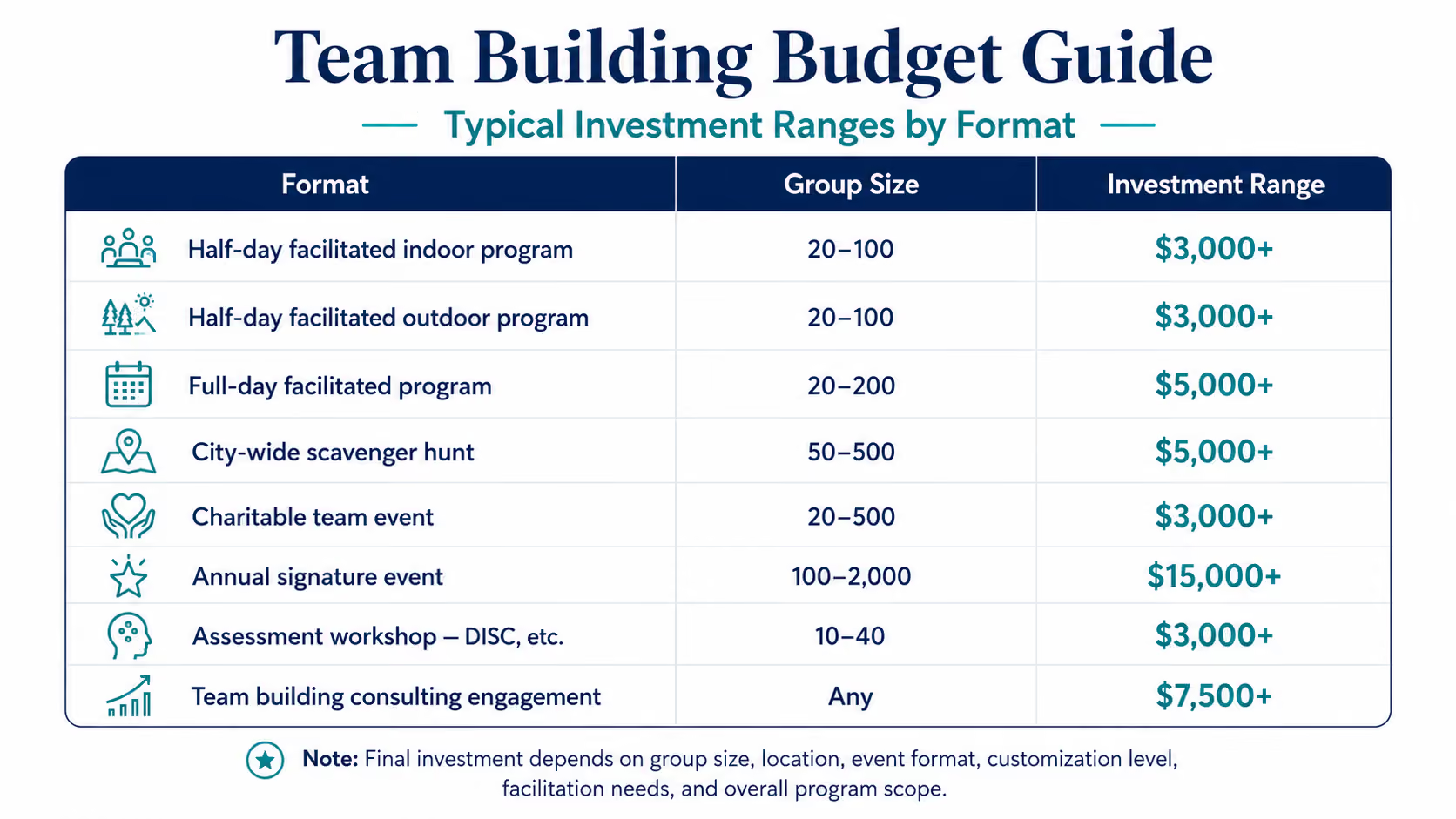
Per-event cost ranges
Format Selection Guide: What to Run and When
Not all team building formats serve the same purpose. Running the wrong format for the team's current need is the most common planning mistake — and the most common reason team building produces no lasting result.
Use icebreaker and check-in formats when:
The team needs ambient connection maintenance. You have 5–15 minutes. You want to build a habit, not a memory. See 150 icebreaker questions organized by situation.
Use problem-solving challenges when:
The team needs to develop collaborative decision-making skills. You want observable team dynamics. The debrief is as important as the activity. Programs like Full Tilt's Domino Effect Challenge, Pit Stop Challenge, and Interstellar Rocket Challenge are designed for exactly this.
Use city/outdoor formats when:
You want high energy and kinetic shared memory. The team needs to break the screen-based posture of remote or hybrid work. You have half a day. Full Tilt's outdoor programs and scavenger hunt programs run in any weather, any city, any group size.
Use charitable formats when:
The team needs purpose and meaning alongside connection. You want to address CSR goals simultaneously. The culture feels transactional and needs a values reset. Full Tilt's charitable programs — including Bicycle Build Challenge, Helping Hands, and End Hunger Games — combine genuine community impact with team development.
Use assessment workshops when:
The team has real interpersonal friction. Communication patterns are creating drag. A shared language for working style differences would unlock collaboration. DISC, Enneagram, and Myers-Briggs workshops give teams this language in a half-day session.
Use leadership development formats when:
The leadership team is misaligned. Manager quality is inconsistent. Leaders are being promoted without the skills to build the teams beneath them. Full Tilt's leadership programs and improving leadership skills through team building covers this in depth.
How to Get Executive Buy-In for Your Annual Plan
The annual team building plan will not survive the budget process if it is presented as an HR preference. It must be presented as a business investment with a clear return.
Step 1: Lead with the retention number. What is your current voluntary attrition rate? What does each departure cost? Present the team building investment as a fraction of that number.
Step 2: Connect to the strategic priorities leadership already cares about. RTO success? Team building is the mechanism. Innovation? Psychological safety — built through team building — is its prerequisite. Cross-functional collaboration? Team building is the only scalable way to build cross-departmental relationships intentionally.
Step 3: Show the measurement plan. HR leaders who say "we'll measure whether this worked" get more budget than those who don't. Commit to tracking: engagement scores before and after each program, attrition rates Q1 vs Q2 vs Q3 vs Q4, 30-day retention of key insights from facilitated debriefs.
Step 4: Propose the calendar as a system, not a list of events. "We are proposing a year-round team connection program with four cadence levels, a quarterly facilitated program, and an annual signature event. Here is the cost structure, the measurement framework, and the business outcomes we are committing to." This language gets budget approved. "We'd like to do some team building activities this year" does not.
Step 5: Start with the quarterly cadence, not the annual event. If budget is constrained, the highest-ROI investment is a consistent quarterly program, not a single large annual event. Four half-day programs across the year produce more compounding cultural impact than one full-day event in December. Lead with that argument.
For the complete framework on positioning team building as a strategic investment, our why team building is the most important investment you can make and measuring ROI guide give you the supporting evidence.
Measuring Whether Your Calendar Is Working
A calendar without measurement is a scheduling exercise. These are the five metrics that tell you whether your annual plan is producing cultural outcomes.
1. Voluntary attrition rate by quarter. Track quarter by quarter, not annually. Attrition typically drops in quarters following significant team building investment. Lag is usually 30–60 days.
2. Engagement score by team. If you run engagement surveys (Gallup Q12, Lattice, Quantum Workplace, or similar), break scores out by team and correlate with the team's team building investment. Teams with consistent investment should track higher.
3. Psychological safety index. Using Edmondson's adapted scale or a simplified three-question version: "In this team, it is safe to speak up." "I can bring up problems without fear." "This team values different perspectives." Track quarterly. Psychological safety is the leading indicator for team performance — it moves before engagement scores and productivity metrics do.
4. Cross-functional collaboration frequency. How many projects in the past quarter involved active collaboration between departments? This metric responds directly to team building investment in cross-functional formats.
5. Team building program Net Promoter Score. After every facilitated program, a single question: "How likely are you to recommend this kind of experience for your team again? (0–10)." Track by program type and facilitator. This data tells you which formats and facilitators produce the strongest participant response — and protects future budget by demonstrating employee demand.
Our team building ROI measurement guide covers the full metrics architecture, measurement timing, and reporting format.
Building the Calendar for Different Team Sizes
The cadence framework is universal. The formats and budget change significantly by scale.
Small Teams (Under 20 People)
Small teams have the advantage of intimacy and the challenge of limited budget. Every team member's presence matters more — one person's absence significantly alters dynamics. Format recommendations: depth-oriented activities over high-energy large-group formats. The User Manual session, DISC workshop, and structured reflection sessions produce disproportionate value at small-team scale. Quarterly facilitated program budget: $2,500–$5,000.
Mid-Size Teams (20–75 People)
The sweet spot for most facilitated formats. Every program in Full Tilt's catalog is optimized for this range. The challenge at this size is preventing clique formation — deliberately cross-mixing subgroups at every event is the critical design principle. Quarterly facilitated program budget: $5,000–$12,000.
Large Teams (75–200 People)
Large teams require explicit architecture around connection. The risk is the event becoming a spectacle rather than an experience — people watching rather than participating. Station-based formats, city scavenger hunts, and structured small-group breakouts within larger events are the right design approach. Quarterly facilitated program budget: $10,000–$25,000.
Enterprise Scale (200–2,000+)
Enterprise team building requires professional facilitation as a non-negotiable. The logistics, safety, and crowd dynamics at this scale are genuinely complex. City-wide programs, app-based challenge platforms, and conference-integrated team building are the primary formats. See Full Tilt's large group team building programs. Annual signature event budget: $25,000–$100,000+.
How to Integrate Team Building With Your Existing HR Calendar
Team building does not operate in isolation. It is most effective when aligned with the HR events already on your calendar.
Q1 onboarding cycle: New hires joining in January–February benefit from icebreaker programs and User Manual sessions in their first 30 days. Integrate these into the existing onboarding schedule rather than adding separate events.
Annual performance reviews (Q4/Q1): The period immediately following performance reviews is the highest-risk window for team tension. A facilitated trust-building session in the month following review completion is one of the highest-ROI uses of the team building budget.
Open enrollment (October–November): High administrative stress period for HR. Keep team building formats in this window very low-effort — embedded in existing meetings, not separate events.
Leadership team planning offsites (Q4): The leadership planning offsite is the most important team building moment of the year that most organizations don't think of as team building. A skilled facilitator embedded in the leadership offsite — running the team dynamics work alongside the strategic planning work — produces dramatically better strategy AND better team cohesion simultaneously.
Return to office transitions: If your organization is navigating an RTO mandate, the calendar needs a supplementary RTO layer on top of the standard annual framework. See the complete RTO team building guide for the 30-60-90 day RTO framework that runs alongside this annual calendar.
For teams navigating continuous team building throughout the year, Full Tilt's framework covers the micro-moment integration in depth.
Frequently Asked Questions
How often should we do team building?
The research-backed answer: quarterly for significant facilitated programs, monthly for structured touchpoints, and weekly for micro-moments. This four-cadence framework is the minimum for producing compounding cultural outcomes. Organizations that run team building annually are essentially restarting from zero each time — the relational capital built at one event decays before the next creates new investment. Outback's 2025 delivery data (1,506 events across North America) found that teams receiving four or more facilitated experiences per year showed measurably stronger cohesion and engagement outcomes than those receiving two or fewer.
How do I create a team building calendar?
Start with your business calendar. Map the high-pressure periods (year-end, Q1 close, performance review cycles) — these are the moments where team connection is most at risk and therefore most valuable to protect. Then place quarterly programs in the windows between those peaks: February/March, May/June, September, and November/December. Add monthly structured touchpoints to existing team meeting cadences. Add weekly micro-rituals to standing meetings. The complete month-by-month framework in this article gives you the specific activities and budget ranges for each window.
What is the best time of year for team building?
September is consistently the highest-quality month for team building in North America: teams are back from summer, energy is high, weather allows outdoor formats, and the Q4 push creates genuine motivation for relationship investment. May and June run close behind for the same reasons in reverse — post-winter energy, pre-summer outdoor windows. The months to avoid for major programs: July (peak vacation season), December (high stress, inconsistent attendance), and the week of any major quarter-close.
How much should we budget for team building per year?
Minimum effective investment: $50–$150 per employee per year. Standard effective investment for compounding results: $150–$400 per employee per year. The ROI calculation: a team building program that retains one employee who would otherwise have left typically pays for itself. SHRM estimates replacement costs at 50–200% of annual salary — against which most team building investment is a fraction of the cost of a single departure.
What should an annual team building plan include?
A complete annual team building plan includes: a four-cadence framework (weekly, monthly, quarterly, annual), a month-by-month calendar aligned to business rhythm and seasonal energy patterns, a budget with per-event cost ranges and total annual investment, a format selection guide (which types of activities for which goals), a measurement framework (which metrics you will track and when), and an executive summary for budget approval. The calendar in this article covers all six components.
How do I get leadership to approve a team building budget?
Lead with the retention calculation, not the culture argument. Calculate your current attrition cost. Divide it by the team building investment you're requesting. The ratio tells your ROI story. Then connect team building to the strategic priorities your leadership has already stated — RTO success, cross-functional innovation, leadership development. Finally, propose the program as a system with measurement commitments, not as a list of events. See the full executive buy-in framework in Section 7 of this article.
Can I run a team building calendar for a remote or hybrid team?
Yes, fully. The four-cadence framework applies regardless of team format. The activities change: virtual formats replace in-person programs, digital tools replace physical activities, async micro-moments supplement synchronous sessions. The compounding principle — frequency of positive interaction, not intensity of any single event — applies equally to distributed teams. See Full Tilt's virtual team building guide for the virtual-specific format recommendations within this annual framework.
How does team building fit with the return to office calendar?
For organizations navigating RTO mandates, team building takes on additional strategic weight. The standard annual calendar should be supplemented with a 30-60-90 day RTO-specific program running alongside the quarterly cadence. The return to office team building guide covers that supplementary framework in full. The two programs are complementary: the RTO program addresses the acute transition moment; the annual calendar addresses the long-term culture infrastructure.
Ready to Build Your Team's Annual Plan?
Full Tilt Teams works with HR directors, CEOs, and team leaders across North America to design year-round team building programs that produce measurable cultural outcomes — not just memorable events.
We design annual programs that map to your business calendar, your team's specific needs, and your budget. We facilitate quarterly, run assessment workshops, design signature annual events, and support the RTO transition programs that sit alongside the standard cadence.
Still figuring out the right cadence before you plan the full year? Our companion article - How Often Should You Do Team Building? The Data-Backed Answer - gives you the frequency framework by team size and situation before you lock your calendar.