

Team performance improvement strategies are supposed to help teams work more closely and smoothly. So new workplace interventions get rolled out with confidence, and new targets are set. There seems to be renewed confidence that workflow will improve this quarter.
Then the weekly meeting happens. Everything looks good. The agenda is full. The right people are there. Marketing shares updates. Operations walks through timelines. Everyone agrees the direction makes sense.
The meeting ends on time—it feels efficient. But there was a mistake. No one was assigned ownership of the decisions. Instead of improving team collaboration, the same workflow issues return later.
Leaders often label this a communication gap. Or a collaboration issue. Yet the pattern repeats across teams that are full of capable people who genuinely want progress.
That’s what this article addresses—not on motivation or generic culture advice, but on practical ways to improve team performance by tightening structural clarity, decision ownership, and execution rhythms.
Before adding another initiative, it’s worth looking closely at why so many well-intended strategies leave this pattern untouched.
Team Performance Improvement Strategies: Why Most Fail Before They Begin
Most team interventions to improve performance don’t collapse because they lack intelligence. They fail because they’re piled on existing work without changing how teams collaborate. On paper, the strategies may look clear. But in practice, the built-in habits and work practices cannot support them.
The Activity Trap
Teams don’t fail from lack of effort. They fail from overload. A classic mistake is launching a new initiative while old commitments go unchallenged. No one checks if these commitments support the new work. So meetings drag on, reporting increases, and focus blurs.
The fix isn’t more energy or overtime. It’s disciplined removal. Teams must develop new priorities to support a new workflow.
FullTilt Team Development’s 8 Productive Practices team building activity forces employees to list their stated priorities. Participants then map where time goes. What develops isn’t a motivation gap. It’s misalignment between declared focus and protected habits.
Expected outcome: Fewer priorities. Clearer execution.
When Busyness Masks Drift
Some teams fall into the trap of mistaking busyness for progress. They’ve got full calendars. They’re meeting deadlines at the last minute, but never late. Meetings end on time. Updates circulate.
But if goals and priorities aren’t aligned, busy schedules just become noise without any result.
The solution to ensure that hard work pays dividends is to make ownership crystal clear. Each follow-through on decisions must be assigned to a designated person.
Discipline Beats Inspiration
When results lag, leaders call for better communication. Or stronger collaboration. Or renewed urgency. Those messages don’t change how trade-offs get resolved.
Let’s say that marketing is measured by speed and engineering by stability—both defend their metrics. But if no one owns the trade-off, friction occurs, and processes slow down.
Without structural discipline—defended authority, clear priorities, visible accountability—strategy becomes aspiration.
Performance improves when daily habits align with declared goals.
Diagnose Structural Friction Before You Add Another Initiative
Before improving team collaboration, leaders must see what’s already broken. It’s a mistake many organizations make—they introduce a new program to improve teamwork, but don’t diagnose what went wrong and why. They don’t stop to trace how decisions move across teams and where they quietly stall. So performance issues remain.
Where Decisions Actually Stall
Start with a simple audit of performance metrics. Pull the last five cross-functional decisions that were delayed or revisited. Identify where each one paused and why. Was the team held up because it was:
- Waiting for budget approval?
- Requiring scope clarification?
- Needing executive sign-off?
Next, review recent meeting notes and ask yourself: How many decisions left the room without a named owner and a deadline? If the same topic appears at two consecutive meetings, that’s a stall point. Track it.
The goal isn’t to blame employee performance. It’s to locate and eliminate friction in the decision path and clarify decision ownership.
Cross-Functional Drag
Collaboration is challenging to manage across cross-functional team-based lines. To diagnose the friction, map one live initiative from start to finish. Make a list of every department that touches it before delivery. Then ask: at which transition does interpretation change?
If scope shifts between teams without a documented trade-off, that is drag. If timelines extend because each function adds its own criteria late in the process, that is drag. Collaboration feels intact, but momentum slows.
Misalignment You Don’t See Until It Costs You
Misalignment is typically one of the last teamwork issues to show up. On paper, it may seem that goals are aligned. But in practice? Teams can interpret them differently and move forward assuming everyone is “on the same page.”
Only later does the cost show up. For example, marketing prepares a campaign assuming the product is ready for launch. Engineering defines launch-ready as production-stable. Finance expects margin approval before release. The customer service team prepares support scripts based on a feature that isn’t final.
To diagnose the effectiveness of performance management, ask each department to define “done” for the same initiative. Compare the language. Differences in criteria reveal where collaboration stalls.
Practical Ways to Improve Team Collaboration by Testing the System
Organizations that want to develop team intervention strategies use team building activities to surface gaps quickly.
FullTilt’s Cross-Boundary Communication is designed to strengthen communication and listening skills across teams. Participants work through facilitated challenges that reveal different communication styles, test feedback culture, and identify what works—and what doesn’t—in real time.
The program focuses on identifying root elements of communication, developing clearer channels, and creating a more positive system of interaction inside the workplace.
Expected outcome: Clearer communication channels and more effective listening across teams.
Mission Vision & Values team event takes a different approach. It is a facilitated program that helps teams craft concrete documents such as mission statements, core values, vision statements, and codes of conduct. The process is customized to gather diverse voices while keeping discussions focused and productive.
The outcome of the team building efforts isn’t some catchy slogan. Teams walk away with a defined foundation that guides behavior, clarifies expectations, and provides direction during organizational shifts or growth.
Expected outcome: Shared clarity around mission, values, and expected behaviors.
Improving Team Collaboration to Reduce Cross-Functional Friction

Once you identify friction points, collaboration can improve as structure and processes change. It’s not a case of improving communication. It’s necessary to define clearer handoffs, streamline meetings, and eliminate opportunities for confusion or misaligned goals.
Dependency Mapping
Most cross-functional team-based work breaks down because people assume dependencies that are not defined.
Instead of reacting to missed inputs, leaders should document dependencies at the start of an initiative. Identify the following:
- Who provides inputs?
- Who reviews?
- Who approves?
- Who executes?
Write it down before work begins.
When every team understands exactly what they owe and when, collaboration shifts from chasing updates to delivering commitments.
This is where Optimal Time Management strengthens execution. Teams learn to align priorities with time allocation and remove work that competes with critical dependencies.
Meeting Architecture
Meeting outcomes must be based on decisions, not summaries. That’s why team leaders define the role of every recurring meeting. If its goal is to decide, the person who assumes ownership must be present. If the purpose is to review progress, it shouldn’t open settled issues.
Including The Amazing Race as part of your team building efforts trains participants in how to plan goals, make decisions fast, and assign ownership roles. Teams compete under time pressure with defined checkpoints and limited information.
In the team event, roles matter. Strategy matters. Delays cost points. Participants quickly see that unclear authority or poor sequencing slows the entire team.
When translated back into the workplace, that pressure clarifies how meetings should function: clear roles, defined checkpoints, and decisions tied to execution timelines.
Documentation Discipline
Documenting all steps in a process is the only way to reduce friction in cross-functional team-based structures. To do this, create one shared decision log that every team uses. This step is not optional and cannot be team-based. It’s one document shared by everyone.
Every entry must include four fields:
- The decision made
- The accountable owner
- The agreed deadline
- What would trigger a revision
If a change affects scope, cost, or the timeline, it cannot proceed until the log is updated. That rule alone removes silent adjustments.
The Domino Effect Challenge mirrors how work actually functions in practice. Teams design and build a large-scale Rube Goldberg-style machine where each component depends on the previous one working precisely.
Every step must be intentional. If one element is poorly designed or misaligned, the entire chain reaction fails. The exercise makes interdependence visible and forces teams to carefully coordinate sequencing.
That same discipline applies to execution systems. When decisions are clearly defined and sequenced, downstream work holds. When they aren’t, small gaps cascade.
Redesign Weekly Meetings to Drive Executable Goals
You can improve team performance by establishing goals and strategies early on. Weekly meetings are where these goals either turn into execution or drift into abstraction. To redesign a weekly meeting, you must force every stated objective into visible action, with clear timing and measurable outcomes before the meeting ends.
When SMART Goals Stall Inside Weekly Meetings
You’ll hear leadership coaches say that SMART goals are the only practical way to improve team collaboration. It’s true, they must be specific, measurable, achievable, relevant, and time-bound. But even they can fail when not executed correctly.
Weekly meetings should require one thing: define the required outcomes before the next meeting. Answer that question, and goals move beyond slide level.
The strongest team strategies take SMART goals one layer deeper. They break them into weekly deliverables with named owners and visible deadlines. That translation step is where execution strengthens.
A goal like “increase retention by 10%” becomes actionable when it connects to this week’s customer follow-ups, product adjustments, or service improvements. The clarity isn’t just in the metric. It’s in the weekly commitment.
Translating Strategy into Weekly Action
Strategy becomes operational when it answers three questions:
- What moves this week?
- Who owns it?
- What does “done” look like by Friday?
Organizations looking for team performance improvement strategies include Mission Incredible as part of a structured team building event. This activity turns broad objectives into time-bound missions. Participants learn the importance of planning, delegation, and coordinated action within specific time limits.
That shift—from talking about strategy to executing defined objectives—is what strengthens weekly performance back at work.
Eliminating Vanity KPIs
Some metrics look impressive, but don’t change behavior. Tracking website visits, meeting attendance, proposal volume or internal response times can create motion.
But what are the numbers telling you about organizational growth, customer retention, margin improvement, or successful project delivery? If a metric doesn’t influence a decision or trigger a weekly adjustment, it’s noise—not performance management.
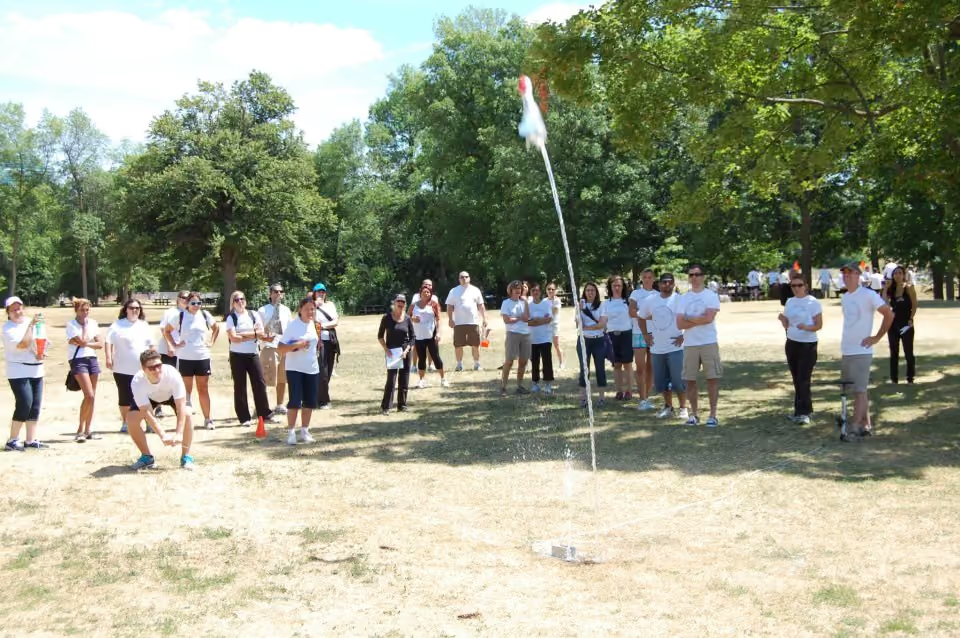
FullTilt’s Rocket Challenge cuts through that ambiguity. Teams are tasked with designing and launching a rocket that must safely return a fragile payload—an egg—within clear constraints and time limits.
The outcome is binary. The rocket either performs or it doesn’t. That clarity reinforces a simple principle: define success precisely, measure what matters, and align effort to the result.
Decision Ownership and Accountability Architecture
A practical way to improve team performance is to ensure everyone is clear who is responsible for the outcome. It’s possible that teams can collaborate well when completing tasks. But they can still fail at the result level if no one owns the final outcome.
Team performance improvement strategies gain traction when authority is defined before work begins, not during conflict.
Collaboration strengthens when teams know exactly who makes the final call and what that authority covers.
Improving team collaboration requires more than defined roles. It requires visible ownership of results that span departments.
Outcome Ownership vs Task Ownership
Task ownership answers: who is doing the work?
Outcome ownership answers: who is accountable if the result fails?
Many cross-functional initiatives assign tasks to multiple teams but never assign a single owner for the final outcome. That creates diffusion when trade-offs appear.
Establish accountability for design by naming one outcome owner for each strategic initiative. That person is responsible for performance metrics tied to revenue, margin, delivery, or retention—not just activity.
When outcome ownership is clear, collaboration sharpens. Teams contribute inputs, but one leader carries final responsibility for results.
Defining Final Trade-Off Authority
Cross-functional work inevitably produces competing priorities. Speed versus stability. Margin versus growth. Customer customization versus scalability.
Accountability architecture requires that the organization define, in advance, who holds final authority when those metrics conflict.
This authority must be role-based, not personality-based. It should be documented at the leadership level and communicated openly, so teams understand how decisions are resolved under pressure.
When trade-off authority is predefined, collaboration becomes faster because debate has a boundary.
Designing Escalation That Supports Flow
Escalation should strengthen execution, not override it.
Design escalation in tiers. First-level resolution stays within the initiative owner’s authority. Second-level escalation moves to a predefined senior role when thresholds are crossed—budget deviation, timeline variance, or risk exposure.
Escalation design must answer three questions:
- What triggers escalation?
- Who receives it?
- What decision window applies?
When escalation rules are clear, leaders intervene deliberately rather than reactively. Middle managers retain authority, and senior leaders step in only when structure requires it.
Communication Cadence Redesign as a Workplace Team Intervention
To improve team performance, redesigning the communication cadence is a vital strategy. This means creating a structure for how information moves through the week. The thing is that improving team collaboration isn’t always about clearer messaging. It’s about these factors:
- When information arrives
- Who receives it
- How fast is it acknowledged
- If it arrives in time to change the work
Communication signals must be clear to improve team-based work.
Cadence mapping
Cadence redesign corrects timing before it becomes rework. To do this, start by mapping a single week of information flow. Track one request from origin to usable response. Note the timestamp. When was it sent? Acknowledged? Clarified? Acted on?
This is when you’ll usually notice three gaps:
- Waiting for a reply.
- Waiting for clarity.
- Waiting for confirmation.
This mapping process helps avoid situations where one team assumes approval was implicit, another thinks it was provisional, and a third doesn’t respond directly. That’s how work processes grind to a halt.
Mapping cadence makes that visible.
Cadence Redesign to Reduce Churn
When redesigning communication pathways, it’s vital to remove blocks. Response should be category-based, not personality-based. In many teams, communication is on a personal level like this:
- If someone is anxious, they reply instantly.
- If someone is overloaded, they reply three days later.
- If someone is senior, others wait.
That communication cadence creates inconsistency.
A simple communication cadence redesign could be something like:
- Acknowledge within 2 hours.
- Resolve or escalate within 24 hours.
In no case should non-response be interpreted as agreement. That’s why it’s vital to redesign response expectations.
Define Communication Response Expectations
It’s common for teams to confuse visibility with commitment. Clarity must be part of the communication cadence. For example:
- Seen is not acknowledged.
- Acknowledged is not committed.
- Committed is not delivered.
Each stage needs a definition. If the product research and development team responds with “noted,” that doesn’t mean engineering can proceed.
Communication cadence discipline is when the redesign creates explicit expectations so that interpretation disappears.
How to Redesign Communication Cadence
Clear, constructive feedback is the basis of team performance improvement strategies. Usually, feedback arrives too late, responses are vague, or it comes across wrong and is misunderstood as criticism. None of those factors will help improve team collaboration.
FullTilt’s Clear and Productive Feedback is an example of a team intervention for HR leaders. Participants practice feedback sessions as a structured, repeatable process. They learn the principles of CAP Feedback:
- Clear
- Authentic
- Productive
The team building module isn’t just theory. It’s an experiential learning event that uses a hands-on format layered into existing training. They practice feedback correction in real time.
Expected outcome: Faster course correction without escalating friction.
Psychological Safety Without Performance Drift

Team performance can only improve when members feel safe to speak up. This is where psychological safety is important. Poor performance doesn’t appear due to open conflict. It starts with hesitation.
When employees feel safe contributing in meetings, hesitation disappears. How does this improve team performance? It allows risks to surface earlier. Flawed assumptions get challenged before work moves forward. Disagreement happens in the room, not afterward in hush-hush side conversations.
Here’s the thing: an employee needs to feel safe, not because everyone is encouraged to speak up. It happens when people understand how others interpret them, how they can understand others, and what constructive challenge actually looks like in practice.
How to Improve Team Collaboration
One of the most practical ways to improve team collaboration is to use the 360-degree approach.
FullTilt Team Development developed the 360 Degree Behavior Matrix to make communication styles visible through experiential challenges. Team members uncover their communication patterns, behavioral tendencies, and natural strengths while working through structured exercises together.
Team performance improves, and conversations sharpen when people understand how others process information and respond under pressure. 360 Degree feedback lands cleaner. Disagreement becomes productive instead of personal.
Preventing Burnout While Raising Performance Standards
Every workplace team intervention strategy—clearer ownership, tighter cadence, faster feedback—raises performance expectations. That’s the point. But there is a risk of burnout if not executed properly.
When standards increase without adjusting capacity, friction shifts from process to people. Even the most resilient team needs enforced trade-offs.
A leadership team can tighten accountability and shorten decision cycles. But the scope should reflect the changes and not remain elastic and “urgent.”
If leaders accelerate delivery without removing lower-value work, teams compensate silently. Deadlines compress. Scope creeps. Quality pressure rises. No one says no.
Preventing burnout while raising performance standards requires enforced constraint. If a new priority enters, another leaves. If timelines shrink, scope tightens. Those trade-offs must be explicit.
High performance is controlled intensity, not constant escalation.
The 30-Day Team Reset Framework
The practical ways to improve team collaboration and performance only work when applied in sequence. Tightening accountability before diagnosing friction creates pressure. Measuring KPIs before clarifying ownership means tracking noise.
This 30-day reset structures the order of change. It moves from visibility to clarity to execution discipline to enforcement. Each week builds on the last, so performance improves without creating new bottlenecks.
Week 1: Diagnose Structural Friction
Goal: Identify where decisions stall and where work slows before adding new initiatives.
- Map one recent delayed project from start to finish. Document where time was lost.
- List recurring blockers from the past 60 days. Identify patterns.
- Track one cross-functional request from submission to resolution. Measure response latency.
- Interview three team members privately: “Where does work slow down?”
- Document decisions that required more than one meeting.
End Week 1 with a visible friction map. No solutions yet.
Week 2: Clarify Ownership and Goals
Goal: Remove ambiguity in decision rights and performance expectations.
- List the top 10 recurring decisions. Assign one accountable owner to each.
- Define what “final approval” means. Document it.
- Rewrite current goals into measurable weekly outputs.
- Remove or merge redundant KPIs.
- Define what silence does not mean (e.g., silence ≠ approval).
By the end of Week 2, ambiguity should be documented and reduced.
Week 3: Rebuild Meeting and Coaching Cadence
Goal: Convert weekly interactions into execution checkpoints.
- Define a single weekly decision docket. No side decisions.
- Require proof-of-progress updates, not verbal status.
- Categorize issues as blocking or non-blocking.
- Set response windows by category.
- Introduce a structured feedback checkpoint before major deliverables.
Week 3 stabilizes rhythm. No new initiatives enter without trade-offs.
Week 4: Install Accountability and Performance Tracking
Goal: Measure behavioral change, not just output.
- Track decision cycle time before and after reset.
- Monitor rework frequency across departments.
- Record number of escalations required per week.
- Audit whether deadlines moved or held.
- Identify one persistent friction point and assign a structural fix.
End Week 4 with observable performance indicators.
When to Escalate Beyond Interventions
Team performance improvement strategies work when the issue is structural. But not every problem lives at the team level. If you’ve clarified ownership, tightened cadence, and enforced trade-offs—and performance still stalls—it’s time to escalate.
Escalation doesn’t mean panic. It means you’ve identified that the issue lies above or outside the team.
Here’s how to know.
- Conflicting incentives: Two departments are rewarded for mutually exclusive outcomes. Marketing is pushed for speed. Engineering is pushed for stability. No meeting redesign will fix that. Leadership must realign metrics.
- Decision avoidance at the top: Deadlines move because senior leaders won’t make the final call. Teams wait. Work slows. If decisions consistently float upward and never land, the bottleneck is leadership, not collaboration.
- Chronic underperformance by one role: Standards are clear. Support is available. Feedback is regular. Output still misses. At that point, it’s not a communication issue. It’s a capability or role-fit issue.
- Scope inflation without authority: Work keeps entering the system, but no one has authority to remove it. Teams stretch. Burnout rises. If trade-offs require executive approval every time, escalation is required.
- Cultural fear that overrides structure: People privately admit concerns but stay silent publicly, even after safety interventions. That signals a deeper power dynamic problem that requires senior correction.
Escalation protects performance.
Measuring Real Performance Gains
If you don’t measure the right things, you’ll think nothing changed.
After a reset, activity often increases. Meetings feel sharper. Feedback sounds clearer. But performance gains are not about energy. They are about output and speed.
Measurement must focus on observable shifts.
- Shorter decision cycles: Track how long key decisions take from first discussion to final approval. If that number drops, collaboration has improved.
- Reduced rework: Monitor how often deliverables are sent back for revision. Fewer rewrites mean earlier clarity and better coordination.
- Fewer escalations: Count how many issues require senior intervention. If escalation frequency drops, ownership is functioning.
- Deadlines that hold: Measure how often timelines move after being set. Stable deadlines signal stronger commitment and clearer trade-offs.
- Faster blocker resolution: Track how quickly blocking issues are acknowledged and resolved. If blockers clear sooner, cadence is working.
Avoid vanity metrics like focusing on more meetings, emails, or reported “alignment” reports. They don’t prove progress. Real performance gains show up in speed, reliability, and reduced friction between teams.
From Intervention to Performance System
At FullTilt Team Development, we know that structure has to change to improve team performance. Another random team building workshop won’t fix it.
That’s why we have designed bespoke team performance strategies that clarify ownership, improve decision-making processes, and enforce standards.
When you’re ready to build a real performance system, not just run another event, talk to us.