

An office scavenger hunt is a team building activity that runs inside your workplace using the physical environment, company knowledge, colleagues, and available materials as the content of the hunt. It requires no external logistics, no budget, and as little as 30 minutes. The 60 ideas below are organized by challenge type and goal — copy the ones that fit your team and run one this week.
Why Office Scavenger Hunts Work Better Than Most People Expect
Most people assume office scavenger hunts are a lightweight, low-impact version of "real" team building. The reality is the opposite — when designed well, an office hunt delivers something that offsite events rarely can: insight into how your team actually operates in its real environment.

The office is where the communication patterns, collaboration habits, and interpersonal dynamics that drive or damage team performance play out every day. A well-designed office scavenger hunt surfaces those dynamics in a low-stakes, observable way — in the same space where they matter.
Watch who takes charge when the instructions are ambiguous. Watch who withdraws when the team is under time pressure. Watch who connects with colleagues from other departments and who stays within their usual orbit. In 45 minutes of a hunt, you'll learn things about how your team operates that would take months to accumulate through normal work observation.
This is the same principle that underpins the full corporate scavenger hunt guide — and it applies whether you're running a 30-minute office activity or a half-day city-wide program. The format scales. The diagnostic value doesn't diminish with proximity to the workplace.
The other underrated benefit: zero logistics. No travel, no booking, no weather contingency. An office scavenger hunt can be decided on a Tuesday and run on a Wednesday. For teams with limited time or budget, that ease of execution is the most important feature.
How to Run an Office Scavenger Hunt in 6 Steps
Step 1 — Set a goal (5 minutes)
Not "fun." A specific goal: new hires learning the office and culture, cross-departmental connection for a team that's been siloed, energy reset for a team in a long sprint. The goal determines which of the 60 ideas below you choose.
Step 2 — Pick your format (2 minutes)
List format: Teams receive a printed or digital list of items and tasks to find or complete. Non-linear — teams work through it in any order. Best for 20+ people, competitive energy, time pressure.
Clue chain format: Each clue leads to a location, which contains the next clue. Linear, sequential, everyone moves together. Best for small groups of 6–15, onboarding, or when you want a shared journey.
Station format: Challenges are set up at fixed points. Teams rotate through. Best for large groups (50+) where crowd control matters.
Step 3 — Build your challenge list (20 minutes)
Use the ideas below. A good 60-minute hunt needs 15 to 20 challenges of mixed difficulty. Too few and it ends too early. Too many and teams feel rushed and skip the interesting ones. Mix challenge types: knowledge, people, creative, physical, discovery.
Step 4 — Assign teams deliberately (2 minutes)
Never let people self-select into their usual groups. Cross-functional, cross-seniority, mixed-tenure teams. This is the single most important design decision. The team composition determines 70% of the team building value. For more on why this matters, see our guide on how to organize effective team building events.
Step 5 — Brief, run, score (your planned duration)
Crisp briefing: rules, boundaries, time limit, scoring, where to submit evidence (photos to a shared channel, physical items to a central desk). The hunt itself — typically 30 to 60 minutes. Scoring and winner announcement — 5 minutes.
Step 6 — Debrief (10 to 15 minutes — never skip this)
One question is enough: "What did you notice about how your team worked together — and where does that pattern show up in your real work?" This is the sentence that turns entertainment into team development. Without it, you've run a game. With it, you've run a team building activity.
For the full planning framework including how to design scoring, manage large groups, and run a structured debrief, the complete corporate scavenger hunt guide covers every detail.
Office Scavenger Hunt Ideas: Company Knowledge and Culture
These challenges test and reinforce institutional knowledge — perfect for onboarding, culture-building, and annual events where you want employees to understand what the company stands for.
1. Find and photograph the company's founding date displayed somewhere in the office. Hint: it may be on a plaque, a framed document, a website screenshot, or hidden in plain sight.
2. Locate the mission statement displayed anywhere in the building. Photograph it — then recite it from memory on video without looking.
3. Find physical evidence of each of the company's core values displayed in the office. One photo per value. Award bonus points for the most creative interpretation.
4. Identify the company's three most important clients or partners and find their logos, names, or references anywhere in the office.
5. Locate the most recent company award, certification, or recognition on display. Photograph it and explain in 30 seconds what the team did to earn it.
6. Find a piece of company history that most employees don't know about. Where did you find it? What does it say?
7. Track down the oldest company artifact still in the office — a piece of equipment, a printed document, a branded item — and find out its age.
8. Find something in the office that represents a product or service the company no longer offers but used to.
9. Locate and read the company's most recent press mention, news article, or external recognition. Screenshot or photograph it.
10. Find three pieces of branded merchandise (mugs, notebooks, bags, shirts) and arrange them to spell something — photograph the result.
Office Scavenger Hunt Ideas: People and Connection
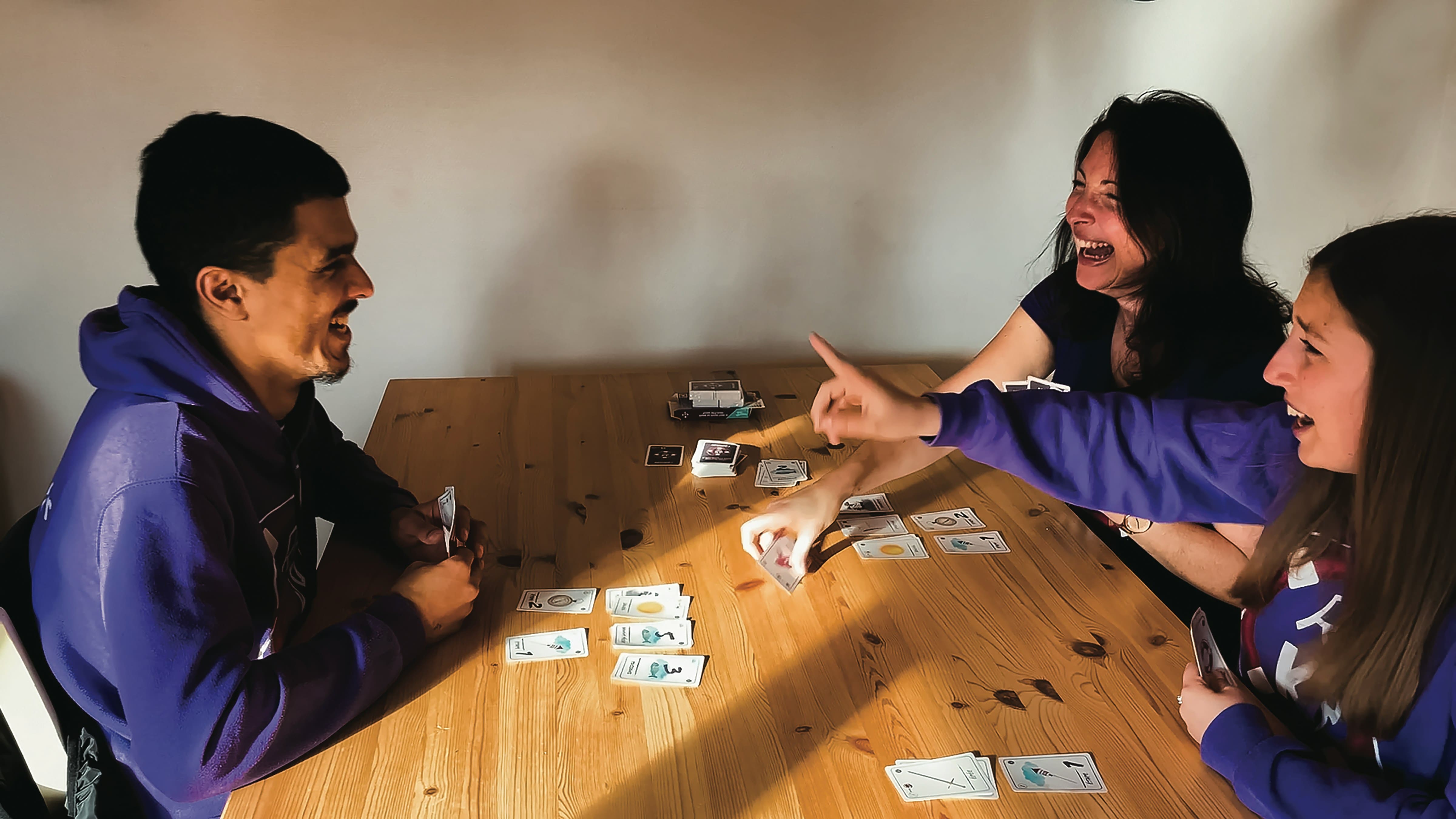
These are the highest-value challenges in any office hunt because they force genuine cross-departmental interaction — the thing that most teams need most and do least.
11. Get a signature from one person in every department in the building. Collect them all on a single sheet of paper.
12. Find someone who has been at the company for more than 10 years. Ask them: "What's one thing about this company that has stayed the same since you joined — and one thing that's completely changed?" Record their answer on video.
13. Take a team photo with someone from a department your team has never directly collaborated with.
14. Find three colleagues who have a skill outside their job description — something you didn't know about them. Document each one.
15. Get a colleague from each floor, wing, or section of the building to write one word describing the team culture on a sticky note. Collect them all. Which words come up most?
16. Find the person in the building with the longest commute. Document their journey.
17. Find someone whose job title you didn't fully understand. Have them explain their role in 60 seconds. Then explain it yourself — on camera — without their help.
18. Find three people who joined the company in three different decades. Get one piece of advice from each of them for someone starting here today.
19. Locate the colleague who has worked in the most different roles within the company. Find out what they've learned from each.
20. Get five colleagues who are not on your team to each perform one 10-second skill demonstration — anything they're good at. Film all five consecutively.
These people-focused challenges are where the most memorable moments of any office scavenger hunt happen — and they're also what builds the kind of cross-departmental trust that improves how teams collaborate long after the hunt is over.
Office Scavenger Hunt Ideas: Creative Challenges
These generate the most energy and laughter — and the most revealing moments about how teams handle ambiguity, leadership, and creative pressure together.
21. Build the tallest freestanding structure possible using only items found at a single desk (not your own). No tape, no glue. Photograph the result with a ruler or hand for scale.
22. Create a 30-second commercial for the company using only office supplies as props and team members as cast. Film it.
23. Recreate a famous painting or photograph using colleagues as subjects and office materials as props. Most accurate recreation wins. Most creative interpretation gets bonus points.
24. Write and perform a 60-second company theme song using only three items from the office kitchen as instruments. Film it.
25. Find five items in the office that, together, tell the story of what this team does. Present them in a 90-second narrative — on camera.
26. Create a company logo using only human bodies — no props, no signs. Photograph from above or at an angle that makes the logo legible.
27. Design a 60-second "new employee orientation" using only what you can find in the office in the next 10 minutes. Deliver it to a camera as if the viewer is on their first day.
28. Find the most photogenic location in the entire office and take the best possible team portrait there. Judged by popular vote from all teams.
29. Create an "Out of Office" voicemail message for the CEO using only office supplies and team members' voices. Make it professional enough to actually use. Film it.
30. Build something functional from materials found in the recycling bin. Document what it does and demonstrate it working.
For teams that want to take creative challenges further — with professional facilitation and custom-designed challenges built around your company's specific goals — Full Tilt's team building activities include custom hunt design as part of every program.
Office Scavenger Hunt Ideas: Discovery and Exploration
These challenges get people moving through the office in ways they don't normally — discovering spaces, details, and colleagues they overlook every day.
31. Photograph your team in five distinctly different locations in the building within 10 minutes. Each location must look completely different in the background.
32. Find a room or space in the building your whole team has never entered before. Document the visit.
33. Locate every emergency exit in the building. Photograph the route map nearest each one. How many did your team not know about?
34. Find the highest and lowest points accessible in the building. Take a team photo at each.
35. Discover the quietest and the noisiest spots in the office at this exact moment. Document both with a 10-second video.
36. Find three things in the office that have been there since the company first moved in. How do you know?
37. Locate something in the office that absolutely should not be there. Most creative interpretation of "shouldn't be there" wins bonus points.
38. Find the view from the best window in the building. Photograph it. Then find the most unusual window view. Photograph that too.
39. Locate every piece of original artwork in the office. Which is the oldest? Which is the most valuable? Which is the most interesting?
40. Find a space in the office that has changed purpose since the company moved in. What was it before? What is it now? Who remembers?
Office Scavenger Hunt Ideas: Problem-Solving Under Pressure
These challenges are deliberately ambiguous — they don't have a single correct answer, which means the team has to make a decision together. That's the point.
41. You have 10 minutes and 10 items you can find anywhere in the office. Build something that demonstrates what your team values most. Present it in 60 seconds.
42. Negotiate a trade with another team — exchange something you have for something you need. Both teams must agree the trade was fair. Document the exchange.
43. Find a problem that exists somewhere in the office right now — something inefficient, unclear, or overlooked. Propose a solution in 90 seconds on camera. No constraints on the solution.
44. Create a "survival kit" for a new employee's first week using only items you can borrow (not take permanently) from around the office. Justify each item.
45. Get three colleagues from different departments to agree on the single most important thing the company should focus on next year. Film the agreement. No staged answers.
46. Find the most complicated piece of equipment in the office that at least one team member doesn't know how to use. Learn to use it. Demonstrate it working — on film.
47. Decode a clue the facilitator has hidden somewhere in the building before the hunt started. (Facilitator plants this in advance.) The clue leads to a second location with a bonus challenge worth double points.
48. Your team has 5 minutes to find one item for each letter of the company name. Every item must be found — not manufactured. Fastest team wins.
49. Find evidence of something that happened in this office that nobody outside the company knows about. Could be a photo, an award, a prototype, a moment. Present it with its story.
50. Create a map of the office from memory as a team — no walking around, draw it together from what you collectively remember. Then walk it and mark what you got wrong.
These problem-solving challenges connect directly to the same skills that determine team performance in real work — ambiguity tolerance, decision-making under pressure, creative resourcefulness. For teams that want to explore these dynamics more deeply, our guide on the best team building problem-solving activities covers both the research and the activity design behind them.
Office Scavenger Hunt Ideas: Onboarding New Employees
These are specifically designed for new hire integration — helping new employees learn the office, the culture, and the people in a way that feels engaging rather than overwhelming. Run these in the first two weeks.
51. Find and photograph 10 specific locations in the office that every employee needs to know: the printer, the coffee machine, the emergency exit, the IT desk, the fire extinguisher, the supply cabinet, the break room, the CEO's office, the nearest bathroom, and one location of your choice.
52. Get a business card (or contact details) from one person in every team in the company. Introduce yourself before asking.
53. Find three colleagues who started at a similar time to you. Exchange one piece of advice each about the first 90 days.
54. Locate the answer to five things new employees always wonder: Where do I print? Who do I contact for IT issues? Where is the nearest pharmacy? What time does the building open? What's the Wi-Fi password for the meeting rooms?
55. Find someone who held a job before this one that has nothing to do with their current role. Find out how they ended up here.
56. Identify the unwritten rules of this office — the things that aren't in the employee handbook but everyone knows. Collect three from three different people.
57. Find the answer to: what is the most important thing that happened in this company in the last 12 months? Ask three different people and see if they agree.
58. Locate and photograph every amenity available to employees in the building that isn't in the standard orientation pack.
59. Find a mentor — someone who volunteers to answer one question from you per week for your first month. Get their name and contact information on camera.
60. Document your first impression of the office in three photos. Then document what you'd change. Present both to the team.
For a structured approach to onboarding that goes beyond the first-day tour, our team building training programs include onboarding-specific designs that combine the scavenger format with culture and values alignment.
Office Scavenger Hunt List Templates
Use these as a starting point. Copy, edit, and print — or share digitally via Slack, Teams, or a shared Google Doc.
Template 1 — 30-Minute Quick Hunt (12 Challenges)
Best for: energy reset, Friday afternoon, post-meeting warm-upTeams of 3–4 | Any group size
- Find and photograph a piece of company history
- Get a signature from someone in a different department
- Build the tallest structure from desk items
- Find the most unusual item in the office
- Take a team photo in the most creative location in the building
- Get a 30-second career advice video from a senior colleague
- Find something that represents a company value — without using words
- Decode the hidden clue (facilitator plants this in advance)
- Create a company logo using only human bodies
- Find the best window view in the building
- Get three colleagues to agree on the company's biggest strength — on camera
- Write the team's 60-second survival guide for a new employee
Template 2 — 60-Minute Engagement Hunt (20 Challenges)
Best for: team connection, cross-departmental events, quarterly team daysTeams of 4–6 | 20–100 people
- Locate every emergency exit
- Find someone who has been here 10+ years — get their story
- Build something functional from recycling bin materials
- Find three colleagues with unexpected outside-work skills
- Find the founding date of the company
- Photograph your team in five completely different locations in 10 minutes
- Get signatures from every department
- Create a 30-second company commercial using only office supplies
- Find evidence of each company core value on display
- Locate the quietest and noisiest spots in the office
- Find the person with the longest commute
- Recreate a famous painting with team members as subjects
- Map the office from memory — then walk it and mark mistakes
- Find a room none of your team has entered before
- Negotiate a trade with another team
- Find three people who joined in different decades — get advice from each
- Find the oldest branded item in the office
- Identify and solve a real problem in the office in 90 seconds
- Get five colleagues to do skill demonstrations on video
- Document your team's answer to: what makes this company worth working for?
Template 3 — Onboarding Hunt (15 Challenges)
Best for: new hire integration, first-week orientation, team welcome eventsTeams of 2–3 new hires | Any group size
- Find and photograph 10 essential locations
- Locate the Wi-Fi password for meeting rooms
- Get contact details from one person in every team
- Find three colleagues who started at a similar time
- Collect three unwritten office rules from three different people
- Find out what the most important thing that happened in the last year was — ask three people
- Find a mentor willing to answer one question per week
- Locate every employee amenity not in the handbook
- Find someone whose previous job was completely unrelated to their current role
- Get career advice from three people at three different levels of seniority
- Photograph your first impression of the office — then photograph what you'd change
- Find the company's mission statement and memorize it
- Get a business card or contact from someone in every department
- Find evidence of a company value in action — not just on a poster
- Answer: who do I call if my laptop stops working at 4:45pm on a Friday?
How to Make It Harder, Faster, or More Competitive
Make it harder: Add constraint layers. "Complete this challenge using only items you find in the kitchen." "Complete this task without speaking." "Every team member must appear in every piece of video evidence — no exceptions."
Make it faster: Reduce time by 30% and eliminate the five lowest-point challenges. Time pressure changes how teams operate — and often reveals more about dynamics than a comfortable pace does.
Make it more competitive: Add a live leaderboard updated in real time (a shared Google Sheet works). Add bonus challenges worth double points that can only be attempted once per team. Add a "steal" mechanic — if Team A completes a challenge first, Team B cannot attempt it for double points (forces prioritization decisions).
Make it collaborative instead of competitive: All teams contribute to a single shared score. The goal is the whole group completing X challenges before time runs out. This format works better when the team has trust deficits or where competition would widen existing divides rather than bridge them.
Add an icebreaker opener: Before the hunt begins, run one quick icebreaker question with the whole group to warm the room — one question, one lap around the room, 3 minutes maximum. It shifts the energy before the hunt starts. The teams that go into a scavenger hunt already warm consistently produce better debrief conversations than cold starts.
Add a team game mid-hunt or post-hunt: For sessions where the scavenger hunt is the main event but you want to extend the team building value, our 30 team building games for meetings has structured game formats that work well as finales or wind-downs after a competitive hunt.
When to Upgrade From a DIY Hunt to a Facilitated Program
A self-run office scavenger hunt is excellent for healthy teams that need energy, connection, and a break from the usual. Run one every quarter. They cost nothing and take 30 minutes to organise using the templates above.
But there are situations where a DIY hunt won't reach far enough:
Your team has structural communication problems. A fun hunt doesn't fix broken communication patterns. It might surface them — but without a skilled facilitator in the room to name what they're seeing and guide the debrief productively, those observations get laughed off rather than acted on.
You're integrating teams after a merger, restructure, or leadership change. These situations require deliberate design — custom challenge sets built around the specific cultural and interpersonal gaps that need bridging. Generic challenge lists don't do this.
Your group is over 50 people. Logistics, safety, scoring, and crowd management at scale require infrastructure that a self-run hunt doesn't have. Full Tilt's large group programs are designed specifically for 50 to 2,000+ participants — with facilitation structures, custom scoring systems, and professional safety briefings built in.
You want the activity to produce behavioral change, not just a fun afternoon. This requires a facilitator who watches the dynamics during the hunt, not just manages the scoring. Who notices that one team member stopped contributing at the 20-minute mark. Who knows how to create the psychological safety in the debrief that allows real observations to surface. That skill is the difference between a team building event and team building. Our team building facilitators are trained specifically in this — and it shows in the debrief quality.
Full Tilt's Scavenger Hunt program runs for groups of 12 to 500+, indoor or outdoor, across any North American city. Every hunt is custom-designed around your team's specific goals — not a recycled template. Get a quote here.
Frequently Asked Questions
What is an office scavenger hunt?
An office scavenger hunt is a team building activity that uses the workplace itself — the physical space, company knowledge, colleagues, and available materials — as the content of the hunt. Teams compete to find items, complete challenges, collect signatures, or solve clues within the office environment. It requires no external logistics, no travel, and no significant budget. A well-designed office hunt runs in 30 to 60 minutes and works for groups from 10 to 200+ people.
What are good office scavenger hunt ideas?
The best office scavenger hunt ideas fall into five categories: company knowledge challenges (test institutional knowledge), people and connection challenges (force genuine cross-departmental interaction), creative challenges (generate energy and reveal how teams handle ambiguity), discovery challenges (get people moving through the office in new ways), and problem-solving challenges (create observable team dynamics under mild pressure). This article's 60 ideas cover all five categories with ready-to-use challenge descriptions.
How long should an office scavenger hunt be?
30 to 60 minutes of active hunt time is the sweet spot for an office setting. Shorter than 30 minutes and there isn't enough challenge variety to generate meaningful team interaction. Longer than 60 minutes and energy typically drops in the final third. Add 10 minutes for briefing and 10 to 15 minutes for debrief — total session time is 50 to 90 minutes. The debrief is non-negotiable; it's where the behavioral value is created.
How do you make an office scavenger hunt list?
Start with your goal, then select 15 to 20 challenges from the categories above. Mix challenge types: 4 to 5 knowledge challenges, 4 to 5 people challenges, 3 to 4 creative challenges, 3 to 4 discovery challenges, and 2 to 3 problem-solving challenges. Assign point values based on difficulty — easy challenges worth 10 points, harder ones worth 25, bonus challenges worth 50. The three printable templates in this article give you a complete list for 30-minute, 60-minute, and onboarding formats ready to use immediately.
What are the best office scavenger hunt ideas for team building?
The highest-value office scavenger hunt challenges are the people and connection ones — specifically those that force genuine interaction with colleagues outside the team's usual orbit. Challenges like "get a signature from someone in every department," "find someone who has been here 10+ years and get their advice on camera," and "find someone whose job title you didn't fully understand and have them explain their role" create the cross-departmental relationships that research consistently shows improve engagement and retention. For the full strategic context on why this matters, see our complete corporate scavenger hunt guide.
Can an office scavenger hunt work for large groups?
Yes — with format adjustments. For groups over 50, use a station-based format (teams rotate through fixed challenge points rather than roaming freely), a digital submission system for photo/video evidence, and a centralized scoring display visible to all teams. For groups over 100, a scavenger hunt app (GooseChase, Actionbound) manages submissions and scoring automatically. For groups over 200, professional facilitation is strongly recommended — the logistics and crowd management at this scale require infrastructure a self-run hunt doesn't have. Full Tilt has run scavenger hunts for large groups from 50 to 2,000+ participants.
What's the difference between an office scavenger hunt and an outdoor team building scavenger hunt?
An office hunt uses the workplace as its environment — zero logistics, zero travel, runnable in 30 minutes. An outdoor hunt uses a city, neighborhood, park, or campus — higher energy, more logistical complexity, typically 90 minutes to half a day. Both develop the same core team skills: communication, collaboration, problem-solving under pressure. The outdoor format adds exploration, physical movement, and city discovery. The indoor format adds workplace-specific insight and culture reinforcement. For teams that want the outdoor version, our outdoor team building programs and the complete scavenger hunt guide cover the full outdoor format with ideas, logistics, and city-specific designs.
What do you need to run an office scavenger hunt?
For a self-run hunt: a challenge list (use the templates in this article), a scoring system (simple point values, track in a shared Google Sheet), teams assigned in advance (cross-functional, 4 to 6 per team), a timer, and 10 minutes of facilitator preparation. For a photo evidence hunt: a shared Slack channel, Google Drive folder, or WhatsApp group where teams submit images. That's it. No materials to purchase, no venue to book, no external vendor required. For facilitated programs, Full Tilt handles everything — challenge design, facilitation, scoring, and debrief.
Related Resources From Full Tilt Teams
- The Ultimate Corporate Scavenger Hunt Guide — The pillar article: every format, 50+ ideas, planning framework, clue templates
- Full Tilt Scavenger Hunt Activity — Expert-facilitated program for 12 to 500+ participants
- Mission Incredible — City-wide scavenger hunt program customized to any location
- 17 Team Building Scavenger Hunt Ideas — Original FTT idea library with outdoor and adventure formats
- Outdoor Team Building Programs — For teams ready to take the hunt outside
- Large Group Team Building — Scavenger hunts and programs for 50 to 2,000+
- 150 Icebreaker Questions for Work — Warm up the room before your hunt starts
- 40 Quick Team Building Activities — For shorter formats that work inside a meeting
- 30 Team Building Games for Meetings — Structured game formats to pair with or follow a hunt
- Team Building Consulting Guide — When a hunt reveals something that needs deeper work