

The best corporate retreat location in the US is not a single destination - it is the destination that matches your team size, your retreat goal, your company's home base, and the season you are traveling. This guide covers the top US corporate retreat locations by region, with the planning framework - goal-setting, format, team building integration, and budget - that determines whether your retreat produces lasting outcomes or just a pleasant trip.
How to Choose a Corporate Retreat Location (The Framework)

The single most common corporate retreat planning mistake is choosing the location first. The destination is step four, not step one. Organizations that start with location shopping consistently end up in beautiful places having mediocre experiences — because the location was chosen before anyone answered the questions that determine what a good location actually looks like for this specific team.
The four questions that must precede any location decision:
What is the retreat's primary goal? Strategic alignment requires different infrastructure than culture building. Leadership development requires different programming than large-scale employee celebration. If you cannot articulate the primary goal in one sentence, the retreat has no design brief and no amount of beautiful scenery will compensate.
Who is coming, and how many? A 10-person executive retreat and a 200-person all-hands event require fundamentally different location infrastructure. Venue capacity, room configuration, outdoor space, and accommodation density all flow from group size.
What is the budget? US corporate retreat costs range from $500 to $5,000+ per person per day depending on location, accommodation quality, programming, and meals. Knowing the realistic per-person budget before selecting a destination prevents wasted effort.
When are you traveling? Every US retreat destination has a peak season (highest cost, best weather, lowest availability), a shoulder season, and an off-season. Timing intersects with budget and availability in ways that are destination-specific.
For the full retreat planning framework — including agenda design, team building integration, and post-retreat follow-through — see our company retreat planning guide. For whether your situation calls for a leadership offsite or a team retreat, see our leadership offsite vs team retreat guide.
West Coast Retreat Locations
Napa Valley and Wine Country, California
Best for: Executive retreats, leadership offsites, incentive trips
Group size: 6–50
Peak season: May–October
Cost: $$$$
Team building: Wine blending challenges, culinary competitions at estate kitchens, vineyard scavenger hunts
Napa Valley is the premier US luxury retreat destination for small leadership groups. World-class accommodation (Auberge du Soleil, Meadowood, Carneros Resort), excellent food infrastructure, and the wine country aesthetic creates an environment that genuinely shifts mental gears — exactly what a strategic leadership retreat needs.
Limitation: expensive, seasonal, and better suited to groups under 60. For large all-hands, logistics are complex and cost-per-person at full quality runs very high.
Full Tilt facilitates team building in the San Francisco Bay Area which pairs naturally with Napa retreats for Bay Area companies. See our San Francisco city page for local program options.
Lake Tahoe, California/Nevada
Best for: Active teams, adventure-oriented companies
Group size: 20–150
Peak season: June–August (summer), December–March (ski season)
Cost:
–$
Team building: Outdoor lake challenges, hiking programs, kayak races, snow-based winter competitions
Lake Tahoe's rarest quality: it works in both summer and winter. Dual-season viability means year-round booking flexibility that most mountain destinations cannot match. Challenge: traffic from the Bay Area can complicate logistics in peak periods. Book 4–6 months ahead for summer weekends.
San Diego and Southern California
Best for: Year-round outdoor retreats, biotech and tech companies
Group size: 20–500
Peak season: Year-round
Cost:
–$
Team building: Beach Olympics at Coronado or La Jolla, city scavenger hunts through the Gaslamp Quarter, harbor-view outdoor challenges
San Diego is the strongest year-round outdoor retreat destination in the US. The climate is reliably excellent every month. Hotel del Coronado, Omni San Diego, and resort properties throughout La Jolla handle groups from 20 to 500.
For the complete San Diego team building guide, see our San Diego corporate guide and San Diego city page.
Seattle and the Pacific Northwest
Best for: Technology companies, innovation retreats, Pacific Northwest teams
Group size: 30–300
Peak season: June–September
Cost:
–$
Team building: City scavenger hunts, Pike Place Market culinary programs, outdoor coastal challenges
Seattle's intellectual culture makes it a strong retreat location for tech and innovation companies. Landmark density — Space Needle, Pike Place Market, the waterfront — provides excellent team building programming content.
See our Seattle team building guide and Seattle city page.
Big Sur and Monterey Peninsula, California
Best for: Small leadership retreats, creative industries
Group size: 6–30
Peak season: Year-round (mild coastal climate)
Cost:
$–$$
Team building: Coastal hiking challenges, nature-based team programs, mindfulness retreats
Big Sur's dramatic coastline and limited accommodation create genuine disconnection from routine. Limited cell service is a feature for retreats where focus is the primary objective. Best for leadership retreats where reflection and strategic thinking are the goal.
Mountain West Retreat Locations
Colorado Mountain Towns (Vail, Aspen, Breckenridge, Snowmass)
Best for: Active teams, leadership retreats, adventure-focused companies
Group size: 10–100
Peak season: December–March (ski season), June–August (hiking season)
Cost:
$–$$
Team building: Ski and snowboard team challenges (winter), hiking and rafting programs (summer), mountain bike challenges
Colorado's mountain towns deliver the most reliable "you're not in the office anymore" shift of any US retreat destination. The altitude, landscape, and physical distance from urban centers combine to enable the strategic thinking and honest conversation that retreats are supposed to produce.
Vail and Aspen are luxury-tier; Breckenridge and Snowmass offer premium quality at slightly lower cost. Denver is the gateway city for all Colorado mountain retreats. Full Tilt facilitates team building in Denver and the Denver city page.
Park City, Utah
Best for: Year-round retreats, active teams
Group size: 20–200
Peak season: January–March (ski season), July–September (summer)
Cost:
–$
Team building: Ski team challenges (winter), mountain biking and hiking programs (summer), purpose-built challenge courses at Park City Mountain Resort
Park City offers Colorado mountain quality at slightly lower average cost. Excellent conference infrastructure at Waldorf Astoria and St. Regis. Best value in October–November and April when peak-season prices drop significantly.
Jackson Hole, Wyoming
Best for: Executive retreats, companies wanting genuine wilderness
Group size: 10–60
Peak season: June–August, December–March
Cost:
$–$$
Team building: Wildlife safari team challenges, whitewater rafting programs, mountain challenge courses, fly-fishing team events
Jackson Hole's remote grandeur — the Tetons as backdrop, Yellowstone 50 miles away, genuine wilderness — creates a retreat environment unlike any other in the continental US. The psychological shift from urban corporate routine is more complete here than anywhere else on this list.
Limitation: remote, requires Denver or Salt Lake City connections, not suitable for groups over 100.
Bend, Oregon
Best for: Technology and outdoor industry companies
Group size: 10–50
Peak season: June–September
Cost: $$
Team building: Rock climbing team programs, mountain biking challenges, Cascade mountain hiking
Bend has emerged as one of the strongest value-for-money retreat destinations in the Mountain West. Excellent outdoor infrastructure, vibrant downtown, and accommodation costs significantly below Colorado or Utah equivalents.
Southwest Retreat Locations
Scottsdale and Phoenix, Arizona
Best for: Year-round retreats (avoiding July–August heat), large corporate groups
Group size: 30–500
Peak season: October–May
Cost:
–$
Team building: Desert scavenger hunts, sunset outdoor challenges, resort-based competitions, Sonoran Desert adventure programs
Scottsdale's resort infrastructure is among the strongest in the US — Sanctuary Camelback, The Phoenician, Talking Stick, and dozens of comparable properties handle groups from 30 to 500 with full conference, outdoor, and recreation facilities on-site.
The most underappreciated retreat timing in the US: January and February in Scottsdale. 70°F and sunny while the rest of North America is in deep winter. Lower prices than May peak season, excellent availability.
Full Tilt facilitates team building in Scottsdale and the Scottsdale city page. See also our Las Vegas guide for Southwest large-group events.
Sedona, Arizona
Best for: Wellness retreats, leadership groups seeking genuine disconnection
Group size: 10–60
Peak season: March–May, September–November
Cost:
$–$$
Team building: Red rock hiking team challenges, mindfulness programs in the buttes, sunset group challenges
Sedona's red rock landscape creates one of the most visually distinctive retreat environments in the US. The wellness orientation of Sedona's resort infrastructure suits retreats where wellbeing, reflection, and reset are primary objectives alongside strategic work.
Las Vegas, Nevada
Best for: Large-scale company events, conference add-ons
Group size: 100–5,000
Peak season: March–May, September–November
Cost:
–$$
Team building: Resort-based challenge programs, Strip and Downtown scavenger hunts, large-scale competitive events at conference venues
Las Vegas is misunderstood as a retreat destination. Its primary strength is logistical: direct flights from every major US city, extraordinary venue infrastructure (MGM Grand, The Venetian, Caesars Palace), and price flexibility no other destination matches. A 500-person event in Las Vegas is operationally easier and often cheaper than the same event in New York or San Francisco.
See our Las Vegas team building guide and Las Vegas city page.
Palm Springs, California
Best for: Leadership retreats, creative industries
Group size: 10–80
Peak season: November–April
Cost: $$$
Team building: Mid-century modern estate challenges, mountain tram hike programs, desert adventure activities
Palm Springs' mid-century architecture and extraordinary desert landscape create a retreat environment that feels like a different world despite being 2 hours from LAX. Best for October–April retreats.
South and Southeast Retreat Locations
Nashville, Tennessee
Best for: Culture-focused retreats, creative and media companies
Group size: 30–300
Peak season: April–June, September–November
Cost: $$
Team building: Music-based team programs, honky-tonk crawl challenges, culinary team events, Junkyard Orchestra in Nashville venues
Nashville has emerged as one of the most popular corporate retreat destinations in the US because the city's culture is itself a team building asset. The music history, the food scene, and the ambient energy create enthusiasm that transfers into group programming. Cost is significantly lower than equivalent-quality destinations on the coasts.
Full Tilt facilitates team building in Nashville and the Nashville city page.
Miami and South Florida
Best for: Large corporate events, international companies
Group size: 50–1,000
Peak season: November–April
Cost:
–$$
Team building: Beach Olympics at Miami Beach, Biscayne Bay water challenges, South Beach scavenger hunts, charitable builds with Miami nonprofits
Miami's combination of international sophistication, winter sunshine, and world-class venue infrastructure (Loews Miami Beach, Fontainebleau, Four Seasons Brickell) makes it a premium retreat destination for companies wanting genuine luxury alongside strong conference facilities.
See our Miami team building guide and Miami city page.
Orlando, Florida
Best for: Large-scale corporate events, family-inclusive retreats
Group size: 100–5,000
Peak season: October–May
Cost:
–$
Team building: Resort-based challenge programs at Gaylord Palms and Rosen Shingle Creek, outdoor programs in the resort district, large-scale competitive events
Orlando's reputation as a leisure destination obscures its strength as a corporate retreat location. The Gaylord Palms, Disney Swan and Dolphin, and Orange County Convention Center make it capable of handling groups from 100 to 10,000 with infrastructure no other Southeast destination matches.
See our Orlando team building guide and Orlando city page.
Charleston, South Carolina
Best for: Culture-focused retreats, smaller leadership groups
Group size: 20–100
Peak season: March–May, September–November
Cost: $$
Team building: Historic district walking challenges, culinary programs using Charleston's food scene, harbor-based water activities
Charleston's antebellum architecture, world-class food, and relaxed Southern pace creates a retreat environment that genuinely decelerates the corporate tempo — useful for retreats where reflection and relationship-building are primary objectives.
Atlanta, Georgia
Best for: Southeast-based companies, large conferences
Group size: 50–2,000
Peak season: April–June, September–October
Cost: $$
Team building: City scavenger hunts through Midtown and BeltLine, Piedmont Park outdoor challenges, charitable builds with Atlanta nonprofits
Atlanta's 15 Fortune 500 headquarters and Hartsfield-Jackson Airport make it a natural retreat staging city for companies with significant Southeast operations.
See our Atlanta team building guide and Atlanta city page.
Midwest Retreat Locations

Chicago, Illinois
Best for: Midwest-based companies, large conferences
Group size: 50–2,000
Peak season: May–June, September–October
Cost:
–$
Team building: Lakefront outdoor challenges, city scavenger hunts through the Loop and River North, McCormick Place large-group programs
Chicago's lakefront, architecture, food scene, and conference infrastructure combine to create a retreat environment that rivals the coasts. Season window matters: May, June, September, and October offer excellent outdoor programming. January and February require indoor formats.
See our Chicago city page for local program options.
Minneapolis, Minnesota
Best for: Midwest companies, spring through fall retreats
Group size: 20–200
Peak season: May–October
Cost: $$
Team building: Chain of Lakes outdoor programs, city scavenger hunts through Downtown and Uptown, indoor challenge programs in winter
Minneapolis is significantly underutilized as a corporate retreat destination — strong hotel conference infrastructure, genuine outdoor programming assets, and costs well below coastal markets.
Door County and Wisconsin Dells, Wisconsin
Best for: Midwest companies wanting natural settings
Group size: 20–200
Peak season: June–August
Cost: –––$
Team building: Lake-based team challenges, outdoor challenge courses at resort properties, nature-based Midwest programming
Wisconsin's retreat infrastructure is underutilized by national companies — Kalahari Resort, Great Wolf Lodge, and Door County's peninsula properties offer strong group accommodation at costs significantly below national resort markets.
Northeast Retreat Locations
Hudson Valley and the Catskills, New York
Best for: NYC-based companies, leadership retreats
Group size: 10–100
Peak season: May–June, September–October (fall foliage)
Cost:
–$
Team building: Farm-based team challenges, hiking group programs, Hudson Valley winery team events, creative retreats at artist residency properties
The Hudson Valley is New York City's most natural retreat counterpart — 60–90 minutes from Midtown, yet a complete environment shift from urban intensity. Wildflower Farms, Chatwal Lodge, and dozens of boutique properties between Cold Spring and Rhinebeck handle groups from 10 to 100 effectively.
Fall foliage season (mid-October to early November) makes this one of the most visually spectacular retreat environments in the country.
The Berkshires, Massachusetts
Best for: Leadership retreats, creative industries
Group size: 10–60
Peak season: July–October
Cost: $$$
Team building: Kripalu wellness programs, mountain hiking challenges, Tanglewood concert-based cultural events
The Berkshires' combination of cultural programming (Tanglewood, MassMoCA, Jacob's Pillow) and natural landscape creates a retreat environment where intellectual and aesthetic stimulation are as available as outdoor programming.
Boston and Cape Cod, Massachusetts
Best for: East Coast companies, academic and healthcare organizations
Group size: 30–500
Peak season: May–October
Cost:
–$
Team building: City scavenger hunts through Back Bay and Beacon Hill, Cape Cod beach programs, historic district challenges
See our Boston team building guide and Boston city page.
New York City and Surroundings
Best for: Multi-office teams, East Coast conferences
Group size: 30–2,000
Peak season: April–June, September–November
Cost:
$–$$
Team building: City scavenger hunts through Manhattan neighborhoods, Hudson River Park outdoor programs, Brooklyn waterfront challenges
See our NYC team building guide and NYC city page.
Texas Retreat Locations
Austin, Texas
Best for: Technology companies, creative industries
Group size: 30–200
Peak season: March–May, September–November
Cost: $$
Team building: City scavenger hunts through 6th Street and South Congress, Lake Travis outdoor challenges, live music team events, culinary challenges using Austin's food truck culture
Austin's culture — music, food, tech, and civic energy — creates a retreat environment where teams consistently report higher engagement than they'd predict from the itinerary. Cost is significantly lower than equivalent-quality West Coast destinations.
See our Austin team building guide and Austin city page.
San Antonio, Texas
Best for: Midwest and South-based companies
Group size: 50–500
Peak season: March–May, October–November
Cost: $$
Team building: Riverwalk scavenger hunts, Mission Trail historical challenges, outdoor team programs at La Cantera and JW Marriott properties
San Antonio's Riverwalk is one of the most distinctive corporate retreat environments in Texas — a 15-mile river walk lined with hotels, restaurants, and event venues creating a ready-made outdoor programming course.
Houston, Texas
Best for: Energy, healthcare, and aerospace companies
Group size: 50–2,000
Peak season: February–April, October–November
Cost: $$
Team building: Downtown and Midtown scavenger hunts, Buffalo Bayou outdoor challenges, George R. Brown Convention Center large-group programs
See our Houston team building guide and Houston city page.
How to Integrate Team Building Into Any Retreat
The single most common corporate retreat planning failure is treating team building as an afterthought — a 2-hour block on Day 2 that gets squeezed by the extended strategy session and ends up being a perfunctory activity with no facilitation and no debrief.
Organizations that get the most from retreat team building treat it as a primary design element. Here is the integration framework:
Match the team building format to the location environment. A beach retreat integrates team building through outdoor water-based challenges. A mountain retreat through hiking team events. A city retreat through urban scavenger hunts. The location is the content.
Schedule team building at the highest-energy time. Day 1 afternoon — after arrival and orientation — is typically the highest-energy window. People are fresh, the novelty of the environment is activating, and professional defensiveness has not yet fully established itself. Avoid scheduling team building as the last activity before departure.
Use the team building debrief to bridge into strategy work. A competitive outdoor challenge that surfaces how the team makes decisions under pressure directly sets up a conversation about decision-making speed in the business. The debrief is the bridge.
Include professional facilitation. Retreat team building facilitated by a professional organizational development expert produces measurably different outcomes than the same activity run by an HR manager. The facilitator observes what actually happens — who leads, who withdraws, who bridges — and uses those observations to run a debrief that produces genuine insight.
For cross-functional retreats specifically, see our cross-functional retreats guide. For summer offsite planning, see our summer offsite guide.
Corporate Retreat Planning Framework
Step 1 — Define the Goal First
Common retreat goals and what they imply:
Strategic alignment: Needs 4–6 hours of working sessions with expert facilitation. Location should minimize distractions. Team building should be relationship-building rather than high-energy competitive.
Culture reset or post-merger integration: Needs significant unstructured social time alongside structured programming. Location should create genuine environmental shift. Team building should be cross-functional, high-energy, and produce shared memory.
Leadership development: Needs assessment tools (DISC, MBTI, 360-degree feedback) and facilitated workshops. Facilitation quality is everything. See our team building consulting guide.
Employee appreciation and celebration: Needs excellent social programming, recognition structure, and something genuinely memorable. Location should be aspirational. Team building should be fun-first.
Step 2 — Build the Agenda Around Energy, Not Efficiency
The most common retreat agenda mistake: packing the schedule so tightly that every session runs into the next and by Day 2 everyone is running on coffee and obligation.
Effective retreat agendas have deliberate white space. Rule of thumb: for every 2 hours of structured programming, build in 45–60 minutes of unstructured time. The informal conversations in unstructured time are often the highest-value moments of any retreat.
Step 3 — Plan Post-Retreat Follow-Through Before You Go
The majority of retreat outcomes dissolve within three weeks without structured follow-through. Before the retreat ends, document:
- The specific commitments each person or team made
- The owner of each commitment
- The date of the first post-retreat check-in (within 2 weeks)
- How the retreat outcomes will be communicated to those who did not attend
For incorporating the retreat into a year-round team building program, see our annual team building calendar guide.
How Much Does a Corporate Retreat Cost?
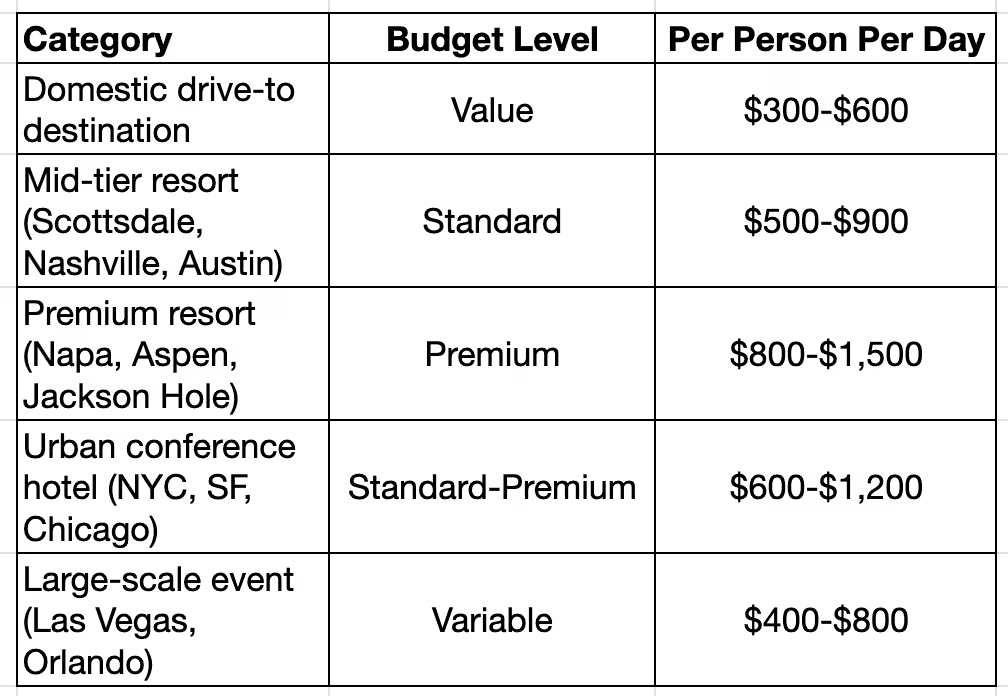
Key cost levers:
Accommodation typically accounts for 40–50% of retreat cost. Room block negotiation consistently produces 15–25% discounts from rack rates.
Food and beverage is the most variable line item. For groups over 50, negotiate a per-person F&B minimum rather than purchasing individual meals.
Team building and programming typically represents 10–20% of retreat budget — but it is the highest-leverage spend. The facilitated programming produces the outcomes; the accommodation and location are the environment. Cutting facilitation budget is the most common retreat ROI mistake.
For specific pricing on Full Tilt's retreat team building programs, contact us for a transparent, itemized proposal after a brief discovery conversation.
Full Tilt Teams: Retreat Team Building Across the US
Full Tilt Teams designs and facilitates corporate retreat team building programs across every major US retreat destination — from Napa Valley to Nashville, Scottsdale to the Berkshires, Lake Tahoe to Orlando.
Our retreat programs are designed around your specific retreat goal, team composition, and location environment — not a standard template. We facilitate outdoor challenge programs using the location's natural assets, city scavenger hunts through destination neighborhoods, charitable programs connected to local nonprofits, and leadership development workshops that use the retreat's separation from routine to produce genuine behavioral change.
Every program includes professional facilitation and a structured debrief connecting the team experience to the retreat's strategic objectives.
Talk to us about your corporate retreat →
View our programs:Outdoor programs | Indoor programs | Charitable programs | Large group programs
Frequently Asked Questions
What are the best corporate retreat locations in the US?
The best corporate retreat location depends on team size, primary goal, geographic base, and budget. For leadership retreats of 10–30 people: Napa Valley, Jackson Hole, Big Sur, Sedona. For mid-size team retreats of 30–100: Lake Tahoe, Scottsdale, Nashville, Charleston, Austin. For large-scale company events of 100+: Las Vegas, Orlando, Scottsdale, Nashville, Chicago, Miami. For Northeast companies: Hudson Valley, Berkshires, Cape Cod. For West Coast companies: Lake Tahoe, Palm Springs, San Diego.
How do you choose a corporate retreat location?
Answer four questions before looking at any destination: What is the retreat's primary goal? Who is coming and how many? What is the realistic per-person budget? When are you traveling? The answers determine the location type — urban, mountain, coastal, wine country — and the specific destination within that type. Only then evaluate specific venues against the criteria those four answers define.
What is the most popular corporate retreat location in the US?
Scottsdale/Phoenix, Nashville, and Las Vegas consistently rank as the three most popular corporate retreat destinations based on group booking volume. Scottsdale leads for winter retreats (outstanding weather January–May, excellent resort infrastructure), Nashville leads for culture-focused retreats (music, food, value), and Las Vegas leads for large-scale events (unmatched logistics and pricing flexibility).
How far in advance should you book a corporate retreat?
Book 4–6 months in advance for peak-season retreats at popular destinations (Scottsdale in January–April, Lake Tahoe in July–August, Nashville in April–May). Book 2–3 months in advance for shoulder-season retreats at mid-tier destinations. Venues with significant group accommodation require earlier commitment to secure room blocks at negotiated rates.
How much does a corporate retreat cost per person?
US corporate retreat costs range from $300 to $1,500+ per person per day depending on destination, accommodation quality, season, and programming. Mid-tier resort destinations with standard programming typically run $500–$900 per person per day all-inclusive. Premium destinations run $800–$1,500. Large-scale events in Las Vegas or Orlando with negotiated room blocks can run $400–$800 per person per day.
What team building activities work best at a corporate retreat?
The most effective retreat team building combines the location's physical environment with professional facilitation and a structured debrief connecting to the retreat's strategic objectives. Outdoor challenge programs using the retreat location's landscape, city scavenger hunts through the destination's neighborhoods, charitable programs connected to local nonprofits, and behavioral assessment workshops (DISC, MBTI, Enneagram) are consistently the highest-rated formats for corporate retreat groups.
Should corporate retreats include team building?
Yes — always. The most common retreat planning mistake is treating team building as optional. A corporate retreat without structured team building produces significantly lower outcomes than one that does, because unstructured social time does not reliably create the cross-functional relationships and psychological safety that structured programs produce. Structured experience with facilitated reflection produces behavioral change; unstructured social time produces pleasant memory.
What is the best season for a corporate retreat in the US?
Every US region has optimal retreat seasons. Scottsdale and Phoenix: January–May. Nashville and Southeast: April–June and September–November. Lake Tahoe and Colorado mountain towns: June–August (summer) and December–March (ski season). New York and Northeast: May–June and September–October. Las Vegas and Orlando: March–May and September–November. The universal principle: avoid the peak summer heat destinations (Scottsdale, Las Vegas, Miami) in July–August and the mountain destinations in their shoulder mud seasons (April–May, October–November).
Full Tilt Teams facilitates corporate retreat team building across every major US retreat destination for groups of 12 to 2,000+. Start planning your retreat →