

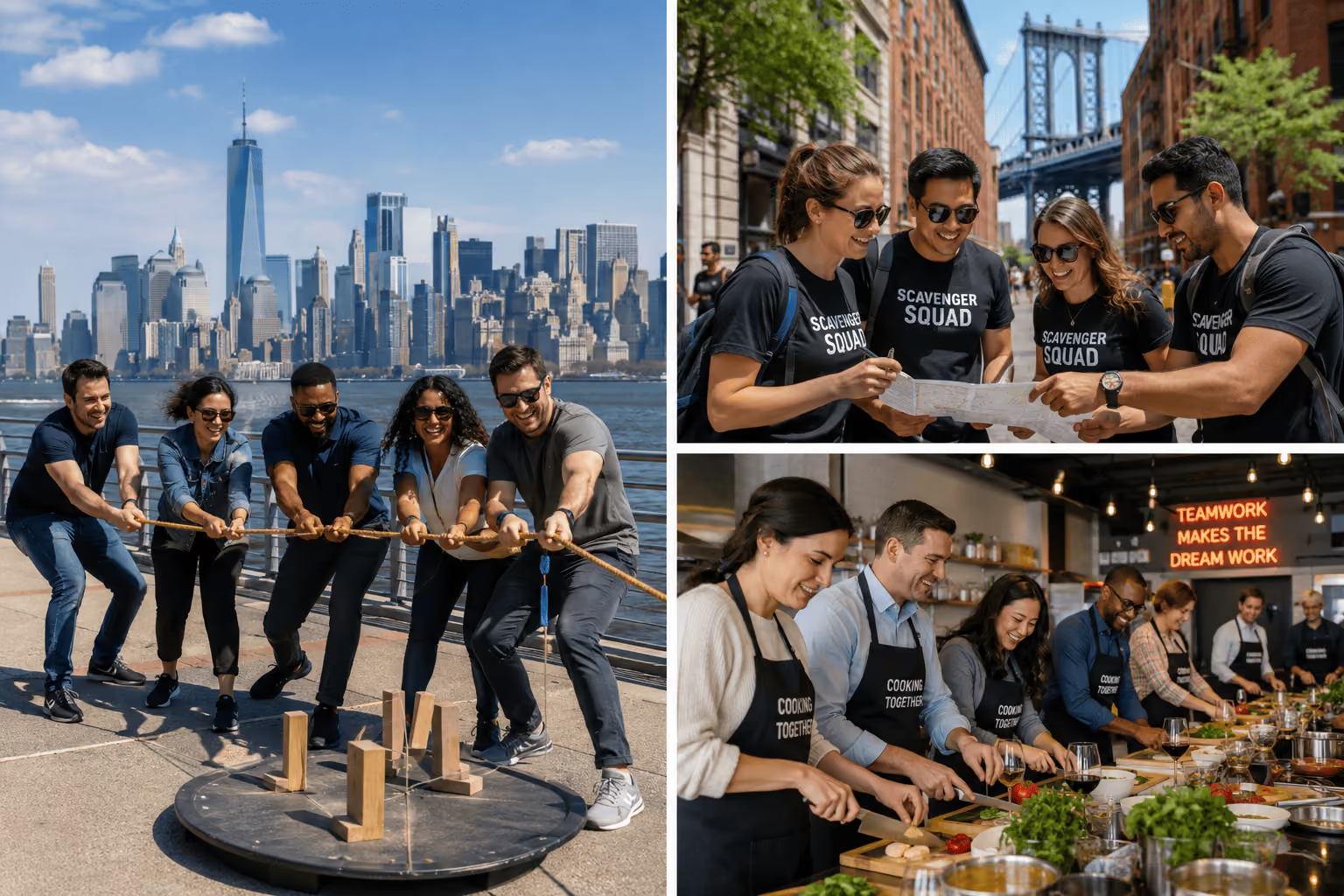
Compare New York City team building activities by purpose, participant needs and the actual location. This guide covers outdoor routes, indoor builds, creative tasks, charitable formats and workshops, with neighborhood and delivery questions for the organizer. A named venue or landmark is a starting point for enquiry, not an approved program site or FullTilt partnership.
Why New York City Demands a Different Kind of Team Building
Start with the actual audience and what colleagues should do together. A conference group, established workgroup and colleagues meeting across boroughs may need different formats. Describe the purpose, attendance, agenda window and venue status rather than inferring preferences from an employer’s industry or neighborhood.

A format should earn its place through fit with the group and purpose. Some gatherings are recreational celebrations; others provide structured practice or reflection. Neither should be judged against a blanket claim that New York employees reject familiar activities or require the same level of competition.
Ask how the provider introduces the task, supports different roles and closes the session. A shared activity can supply practice and discussion, while managers remain responsible for everyday working conditions. No event design guarantees trust, productivity or lasting organizational change.
Compare a neighborhood route, waterfront plan and indoor venue against actual travel, participation and property requirements. Manhattan, Brooklyn and other boroughs provide different enquiry options, but a view or landmark does not establish permission to run organized tasks, place equipment or reserve space.
For colleagues meeting in person after remote or hybrid work, explain the purpose and how remote attendees will contribute. The return-to-office guide supplies broader context. This guide makes no current claim about specific employers’ office mandates.
Best Outdoor Team Building Activities in NYC
City Scavenger Hunt (Manhattan, Brooklyn, or Multi-Borough)
A city scavenger format can use photographs, location clues and shared tasks within a proposed area. Ask about the route, start and finish, scoring and how teams move. Include participation options for people who cannot complete every walking segment, and clarify what happens if a checkpoint becomes unavailable.
Choose the neighborhood using the actual attendee journey and activity requirements. A Midtown route may reduce transfers for one meeting, while a Brooklyn or Lower Manhattan location may fit another. Do not assign formats by stereotypes about finance, creative or technology employees, or assume age determines preferences.
Ask FullTilt what customization is included for the actual neighborhood and group. Confirm current route, permission and delivery assumptions rather than treating any location or attendance as approved. The corporate scavenger guide provides wider planning questions.
Possible fit: Cross-departmental connection, conference add-ons, new hire onboarding, any group wanting to use the city itself. Confirm actual attendance, agenda and delivery scope with the provider.
The Amazing Race NYC
An Amazing Race-style format uses tasks at checkpoints. Ask for the actual route, challenge requirements, transport and meeting points. Grand Central, Hudson Yards, the High Line or a bridge reference does not establish an approved activity stop or a feasible multi-borough itinerary.
Compare the proposed race format with the available agenda and group requirements. Ask how instructions, route movement, scoring and the close are handled. The program should be assessed for its actual course rather than a general description of Manhattan as walkable.
Possible fit: High-energy culture events, leadership offsites, annual celebrations. Confirm actual attendance, agenda and delivery scope with the provider.
Hudson River Park Outdoor Challenge
For a Hudson River Park proposal, identify the exact area, responsible operator and intended task. Confirm permissions, equipment, participant movement and usable space. A waterfront setting does not establish availability, activity approval or capacity for a particular group.
Ask about attendee travel and the whole agenda rather than assuming any office cluster can reach the site without transport. Confirm the proposed format and weather backup before advertising an outdoor location. No site relationship or reserved space is implied by this guide.
Ask FullTilt which current outdoor format it recommends for the confirmed site and why. Allocate permission, supervision, equipment and host responsibilities in the proposal, including the conditions for changing the plan.
Possible fit: Q2 and Q3 outdoor events, conference add-ons, large group formats. Confirm actual attendance, agenda and delivery scope with the provider.
Central Park Team Challenge
For a Central Park task, identify the actual activity area and operator requirements. The Great Lawn, Reservoir area, Ramble and Sheep Meadow should not be treated as interchangeable or automatically approved challenge spaces. Confirm the task, access and permission route before booking.
Possible fit: Spring and fall events, large group formats, creative industries. Confirm actual attendance, agenda and delivery scope with the provider.
Brooklyn Bridge and DUMBO Challenge
For a Brooklyn waterfront or DUMBO route, confirm the actual streets, park areas, checkpoints and responsible operators. Ask how participants move and what happens if a stop changes. A skyline backdrop does not establish availability, usable capacity or permission for an organized activity.
Possible fit: Creative, media, and tech companies; groups wanting a distinctive NYC experience. Confirm actual attendance, agenda and delivery scope with the provider.
Best Indoor Team Building Activities in NYC
Dragon Throne (Strategy and Negotiation)
Dragon Throne is a strategic challenge involving resource decisions and negotiation. Confirm the current task, room layout, materials and participant roles. It is not automatically suitable for every large conference room or for an employer simply because its work involves strategy.
Agree which decisions the facilitator will discuss and how those connect with the brief. Keep workplace comparisons as reflection prompts rather than proof of how colleagues perform in their jobs. Explore the Dragon Throne program for scope questions.
Possible fit: Finance, consulting, law, strategy-oriented organizations. Confirm actual attendance, agenda and delivery scope with the provider.
Domino Effect Challenge
The Domino Effect Challenge asks teams to build linked components that perform a shared task. Confirm materials, work surfaces, testing and the handoff between groups. The result can prompt discussion about dependencies without diagnosing individual ability or guaranteeing workplace improvement.
See Full Tilt's Domino Effect Challenge.
Possible fit: Technology, product, engineering, media organizations. Confirm actual attendance, agenda and delivery scope with the provider.
Junkyard Orchestra
Junkyard Orchestra is a creative format involving instruments and a shared performance. Confirm the actual materials, sound restrictions, usable space and participation roles. A musical task does not automatically fit every event venue or change workplace hierarchy.
See Full Tilt's Junkyard Orchestra.
Possible fit: Company culture events, media and entertainment organizations, year-end celebrations. Confirm actual attendance, agenda and delivery scope with the provider.
Lights Camera Action
Lights Camera Action is a short-video production format. Agree the actual process, equipment, support and agenda rather than a universal production window. Confirm consent, sharing and location restrictions before recording colleagues or other people. The task need not be chosen only for media employers.
Possible fit: Media, advertising, entertainment, creative industries. Confirm actual attendance, agenda and delivery scope with the provider.
DISC / Myers-Briggs / Enneagram Assessment Workshop
An assessment workshop needs a clear purpose and appropriate facilitation. Ask which instrument is proposed, what participants share, how information is handled and what the session can reasonably address. It should not be presented as diagnosis or a shortcut to resolving workplace tension.
Full Tilt offers DISC personality assessment, Myers-Briggs (MBTI), and Enneagram workshops for New York City corporate groups.
Possible fit: Leadership teams, cross-functional groups with recurring tension, newly formed teams. Confirm actual attendance, agenda and delivery scope with the provider.
Pit Stop Challenge
Pit Stop Challenge is a competitive coordination format. Ask about the actual task requirements, equipment, usable space and participation options. Do not assume the activity fits every indoor room or has no physical requirements; the provider should assess the actual group and venue.
See Full Tilt's Pit Stop Challenge.
Possible fit: Operations, logistics, financial services teams; high-energy culture events. Confirm actual attendance, agenda and delivery scope with the provider.
Maker Bootcamp
Maker Bootcamp is a shared build format involving physical materials and task constraints. Ask what participants construct, what is supplied and how testing and the close work. Compare it with the actual purpose rather than assuming a technology or product team is automatically the right audience.
See Full Tilt's Maker Bootcamp.
Possible fit: Technology, product, innovation-oriented companies. Confirm actual attendance, agenda and delivery scope with the provider.
Charity and CSR Team Building in New York City

For a charitable or CSR brief, confirm both the participant task and a receiving organization’s actual needs. Separate materials, assembly, checks, storage and handoff from event facilitation. Do not infer an employer’s commitments or reporting requirements from its industry or size.
Discuss these charitable formats with FullTilt, subject to current program scope and confirmed receiving arrangements. The charity buyer guide helps compare format and handoff responsibilities.
Bicycle Build Challenge. Confirm materials, assembly and equipment checks, receiving needs and delivery. No New York youth organization relationship or recipient presentation is automatic. Explore the program details with those questions in hand.
End Hunger Games. Confirm accepted items, packaging, storage and handoff before purchasing supplies. This guide does not establish a FullTilt relationship with Food Bank For New York City, City Harvest or any other named organization.
STEM Kit Building. Ask about kit contents, assembly instructions and receiving needs. Do not promise delivery to New York City public schools or imply a school partnership before those arrangements are confirmed.
Helping Hands. Confirm the current task, quality checks and receiving arrangements. Ask what evidence of handoff is available rather than assuming a local nonprofit relationship or documentation that satisfies ESG reporting requirements.
Backpack care-kit format. Confirm the current program name, contents, assembly instructions and receiving needs with FullTilt. A housing or community-support theme does not establish a particular recipient, accepted materials or handoff.
For an appreciation event, choose the charitable or recreational format against the group’s actual purpose. The employee appreciation guide provides wider ideas; a charitable task is not automatically the highest-impact choice.
For the broader CSR landscape in New York City, our dedicated NYC CSR programs guide covers the full range of corporate social responsibility programming available in New York.
Team Building by Neighborhood and Borough
Midtown Manhattan
For a Midtown Manhattan event, compare an activity in the main meeting room with a separate route or outdoor site. Confirm property access, participant flow and the whole agenda. A corporate office, hotel, Bryant Park and waterfront area involve different approval and setup questions.
Venue enquiry: Confirm the actual property, usable space, access, restrictions and current availability. No named venue relationship or booking is implied.
Plan corporate events in Midtown Manhattan around the actual room
For a Midtown office or hotel conference, compare keeping the task in the meeting room with moving participants to another floor, property or route. A short agenda window can be consumed by arrival, lifts, coat or bag arrangements and instructions before the activity begins. Ask the host and venue for the actual flow rather than treating nearby landmarks as a ready-made itinerary.
- Confirm the booked room, usable layout, circulation and permitted activity.
- Agree provider load-in, equipment delivery, storage and setup access with the venue.
- Identify who supplies work surfaces, power, sound and other required equipment.
- Show participant arrival, instructions, task, transitions, close and hard finish in the agenda.
- Allocate reset, removal, waste handling and the host contact for changes.
- Confirm permissions and third-party responsibilities for food, filming or any outdoor element.
For a separate Midtown route, identify the actual meeting points, property boundaries and participant travel. The NYC311 park-event permit page is relevant to a parks or beach enquiry; it is not blanket authority for a private hotel, office, privately managed waterfront or every public space. Ask the responsible operator which process applies.
Use the company selection guide to compare scope and the facilitator hiring checklist to assess delivery. For agenda handoffs, the conference planning guide and office planning guide provide related questions. For local delivery, share the actual Midtown property and brief through the NYC service page.
Lower Manhattan and Financial District
For Lower Manhattan or Financial District events, identify the actual room or route, arrival points and finish location. A historic building or waterfront reference is not approval for a checkpoint. Compare travel and participation requirements with the available agenda.
Venue enquiry: Confirm the actual property, usable space, access, restrictions and current availability. No named venue relationship or booking is implied.
Hudson Yards and West Side
For a Hudson Yards or West Side event, ask the responsible operator about the specific room, outdoor area or proposed route. Proximity to the waterfront does not automatically permit an outdoor format, and an observation venue should not be assumed to allow equipment or organized tasks.
Venue enquiry: Confirm the actual property, usable space, access, restrictions and current availability. No named venue relationship or booking is implied.
Flatiron, Chelsea, and SoHo
For Flatiron, Chelsea and SoHo enquiries, choose the actual property or route against the group and purpose. A loft, market, pier and public space can have different facilities and restrictions. Do not assume creative industries prefer a particular program or that a named area is available.
Venue enquiry: Confirm the actual property, usable space, access, restrictions and current availability. No named venue relationship or booking is implied.
Brooklyn (DUMBO, Williamsburg, Greenpoint)
For DUMBO, Williamsburg or Greenpoint, use actual attendee starting points and the specific meeting site. Confirm the route, park or private-property arrangements rather than assuming borough-based preferences or a guaranteed attendance benefit.
Venue enquiry: Confirm the actual property, usable space, access, restrictions and current availability. No named venue relationship or booking is implied.
Queens and the Bronx
For Queens, the Bronx or another borough, compare actual travel and site requirements with a Manhattan meeting. Ask which location and format fit the group. An outer-borough setting may be practical, but it does not automatically improve attendance or engagement.
For NJ-based teams bridging into New York, our New Jersey team building guide covers the full NJ corporate market including programs that bridge both states.
Team Building for Large Groups in NYC
For a large group, ask the venue and provider to assess actual attendance, usable layout, circulation, staffing and equipment. A convention property or hotel’s general capacity is not confirmation that the proposed team activity fits. Named sites are enquiries, not approved FullTilt program venues.
If your team building session sits inside a conference agenda, use our NYC conference planning and venue checklist to confirm usable space, setup and reset time, arrival flow and the hard finish time before selecting a format.
Ask FullTilt for a delivery design that explains how people participate, where they move and which host and venue tasks must be complete. Do not infer confirmed capacity or organizational impact from a general group-size range.
Route-based design. Confirm the proposed area, team starts, checkpoints, scoring and finish, including participation options and permissions. Compare the whole route agenda with an activity at the main venue.
Station-based design. Review usable room space, rotation, waiting, staffing, equipment and scoring. Ask which responsibilities belong to the provider, host and venue.
Conference add-on design. Confirm the actual audience, room access, setup and agenda handoff. A named convention venue or large headcount range does not establish that a provider can deliver any format at any scale.
Specify the actual agenda window and include arrival, instructions, transitions, activity and close. Ask what changes if the previous session overruns. Do not assume a standard ninety-minute program fits every room, audience or conference.
Industry-Specific Team Building for NYC Companies
Financial Services (Wall Street, Private Equity, Investment Banking)
For a financial-services group, describe the particular purpose and working relationships rather than assuming named employers share one culture. Compare task requirements and facilitation with the actual audience and agenda.
Questions for a financial-services brief can include participation, competition, information sharing and reflection. Ask why the proposed format fits rather than asserting a universal preference for winners, assessment tools or a particular competitive level.
A competitive or strategic format may provide shared decisions and visible scoring. Confirm the rules, participation roles and proposed close. Those features should fit the brief rather than be sold as a guarantee of engagement.
For an assessment workshop, confirm the actual instrument, purpose, delivery team and information-handling arrangements. Participation should not be treated as a diagnosis or a measure of job performance.
For an in-person gathering after hybrid work, describe actual attendance and remote participation needs. No current employer policy or five-day mandate is asserted here.
Technology (Hudson Yards, Flatiron, Remote-First Companies)
For a technology group, identify which colleagues already work together, which task would be useful and how remote attendees participate. Do not infer preferences from a company’s address, brand or sector.
Compare a city challenge, build, assessment workshop or charitable format against those answers. Ask what participants do and how the facilitator supports roles and closes the session. No format is established as best for every technology employer.
Media and Advertising (Hudson Square, Times Square, Soho)
For media and advertising colleagues, a creative production or musical task may be an option, but it should fit the actual group. Agree materials, sharing, recording and any intended audience before choosing the format.
A route may use cultural or architectural clues where the locations and tasks are approved. Ask which content is included rather than assuming a neighborhood or cultural reference ensures engagement.
Legal and Professional Services (Park Ave, Midtown)
For a legal or professional-services group, start with the available time, attendance and purpose. Avoid assuming participants are resistant, analytical or competitive because of their profession.
Compare a workshop, challenge or city task with the actual brief. Ask about participation, rules, preparation and the close. No professional category automatically establishes a preferred assessment tool or program.
Healthcare and Life Sciences (NYU Langone, Memorial Sloan Kettering, NYC area hospitals)
For a healthcare or life-sciences group, share actual scheduling, attendance and site-access requirements. Describe which relationships or tasks the gathering should address without inferring needs from the size or reputation of named institutions.
A recreational activity should not be prescribed as treatment for burnout or a repair for structural workplace problems. Leaders remain responsible for working conditions and follow-up. A session can provide an appropriate shared experience without promising psychological safety.
Startups (Brooklyn, Flatiron, Hudson Yards)
For a startup or smaller group, compare the activity with the actual attendance, budget and purpose. Ask how staffing, materials and room needs affect the scope. A company stage or headcount does not guarantee disproportionate impact or a preference for high-energy tasks.
For smaller teams, our best team building activities for small groups guide covers formats specifically designed for groups under 25.
Team Building for Remote and Hybrid NYC Teams
For a hybrid group, map where participants will join, how instructions are shared and how each person contributes. Test the actual audio, devices and proposed tools. Neither a digital platform nor physical proximity alone creates an equivalent experience.
Devices and audio. Agree whether people join individually or through a room system, then test the actual setup. Confirm support and access arrangements rather than requiring one universal device design.
Team assignments. Mixed-location roles may fit the purpose, but confirm how people exchange information and complete tasks. Being placed together does not by itself establish participation.
Response tools. Confirm the proposed platform, access and task flow. A whiteboard or polling tool can support an activity without guaranteeing simultaneous contribution or eliminating a participation gap.
For the full hybrid team building framework, our rebuilding team culture after remote work guide covers the specific design principles for NYC's complex hybrid organizations.
Corporate Retreats and Offsites Near New York City
For a regional offsite, identify the actual destination, property, starting points and journey. Do not use one fixed Midtown travel estimate for different sites or assume a retreat booking includes the activity, transport or outdoor permissions.
Hudson Valley. Compare the actual property, journey, facilities and outdoor operator arrangements. A regional landscape or hotel description does not establish availability or task approval.
Catskills. For a resort or retreat enquiry, confirm usable rooms, grounds, equipment and the weather backup. Include the whole attendee journey and avoid treating a regional travel estimate as a booking fact.
Long Island. Identify the actual venue and transfer requirements, along with the operator’s activity restrictions. A waterfront or estate setting is not permission for every task.
Connecticut and Westchester options. These are different location briefs, not one jurisdiction. Name the actual property and municipality and confirm site responsibilities and travel separately.
New Jersey. Compare actual attendee starting points and venue requirements with a New York plan. Use the New Jersey guide for regional context, subject to the actual site and delivery confirmation.
For the complete corporate retreat planning framework — venue selection, agenda design, team building integration, logistics — our company retreat planning guide covers every decision point.
How to Plan a Team Building Event in NYC
Step 1 — Define a specific goal
Set a realistic purpose and describe what participants should do together. A shared activity can provide practice, reflection or recreation. It should not be promised as a culture reset or a substitute for management decisions after organizational change.
Step 2 — Choose the neighborhood deliberately
Choose the neighborhood against the actual group, travel and task. A convenient room may fit one agenda while a separate route fits another. The price or distinctiveness of a location is not proof of organizational investment or a better event.
Step 3 — Assign teams deliberately
Discuss team assignments with the provider and host. Mixing functions may fit the purpose, but it is not a universal rule. Consider relationships, participation needs and the actual task rather than promising new connections from one assignment method.
Step 4 — Book early
Confirm actual provider and venue availability, permissions, preparation and booking terms for the date. Do not rely on a universal quarterly booking deadline or a claim that planning early guarantees a preferred format or facilitator.
Step 5 — Build in the debrief
Agree the close, disclosure boundaries and time needed for this purpose. Reflection can help people discuss their experience without guaranteeing a measurable business result. No universal number of minutes converts recreation into development.
For the full annual planning framework covering all four quarters, see our annual team building calendar guide.
When to Book: The NYC Corporate Events Calendar
January–February. Compare actual venue availability, weather and agenda. An indoor format may fit, but the room and group still need assessment; lower prices or competition are not guaranteed.
March–May. Check actual dates, availability and preparation deadlines. For an outdoor proposal, confirm permissions, current conditions and the indoor alternative rather than a fixed lead-time rule.
June–August. Review the exact site, group, conditions and travel. A summer booking does not establish outdoor suitability or an approved waterfront or park program.
September–November. Compare current proposals with the actual conference or company agenda. A season does not guarantee ideal weather, attendance, venue availability or retention.
December. Confirm the actual preparation, venue and provider deadlines for a year-end event. Do not assume a city-wide booking cutoff or that every venue is unavailable after a particular month.
Full Tilt Teams in New York City
Ask FullTilt to confirm delivery for the actual New York City or tristate location, date and group. A regional service description does not establish every venue, format or attendance level. Share the brief before requesting a recommendation.
Ask what discovery, preparation and customization are included, how the brief reaches the delivery team and which details need host or venue confirmation. The proposal should identify what is standard and what is adapted, rather than promise every program is entirely bespoke.
Get a quote for your New York City team building event
Explore more: NYC city page | Existing NYC corporate events guide | NYC CSR programs | All programs
Frequently Asked Questions
What are the best team building activities in New York City?
Compare city routes, indoor builds, creative tasks, charitable formats and workshops against the actual purpose, participants and venue. Ask why the proposed format fits and what facilitation is included. No category is established as universally superior for New York employers.
What team building activities work for large groups in NYC?
Ask the venue and provider to assess the actual attendance, layout, circulation, staffing and equipment. Compare the delivery design rather than assuming a named venue or a general range confirms capacity.
What team building activities work for financial services companies in NYC?
Start with the particular group and purpose. Compare rules, participant roles, facilitation and the close. A competitive challenge or assessment workshop should be recommended for fit, not a claimed universal industry preference or engagement result.
What team building activities work for NYC tech companies?
Describe the actual audience, working relationships and agenda. Compare a route, build, workshop or charitable task against those needs rather than assuming technology employees require one style or that it outperforms alternatives.
How much does team building cost in New York City?
Request a current itemized quote for the actual event. Confirm currency, taxes, staffing, materials, travel, venue, permissions and exclusions. Do not assume universal volume discounts, lower park costs or that a general per-person range is a FullTilt offer.
When is the best time of year for team building in NYC?
Choose against the actual site, date, current conditions and availability. Confirm the weather backup and real preparation deadlines. No month guarantees suitable outdoor conditions, better pricing, available venues or a business outcome.
What team building activities work for hybrid teams in New York City?
Agree how remote and in-room colleagues receive instructions, contribute and share results. Test the actual technology, audio and support responsibilities. A response tool, device choice or mixed-location assignment does not by itself guarantee equivalent participation.
Do you run team building in Brooklyn, Queens, and the outer boroughs?
Ask FullTilt to confirm the actual borough, venue, date and delivery scope. Brooklyn, Queens, the Bronx, Staten Island and tristate sites have different journeys and operator arrangements. A service-area description does not establish every location, task or group size is available.
Use the New York City service page to enquire about actual local delivery. Keep venue, participant arrangements, permissions and quote exclusions visible until confirmed.