

Choosing charity team building activities means considering two needs together: an experience your colleagues can take part in, and a contribution a receiving organization actually wants. Start with those needs before choosing the most photogenic build or the largest promised donation count.
For a corporate organizer, the useful questions are practical. Which format fits the room and group? Who confirms the donation specifications? What checks happen before items leave the event? Who arranges collection, delivery and the record of acceptance?
This guide compares nine charity team building options and the questions to ask before booking. For the wider organizational context, see the charity team building guide for HR leaders. To explore current programs, visit FullTilt's charity and CSR event options.

Choose the contribution before committing to the activity
A charitable element can involve goods, an agreed project or a separate financial contribution. Those are different arrangements. Clarify what the event produces, which organization is expected to receive it, and whether that organization has confirmed the proposed quantity, condition and timing.
A useful activity does not need to produce the highest item count. The receiving organization may prefer fewer items that match its current needs, or a different form of support altogether. Ask what would be genuinely useful before buying materials or announcing the beneficiary.
Also distinguish the participant experience from the donation itself. A team might enjoy designing a structure while the receiving organization needs undamaged, clearly labeled goods. The event plan should protect both objectives rather than assume one automatically delivers the other.
Nine charity team building activities to compare
The options below describe formats to discuss with the provider. They are not promises that a particular beneficiary, donation quantity or delivery arrangement is available for your date. Confirm the current program, venue requirements and charitable component in the written proposal.

1. Bicycle Build Challenge
In FullTilt's Bicycle Build Challenge, teams complete challenges to earn tools and components, then collaborate on a bicycle build. It gives participants a shared assembly task and makes coordination between different roles visible.
Shortlist this format when the group wants a hands-on build and the venue can accommodate work areas, materials and completed bicycles. Ask how people with different levels of confidence or dexterity can contribute, rather than assuming everyone needs to perform the same task.
Before booking, confirm the required bicycle specifications, who performs the final checks and what happens to any build that needs correction. Agree the receiving organization's acceptance and transport arrangements. Do not promise children will attend the event or that every completed assembly is immediately ready for use.

2. The Wheelchair Connection
The Wheelchair Connection is a collaborative wheelchair-building format. The buying decision requires attention to the receiving pathway as well as the event itself: equipment needs, acceptance, checking and onward handling should be established before materials are ordered.
Ask the provider to explain the participant tasks and the process that follows assembly. Who checks the equipment, what standards or instructions govern those checks, and who confirms it is appropriate for the intended distribution arrangement? Seek answers from the responsible qualified contacts rather than asking participants to judge suitability.
Do not present the session as a simulation of living with a disability or promise a medical outcome. The participant objective can be careful collaboration and shared responsibility. The donation objective depends on a confirmed, appropriate process beyond the activity room.

3. Mission Incredible and backpack care kits
FullTilt lists a Mission Incredible: Backpack Care Kit option. Discuss how the proposed challenges connect to collecting or assembling the agreed items, and which version of the program is being quoted.
This can be worth exploring when you want varied team tasks alongside a clear packing objective. Ask whether the activity is stationary, spread across a room or uses a wider route. That choice affects access, supervision, weather exposure and the time available for packing and checking.
Confirm the contents with the receiving organization before purchasing. Age suitability, packaging, product sizes and permitted items should come from its requirements. Make substitutions visible and approved; a kit that looks complete to the organizer may still be unsuitable for its intended use.

4. Charity Guitar Building
Charity Guitar Building combines designing, decorating and assembling guitars from kits. It offers different kinds of tasks, which may suit a group interested in both creative decisions and practical coordination.
Ask how the design choices affect the finished instrument. What materials may be used, what drying or finishing time is needed, and who checks the guitar before handoff? A tight agenda should not leave the organizer with incomplete work and an unplanned storage problem.
Confirm that the proposed receiving organization wants the instruments and can use or distribute them. Ask about accessories, maintenance and delivery needs where relevant. A school or music organization should not be named as a recipient merely because it seems like an obvious match.

5. End-Hunger Games
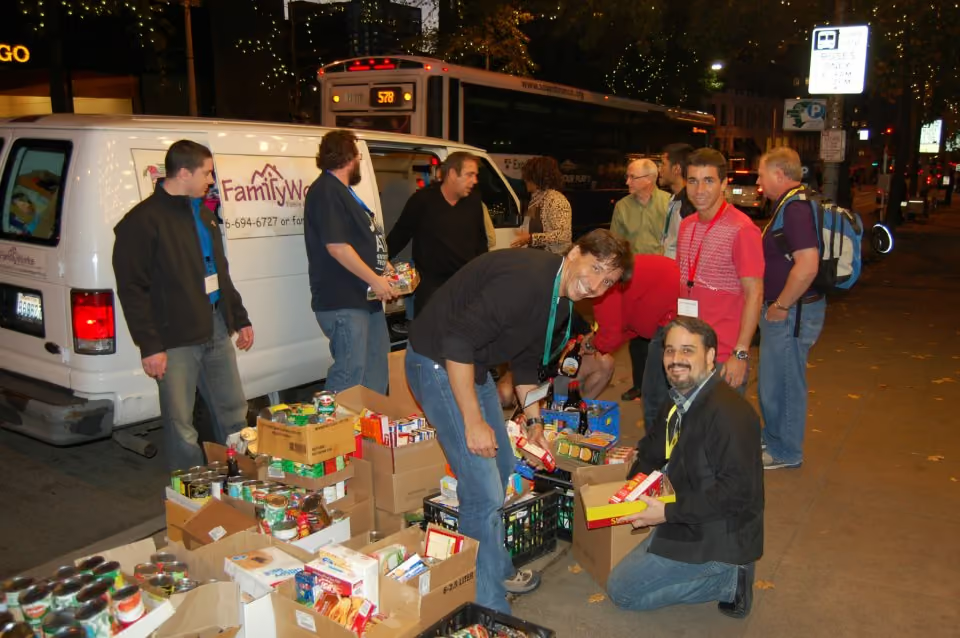
In End-Hunger Games, teams create structures using non-perishable food. It combines planning and building with a food-donation component that needs its own specifications and handling plan.
Ask the receiving food bank what items it currently accepts and how they must be packed. The shape or size of a container should not become more important than its usefulness. Plan the activity so labels and packaging remain intact and goods can be checked before collection.
Feeding America's food-donation guidance recommends contacting a local member and identifies labeling, packaging condition and expiration dates as important acceptance considerations. Follow the actual receiving organization's instructions; a general list does not establish that it can accept your particular donation.

6. Broken Bear
Broken Bear is one of FullTilt's listed charitable formats. Ask for a clear description of the current build or assembly tasks, the finished items and the proposed receiving route rather than relying on the name alone.
For a program involving toys or comfort items, the recipient's requirements should shape the materials and preparation. Confirm whether items must be new, how they are packaged and whether particular components or messages are acceptable. Do not assume a hospital, shelter or youth organization can accept any handmade item.
Consider how participants can contribute through preparation, checking, organization and presentation as well as assembly. Keep the event explanation respectful: the purpose is to complete an agreed contribution, not to turn another person's difficult circumstances into a motivational story.

7. Anything It Takes
Anything It Takes is FullTilt's custom charity team building option. It is a useful conversation when a cause or receiving organization's request comes first and a standard activity does not clearly fit.
Customization creates more decisions to resolve. Ask what is already established, what needs design work and which tasks require specialist skills, permission or oversight. A project that sounds simple in a planning call may depend on a site's access rules, materials or long-term maintenance.
Get the intended output and responsibilities in writing. Who approves the design, supplies materials, supervises the work, checks completion and accepts the result? Do not announce a construction, environmental or community project until the relevant organization and responsible contacts have confirmed the arrangement.

8. Mini Golf Masters
Mini Golf Masters uses non-perishable food in a course-building and playing format. It gives teams a design problem followed by a shared activity, while the food component requires a separate acceptance and packing plan.
Compare it with a structure-building event based on how your group wants to participate. Ask about the course footprint, movement between holes, floor protection and the handling of food packaging during play. A room large enough for tables may not offer a suitable circulation route.
Confirm how the provider separates, checks and packs donated goods afterward. Avoid promising a number of meals or people served unless the receiving organization supplies an appropriate, clearly explained basis for that statement.

9. Elevated Raceway with a confirmed charitable component
Elevated Raceway involves teams designing and building a track for remote-controlled cars. The racing format should be assessed on its own practical requirements; its materials do not automatically become a useful donation.
If you want to pair it with charitable giving, ask the provider to specify that component separately. What goods or funds are contributed, who supplies them, and who has agreed to receive them? Make sure the quoted event actually includes the arrangement you intend.
This distinction helps you choose honestly. A shared build followed by a separately organized donation may fit your group. Confirm the charitable component as carefully as the racing format, so the contribution is clear to the organizer and participants.

Match the format to your group, venue and schedule
Start with participation, not a headline capacity. Ask how the proposed format works at your expected headcount, how teams are organized and what each person can do. The same activity name can cover different room layouts and delivery plans.
Review the actual tasks with your provider and use the team building accessibility checklist to identify questions. Handling small components, reading labels, reaching across tables, moving between stations and hearing instructions may all require planning.
Venue fit includes the donation after the activity. Ask about loading access, room protection, storage and the route for removing completed items. A venue may be suitable for participants but difficult for a collection vehicle or bulky finished goods.
For local planning, review Atlanta team building options, Orlando events or Dallas programs, then confirm the specific location and date. A local service page does not establish which nonprofit is available or whether collection can happen on site.
Protect time for briefing, the activity, quality checks, packing and the close. Ask which elements can be shortened and which cannot. If the preceding conference session overruns, the answer should not be to skip the steps needed for an acceptable donation.
Confirm the receiving organization's fit and capacity
A cause that matters to employees is a good starting point, but it is not confirmation of need. Have a responsible contact agree the intended items or project, quantity, specifications and delivery window. Ask whether the organization has capacity to store, distribute or use the contribution.
Clarify who owns that conversation: your organization, FullTilt or another partner. If the receiving organization has not agreed yet, label it as proposed in internal plans and avoid announcing its participation publicly.
For U.S. organizations, the IRS Tax Exempt Organization Search provides information about status and filings. Use it as one factual check where relevant. It does not confirm that an organization wants your items, can attend the event or has approved a partnership.
Keep tax treatment separate from event selection. An event fee, donated goods and a financial contribution can involve different arrangements. Ask your organization's qualified tax or finance adviser what records are needed and whether any deduction is available; do not assume the entire booking is deductible.
Make donation logistics a clear part of the proposal
A good charitable-event proposal makes the contribution traceable from purchasing to acceptance. Use the event brief and provider request to ask for answers before approval, rather than adding donation logistics as a closing note.
Confirm these responsibilities:
- Who agrees the specifications with the receiving organization.
- Who buys or supplies goods, kits and packaging.
- Who supervises assembly and performs the required checks.
- Who corrects, replaces or retains items that cannot be accepted.
- Who packs, stores and transports the completed contribution.
- Who receives it, and when acceptance will be recorded.
- Who approves names, photographs and statements about the event.
Ask whether collection happens during the event or later. A receiving representative's attendance can add context, but it should be confirmed rather than used as an assumed finale. Do not make recipients' attendance, personal stories or photographs a condition of the contribution.
Keep a fallback for a delayed collection or changed receiving need. Establish who will store the goods and arrange a revised handoff. An alternative recipient should be checked and agreed, not selected at the last minute simply to clear the venue.
Compare the event cost and the contribution transparently
Ask the provider to distinguish facilitation and event delivery from goods, shipping, donation handling and optional additions. Confirm the total price, currency, taxes, payment schedule and headcount assumptions. A quoted per-person figure is not enough to establish what reaches the receiving organization.
If your company supplies the donation separately, keep that responsibility visible. If a contribution depends on activity scores, ask whether it changes the amount donated or only the game result. Make the agreed mechanism understandable to participants without implying that a weaker team performance deprives someone of support.
When comparing providers, use the company selection guide to evaluate equivalent scope. Use the facilitator hiring checklist to assess who will guide the group, support participation and handle changes.
Choose what you will report afterward
Separate the participant experience, the delivered contribution and any longer-term outcome. You can ask attendees about the session, record the goods accepted and describe the agreed activity. Those observations do not automatically establish improved retention, productivity or lasting community impact.
Use precise language: goods assembled are not necessarily goods accepted, and goods accepted are not necessarily goods already distributed. Confirm what the receiving organization is comfortable reporting. Do not convert item counts into meals, lives changed or financial value without an appropriate basis.
If the event produces a useful team insight, let participants explain it in the close. Managers can decide what to carry into work. Charitable giving and team learning can sit together without needing a promise that one afternoon transforms company culture.
A practical handoff example
Consider an illustrative food-based event in a hotel meeting room. Before approval, the organizer would want the receiving food bank to confirm the item list and delivery window. The provider's proposal would identify who supplies the goods, protects packaging during the activity, checks the final collection and provides suitable boxes.
The venue contact would confirm where packed goods can wait and how they leave the building. The organizer would know who keeps the acceptance record and who handles a delayed pickup. The closing remarks could describe what was prepared, with distribution reported later only when confirmed.
This is a planning example, not a FullTilt case study. The point is to close the gaps between an enjoyable activity and a completed contribution. Use the same sequence of questions for bikes, instruments or kits, replacing the food-specific checks with requirements from the responsible receiving and quality contacts.
Build a shortlist you can confidently book
Choose a small set of formats that fit the group and the receiving need, then compare the actual delivery plans. For example, a buyer with an indoor meeting room might compare a food-based build with care-kit preparation. The deciding factors would include accepted items, participation, space, checking and collection, not which name sounds more impressive.
Explore the charitable program collection and send FullTilt your event brief. Include the date, city, group, venue status, purpose and any proposed receiving organization. Ask for the recommended format and a confirmed donation plan before committing.
Frequently asked questions
What is the best charity team building activity?
The best fit combines a suitable participant experience with an accepted contribution. Compare the group's tasks, venue and time with the receiving organization's actual needs. A familiar format or large item count is not enough on its own.
Can we choose our own charity?
Ask the provider to confirm the arrangement with your proposed organization. Acceptance depends on its needs, specifications and capacity as well as the event plan. Keep the organization listed as proposed until it has agreed.
Will a charity representative attend?
That depends on the agreed arrangement and the organization's availability. Confirm attendance separately, and plan a respectful close that still works if collection or acknowledgment happens later.
Are charity team building events tax-deductible?
Do not assume the event fee or contribution is deductible. Ask your qualified adviser to review the actual arrangements, recipient and records. The IRS lookup supports factual checks; it is not a decision about your booking's tax treatment.