

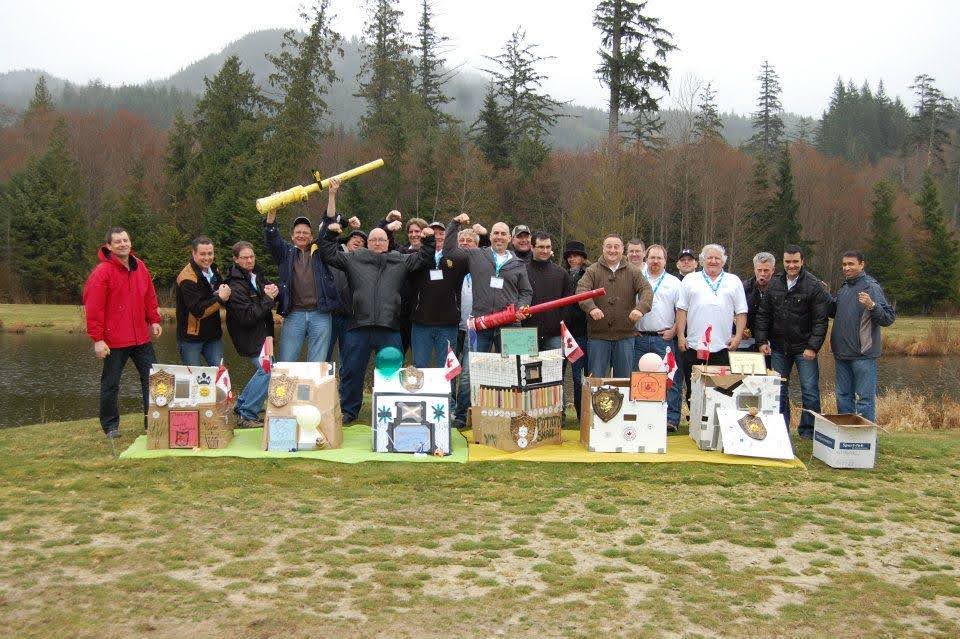
Everyone has sat through the corporate event nobody wanted: the ballroom, the rubber chicken, the speeches that ran long, the colleagues checking phones under the table. It costs real money, consumes a rare evening or afternoon together, and changes nothing.
Then there's the other kind — the event people bring up months later. The boat that almost sank. The 300-person field day. The afternoon your team built forty bikes for kids who needed them. Same budget category, completely different return.
The difference is never luck. It's choosing the right format for a clear goal, planning it properly, and giving people something to do together rather than something to sit through. This guide covers 40+ corporate event ideas organized by goal, how to choose between them, what they cost, and how to run one without the logistics becoming your second job. If you'd rather hand the whole thing to a team that does this daily, our corporate event planning service designs and delivers events end to end.
Why corporate events matter more in 2026
The case for gathering people has never been stronger — because connection has never been scarcer. U.S. employee engagement sits at roughly 31%, an 11-year low (Gallup, State of the Global Workplace 2026), and Gallup estimates disengagement costs U.S. employers around $2 trillion a year in lost productivity.
Meanwhile, hybrid work has quietly thinned the everyday interactions that used to build teams for free. Many colleagues now meet in person a handful of times a year — which means each corporate event carries far more weight than it did in 2019. It may be the only moment your whole team shares a physical experience.
That's why the format matters so much. A passive event (sit, eat, listen) spends the rare in-person moment without building anything. An active, shared experience compresses months of relationship-building into an afternoon — and engaged, connected teams are linked to 23% higher profitability and meaningfully lower turnover. The event isn't the perk; it's the mechanism.
The six types of corporate events (and what each is for)
Almost every corporate event falls into one of six buckets. Naming yours first makes every other decision easier.
1. Team building events
Structured, facilitated experiences whose explicit goal is connection, communication, or collaboration — from a two-hour Minute to Win It session to a company-wide field day. Browse the full catalog on our team building events page.
2. Celebrations and parties
Holiday parties, milestone celebrations, awards nights, summer picnics. The goal is morale and recognition — but the best ones still include a shared activity, because "party plus experience" beats "party" every time.
3. Offsites and retreats
Strategy and alignment sessions held away from the office, usually mixing working blocks with connection time. See our complete retreat planning guide and leadership retreat ideas.
4. Charity and CSR events
Events where the output is donated — bikes built, meals packed, care kits assembled. The strongest format for meaning and the one people talk about longest. Explore charity team building programs.
5. Conferences, kickoffs, and all-hands
Content-led gatherings — sales kickoffs, annual meetings, department summits. These succeed or fail on energy management: the shared experience you build around the content is what people remember.
6. Client and hospitality events
Events for customers and partners. Different audience, same rule: an experience people participate in outperforms a reception they attend.
How to choose the right corporate event
Four questions, answered in order, get you to a shortlist in ten minutes.
What's the business goal?
Connection and morale point to team building or a celebration-plus-activity. Alignment points to an offsite. Purpose and employer brand point to charity. Recognition points to an awards format. If you can't name the goal, you're not ready to book a venue.
How many people, really?
Headcount is the biggest practical filter. Under 30, almost anything works. From 50 up, you need formats that run in parallel so nobody stands around watching — our large-groups guide covers this in depth.
What's the setting?
Office, venue, outdoors, or distributed? Outdoor formats bring the most energy (see the outdoor team building guide); indoor formats remove weather risk; virtual formats include remote teammates. Your venue decision and event decision should be made together — more in our companion guide to choosing a corporate event venue.
What's the budget per person?
Corporate events are best budgeted per head. Set the band early — it filters the options honestly and prevents the classic mistake of overspending on the venue and underspending on the experience.
Corporate team building event ideas
The highest-return category, because connection is the thing most teams are shortest on. Every idea below is fully facilitated by FullTilt — equipment, staff, and structure included.
Celebration & company party ideas
Celebrations earn their budget when they include something to do, not just something to attend. Pair any of these with a short facilitated activity and the energy doubles.
Charity & CSR corporate event ideas
If you want the event people mention in exit-interview "what I'll miss" answers, make it a giving event. The mechanics are identical to team building — sub-teams, a challenge, a clock — but the output goes to a local cause, and the size of your group becomes the size of your impact.
For the full picture — including how to choose a provider — see our guide to charity & CSR team building companies and our top charity activities.
Offsite & retreat event ideas
Offsites blend work and connection — and the mix is the craft. The strategy blocks give the offsite its purpose; the shared experience gives it its memory.
Seasonal corporate event ideas
The calendar hands you four natural excuses a year — use them.
Virtual & hybrid corporate event ideas
Distributed teams still need shared experiences — the rule is participation, not spectating.
Corporate event ideas for large groups (100–500+)
Big groups break most event formats — 200 people can't share one escape room. What scales is anything that runs in parallel: field-day olympics, city-wide races, charity builds with dozens of simultaneous build stations, and station-based game tournaments. The planning discipline (space, check-in flow, facilitator density) matters as much as the pick — our large-groups guide covers it end to end, and our large-group programs are built for exactly this.
How to plan a corporate event (step by step)
- Name the goal and the metric. "Reconnect the team after the reorg, measured by a before/after pulse" beats "have a summer event."
- Lock headcount, date, and budget-per-person. These three constraints do most of the filtering for you.
- Choose the format before the venue. The event drives the space requirements, not the other way around — our venue guide shows how to match them.
- Book the experience provider early. Good facilitation teams book out weeks ahead, especially for fall and December dates.
- Plan the run-of-show with buffers. Arrival, activity, food, close — with 15-minute buffers between blocks and a confirmed weather backup for anything outdoors.
- Communicate like you mean it. A save-the-date, one logistics email, and a same-day reminder. Tell people what to wear and what to expect.
- Close with meaning and measure after. A short debrief or donation reveal, then the pulse survey within a week.
Our guide to organizing effective team building events goes deeper on each step.
Budgeting: what corporate events cost
Think per-person, and think in three buckets: the venue and food, the experience (activity, facilitation, equipment), and logistics (AV, travel, extras). The most common budgeting mistake is spending 80% on venue and catering and treating the experience as an afterthought — which is how you get a beautiful room full of people checking their phones.
Cost moves with four levers: group size (per-head rates usually improve at scale), format (build-based and charity events carry materials costs — for charity builds, that cost is the donation), location, and length. Rather than anchor on a generic number, get an all-in per-person quote for the experience with facilitation and backup plans included, then build venue and catering around it. Request one from us and we'll respond within 15 minutes — and if you're comparing providers, our notes on choosing team building companies will help you compare fairly.
Corporate event mistakes to avoid
- All sitting, no doing. The single biggest predictor of a forgettable event is a passive format.
- Choosing the venue before the event. You end up forcing an experience into a space that fights it.
- Ignoring the large-group math. An activity that's great for 20 strands 200. Parallel formats only, past 50 people.
- No weather backup. Outdoor events need a confirmed indoor alternative in writing.
- Mandatory "fun" with no inclusion plan. Mixed ages, abilities, and personalities need roles for everyone — and alcohol-centric events exclude more people than planners think.
- Skipping measurement. No pulse survey means no case for next year's budget.
How to measure whether it worked
Decide the metric before the event. The practical set: a two-question pulse (connection to colleagues, positivity about the company, 1–10) the week before and after; participation and dwell (did people stay past the minimum?); and the qualitative tell — is the event still coming up in Slack two weeks later? For a full framework, see measuring the ROI of team building.
The bottom line
A corporate event is a rare, expensive moment when your whole team is in one place — too valuable to spend on rubber chicken and speeches. Name the goal, pick an active format that fits your headcount, budget the experience before the venue, and measure the result.
And if you'd rather skip straight to the part where it's handled: tell us your goal, headcount, and date, and our event planning team will design, staff, and run the whole thing.