

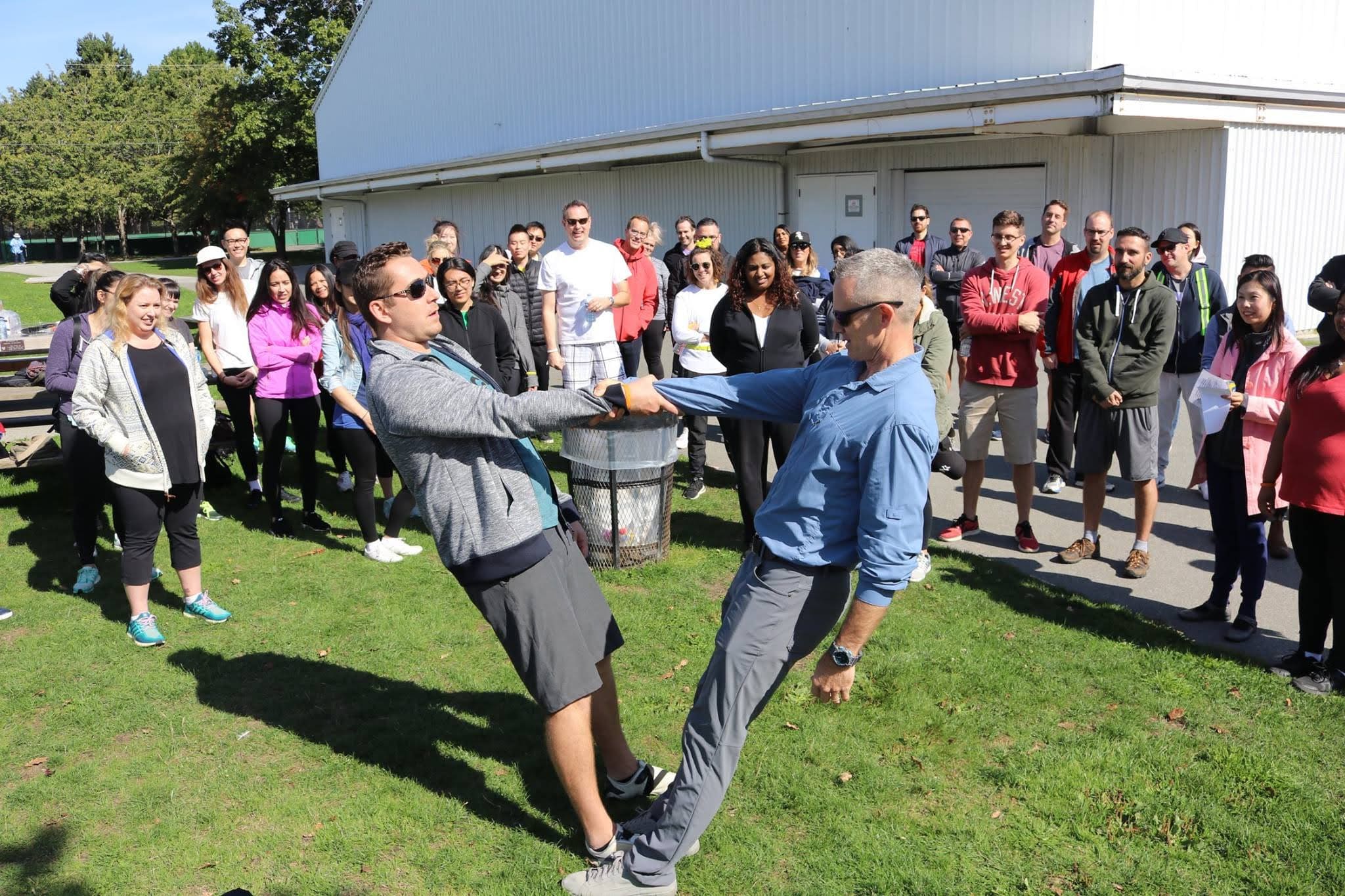
Somewhere between the third all-hands video call and the second reorganized seating chart, most teams quietly stop feeling like teams. People who have worked together for two years have never shared a meal, never solved a problem shoulder-to-shoulder, never had the kind of low-stakes, high-energy afternoon that turns colleagues into a unit. In 2026, that gap has a price — and getting people outside, together, is one of the fastest ways to close it.
This guide is written for the person who actually has to make it happen: the HR or people leader, the office manager, the EA planning the offsite. It covers what "outdoor team building for work" really means, which activities fit which teams, what they cost, the best time of year to run one, and how to pull it off without the logistics becoming a second job. Wherever it helps you decide, we've put the practical answer first. If you'd rather talk it through, our corporate event planning team can scope an event with you in one call.
Why outdoor team building matters more in 2026
The backdrop isn't subtle. U.S. employee engagement has fallen to roughly 31% — an 11-year low (Gallup, State of the Global Workplace 2026), and the global figure sits near 21%. Gallup puts the cost of that disengagement at around $2 trillion a year in lost productivity in the U.S. alone. The decline is sharpest among managers and under-35 employees - exactly the people whose connection to the team holds everything else together.
At the same time, return-to-office mandates have made in-person time scarcer and more contested, and a wave of AI adoption has left a lot of employees quietly anxious about where they stand. The result is teams that are physically back in a building but not actually re-formed as a group. Microsoft's 2026 work research found nearly half of employees describe their work as "chaotic and fragmented," and fewer than one in three feel genuinely connected to their company's mission.
An outdoor team building event is not a cure for a broken culture. But it does something specific and measurable that a meeting cannot: it pulls people out of their roles and routines, gives them a shared goal that has nothing to do with their job titles, and creates a memory they'll reference for months. That's the mechanism behind the engagement numbers - and it's why "let's get everyone outside for an afternoon" has become a serious people strategy rather than a nice-to-have. For the deeper case, see our guide to how team building boosts employee engagement.
What counts as "outdoor team building for work"
Not every outdoor activity is team building, and not every team building activity belongs at work. The phrase, used precisely, means three things at once: it's outdoors (a field, park, beach, retreat ground, or city street), it's structured around a shared goal that requires collaboration rather than individual athletic ability, and it's appropriate for a professional group of mixed ages, fitness levels, and seniority.
That last filter rules a lot out. A brutal ropes course or a competitive sports tournament can divide a team as easily as unite it — the fittest dominate, the rest disengage. The activities that work for a work team share a different shape: everyone has a role, the challenge is mental as often as physical, and the outcome depends on coordination, not on who can run fastest. A cardboard boat only floats if the whole team designs it well. A field-day olympics keeps 200 people moving because it's built from many small stations, not one big race.
The best of them also leave something behind — a built object, a donated bike, a shared story — because tangible outcomes are what people remember and talk about long after the event ends. You can browse our full range on the team building events page, or see every outdoor option in the comparison table below.
Outdoor vs indoor team building: which is right for your team?
Outdoor isn't automatically the better choice — it's the better choice for specific situations. Use this quick logic before you commit:
Choose outdoor when…
You want maximum energy and novelty, you're moving a large group, the weather and season cooperate, and you have access to open space — a field, park, beach, or retreat ground. Outdoor events are also the strongest argument for in-person time, which matters if you're bringing a hybrid team together.
Choose indoor when…
Weather is unreliable, your group has mixed mobility needs that an open field complicates, or your venue is a hotel or conference center with no usable grounds. Plenty of high-impact activities run beautifully indoors — see our roundup of the best indoor team building events to plan. The good news: most FullTilt activities have a confirmed indoor backup, so you don't have to gamble the whole day on a forecast.
If you're still weighing options, our broader list of the best outdoor team building activities is a useful companion to this guide.
The real benefits (beyond "morale")
"It boosts morale" is true but lazy. Here's what outdoor team building actually does for a work team, and why each one matters to the business.
It rebuilds connection that remote and hybrid work erode
Trust is built through shared experience, and screens are terrible at producing it. An afternoon of solving something together outdoors compresses months of incidental bonding into a few hours. Teams that feel connected communicate faster, escalate problems sooner, and cover for each other — the quiet behaviors that make work actually function. We go deeper on this in building team cohesion that lasts.
It surfaces strengths that job titles hide
The quiet analyst who turns out to be a natural strategist; the junior hire who organizes 40 people without being asked. Outdoor challenges put people in unfamiliar roles, and managers consistently say they learn something about their team in two hours that they hadn't seen in two years of meetings.
It makes return-to-office worth the commute
If you're asking people to come in, give them a reason that couldn't happen on a video call. A shared outdoor event is the strongest possible argument for in-person time — it's the thing that's genuinely better in person. If RTO is your context, our return-to-office team building guide pairs well with this one.
It improves retention
People stay where they feel they belong. Connection built outside the daily grind is a measurable factor in whether someone renews their commitment to a team — see team building employee retention strategies for the mechanics.
It creates a shared story
Months later, people still reference the boat that sank, the race they nearly won, the bikes they built for kids who needed them. That shared story is social glue, and it's the part of an event that keeps paying off long after the day is over.
How to choose the right outdoor activity
Skip the "31 ideas" overwhelm. Five decisions, in order, get you to the right activity faster than any list.
1. Start with group size
This is the single biggest filter. Under ~30 people, almost anything works. Between 30 and 100, choose activities that split cleanly into sub-teams of 6–10. Over 100, prioritize parallel-station or heat-based formats (olympics, races, charity builds) that keep everyone active at once. If you're at the big end, our large-group team building page is built for exactly that.
2. Match the setting to your venue
A flat field or park suits olympics and races. A boat build needs water access — a pool, lake, or calm shoreline. A downtown location is perfect for a city-wide race. Be honest about what you actually have access to before you fall in love with an activity.
3. Lead with the outcome you want
Pure energy and morale? Go competitive. Collaboration and problem-solving? Go build-based. Meaning and CSR impact? Go charity. Leadership development? Look at leadership team building activities. The activity is a means to an outcome — name the outcome first.
4. Set a realistic budget and headcount band
Outdoor pricing is per-person and moves with the activity and group size. Know your rough band before you shortlist, so you're comparing like with like. (We break down costs in the cost section below.)
5. Plan for season, weather, and accessibility
The forecast shouldn't be able to cancel your event — choose activities with a confirmed indoor backup, and lock it in when you book. Equally, confirm every activity has a role for mixed mobility and fitness, so nobody sits out.
The best outdoor activities for work, by goal
The table shows the specs; here's the judgment behind them — which activity to reach for depending on what you're actually trying to achieve.
Best for large groups (50–500+)
When you're moving a whole department or company outside, scalability is everything. Beach Olympics and The Amazing Race run in parallel heats so 500 people stay engaged at once, and charity builds like the Bicycle Build Challenge turn a big headcount into a bigger donation — scale becomes the point rather than the problem. More options in our large-group activities guide.
Best for half-day retreats and offsites
Short on agenda time? The Cardboard Boat Build and Spuds of Thunder deliver a full arc — design, build, compete — inside 2–3 hours, leaving the rest of your offsite for strategy.
Best for problem-solving and engineering teams
Build challenges with a real constraint mirror how your team ships under pressure: the Cardboard Boat Build, Elevated Raceway, and Spuds of Thunder all force a team to plan, build, and deliver a working result against the clock.
Best for purpose-driven teams (charity / CSR)
If you want the event people talk about for weeks, end it with a donation. The Bicycle Build Challenge, End-Hunger Games, and Helping Hands end with a tangible give to a local cause — the shared meaning that lifts engagement most.
Best for smaller teams
Under 15 people, you have the most freedom — almost any activity works, and intimacy is an asset. If that's you, our small-group activities guide has tailored picks.
Outdoor team building for large work groups
Large groups are where generic activity lists fall apart. A "fun outdoor game" that's perfect for 15 people becomes 200 people standing in a field waiting for a turn. Running a genuinely good event for a big group is a different discipline - it's about format and facilitator density, not about the activity being bigger.
What actually scales
The formats that work share two traits: they run in parallel (many small stations or simultaneous heats, so nobody waits), and they're staffed with enough facilitators to keep every sub-team moving. Beach Olympics is the archetype - a dozen stations running at once, teams rotating through, energy never dropping. Charity builds scale beautifully too: a 500-person Bicycle Build assembles a fleet of bikes for a local cause in a single afternoon, and the size of the group becomes the size of the impact.
What changes when you go big
The practical planning shifts: you'll want more space than you think, a clear check-in flow so 300 people aren't bottlenecked at the start, and a facilitator-to-participant ratio that holds up. This is exactly the kind of thing worth handing to a provider who runs events at this scale regularly rather than improvising internally - start with our large-group team building page.
Outdoor team building at a retreat or offsite
If you're building an offsite agenda, the outdoor block is usually the part people remember — so it's worth placing it deliberately. The most common mistake is scheduling the big physical activity at the very end of a long strategy day, when everyone's depleted. Put it mid-morning or early afternoon, when energy is high, and let the looser social time follow it.
For a half-day retreat, a single 2–3 hour activity with a clear arc (build, compete, debrief) is plenty. For a multi-day offsite, you can layer: a high-energy outdoor event on day one to break the ice, a quieter, more reflective activity later. The key is matching intensity to the moment — you're orchestrating a day, not just booking a game. Our ultimate guide to planning a company retreat walks through the full agenda, and leadership offsite vs team retreat helps you pick the right format.
Choosing a destination too? Our 2026 guide to the best corporate retreat locations in the U.S. pairs naturally with this — pick the place, then fill the agenda with the right outdoor activity.
Outdoor team building for remote & hybrid teams
For distributed teams, the outdoor day carries extra weight: it may be the only time all year the whole team is physically together. That makes it less of a "fun extra" and more of the anchor event of your in-person calendar. Treat it that way — build the rest of the gathering around it, not the other way round.
Two practical notes for hybrid teams. First, choose an activity that deliberately mixes people who normally work in different time zones or pods, so the connection crosses the lines that distance usually reinforces. Second, capture it — a few good photos and a short recap keep the energy alive for the people back in their home offices. If in-person cadence is your real challenge, continuous team building and our return-to-office activity playbook are worth a read alongside this.
Charity & CSR outdoor team building
If you want an outdoor event that doubles as a CSR moment, charity builds are the strongest format going. Teams compete and collaborate exactly as they would in any activity — but instead of a trophy, the output is something real that goes to a local cause: bikes for kids, food kits for a pantry, care packages for people in need.
The engagement effect is outsized because the activity has meaning baked in. People who'd be lukewarm about a field game lean in hard when the result helps someone. And it scales: the more people in the room, the bigger the donation. Start with the Bicycle Build Challenge, End-Hunger Games, or Helping Hands, browse the full charity & CSR team building range, or read our top charity team building activities.
The best season for outdoor team building
Outdoor doesn't mean summer-only, but season shapes the experience. Here's the honest read:
Spring & early summer
The sweet spot — mild weather, long daylight, high energy after winter. Book early; this is peak demand for outdoor events.
Late summer
Great, with one caveat: heat. Schedule for morning or late afternoon, provide shade and water, and keep high-exertion activities shorter. See our summer team building events and summer offsite ideas.
Autumn
Arguably the best season of all for a work event — comfortable temperatures, fewer scheduling conflicts than summer, and a natural "reset the team for Q4" narrative.
Winter
Outdoor is still on the table in milder regions, but this is when a strong indoor backup earns its keep. For cold-weather climates, see winter team building events - many outdoor activities move indoors without losing their punch.
Logistics & planning: what to handle (and what to hand off)
The difference between an event your team loves and one that quietly stresses you out is logistics. Here's the checklist, and the honest division of labor.
The planning checklist
- Equipment & setup — for build-based activities this is significant (materials, tools, staging). A good provider brings and sets up everything; your team arrives to a ready event.
- Facilitation — professional facilitators run the activity, hold the energy, manage timing, and scale staffing to your headcount. This is the single thing most worth outsourcing.
- Weather backup — confirm the indoor alternative in writing when you book. Most activities have one; don't leave it to the forecast.
- Venue — office grounds, a park, a retreat venue, or a city location. Check space, permits, parking, restrooms, and (for boat builds) water access early.
- Accessibility — confirm every activity has a role for mixed mobility and fitness levels, so nobody sits out.
- Timing — build in buffer for check-in and a short debrief; the debrief is where the lessons stick.
Who owns what
The realistic split: you own the people logistics (who's coming, when, where, dietary and accessibility needs), and a provider owns the activity logistics (equipment, facilitation, structure, backup). Trying to own both is how a "fun day" becomes a second job. Our guide to organizing effective team building events covers the full sequence, and our corporate event planner can take the activity side off your plate entirely.
Common mistakes to avoid
The events that fall flat usually share the same handful of errors. Sidestep these and you're most of the way to a good day.
- Choosing the activity before the outcome. "Let's do an escape room" is a solution looking for a problem. Name what you want to change first.
- Forcing hyper-physical activities on a mixed group. If a third of the team can't fully participate, you've split the team, not built it.
- No weather backup. The single most avoidable way to lose a day. Lock it in at booking.
- Scheduling the big activity when everyone's exhausted. Energy is a resource — spend it when people have it.
- Skipping the debrief. Ten minutes of "what did we notice about how we worked?" is what turns a fun afternoon into a lasting lesson.
- Treating it as a one-off. Connection decays. One great event a year beats zero, but a rhythm beats a one-off — see continuous team building.
What outdoor team building costs
Pricing in this space is almost always per-person, and it moves with three things: the activity (build-based events cost more than field games because of materials), the group size (per-person rates usually drop as the group grows), and the location (travel and venue affect the total). Charity builds carry the materials cost of the donated item — a bike, food kits — which is also what gives them their impact.
Rather than quote a number that won't match your situation, the honest guidance is: tell a provider your group size, location, and the outcome you want, and ask for an all-in per-person quote with the weather backup included. If you're comparing providers, our notes on choosing team building companies for corporate events are a useful filter.
How to measure whether it worked
Team building has an unfair reputation as unmeasurable. It isn't — you just have to decide what you're measuring before the event, not after. Three practical approaches:
- A two-question pulse, before and after. Ask the team how connected they feel to their colleagues and how positive they feel about the company, on a 1–10 scale, the week before and the week after. The shift is your most direct signal.
- Engagement-survey movement. If you run a regular engagement survey, watch the connection and belonging items in the cycle after the event.
- The qualitative tell. Are people still referencing the event in standups and Slack two weeks later? Sustained mentions are a strong sign it landed.
Tie it back to the business case: engaged teams are linked to 23% higher profitability and markedly lower turnover. Even a modest, durable lift in connection is cheap insurance against the cost of a disengaged team. For a full framework, see measuring the ROI of team building and how to measure what really matters.
Where we run outdoor team building events
FullTilt delivers outdoor events nationwide — at your office grounds, a local park, a retreat venue, or across a city. We run regularly in major hubs including Boston, Austin, Chicago, San Francisco, New York City, Denver, and dozens more. If you'd like a single point of contact to handle the activity, venue advice, and logistics, our corporate event planning service coordinates the whole thing.
The bottom line
Outdoor team building isn't a perk - in 2026 it's one of the most direct tools you have for rebuilding the connection that remote work, RTO friction, and constant change have worn down. Start with your group size, match the setting, lead with the outcome you want, pick a season that cooperates, and lock in a weather backup. Then hand the activity logistics to someone who runs these every week, so the only thing your team has to do is show up and remember why they like working together.