


In-person team building activities show up on company calendars every quarter. Teams gather, laugh through a few fun challenges, maybe build something together, and leave the room feeling re-energized. The proof of the “fun event” usually appear a few days later on LinkedIn or Instagram—smiling photos and celebratory captions.
Fast-forward two weeks, and nothing has changed. Marketing waits on engineering. Finance asks for another review. Decisions move to “next week”—then the week after that. Sound familiar?
The problem isn’t that team building is pointless. It’s that most of the usual activities never reflect how teams actually work when things get busy. HR often assumes that a bit of fun will magically lead to better results. They search for “fun team building ideas,” try them out, and then wonder why nothing really changes.
When deadlines close in and departments start tugging for the same resources, cracks appear quickly. Who owns what gets fuzzy. Decisions get hashed out on the fly. The real friction isn’t about culture; it’s built into the way things are set up.
That’s why some in-person team building activities create lasting improvement while others fade into pleasant memories.
The difference isn’t energy or creativity. It’s whether the experience reveals how teams actually work together—and forces them to practice better ways of doing it.
Once you see that distinction, the entire idea of team building changes.
Do Team Building Activities Actually Improve Productivity?
Team building can boost productivity, but not because of the icebreakers. When people actually practice working together—solving problems, sharing information, making decisions on the spot—they start to coordinate better. Those habits tend to follow them back to their desks.
Studies show team building works when it changes how people interact during tasks. Researchers found that team activities that get participants sharing information, coordinating roles, giving feedback, and solving problems together build familiarity and trust, helping teams communicate faster and collaborate more effectively back at work.
Why Most Team Building Activities Fail
Most team building activities create a short burst of energy. People step away from their desks, compete in a few challenges, and reconnect with colleagues. The atmosphere feels lighter, and for a day or two, communication across the team improves.
Then normal work resumes. The same meetings run long, decisions stall between departments, and projects move from one review to another.
The problem isn’t effort—it’s design.
The reason is that HR wants to give employees a break. Time to relax. Have fun together. But the activities don’t affect actual workplace behavior. Yes, teams might solve puzzles or complete games. But are they structured activities that mirror the communication pressures or decision dynamics they face at work? Rarely.
Because the challenges aren’t tied to real responsibilities, teams never practice the behaviors that actually affect performance. Ownership remains unclear. Information still travels through the same informal channels. The same people still control decisions.
There is also no mechanism for behavioral change. Participants experience the activity, enjoy the moment, and then return to the office without a clear way to apply what they learned.
Without follow-through, the experience fades into memory rather than shaping how teams work together.
Fun events build camaraderie.
Functional team building improves how teams communicate, collaborate, and make decisions every day.
The 4 Layers of High-Impact Team Building
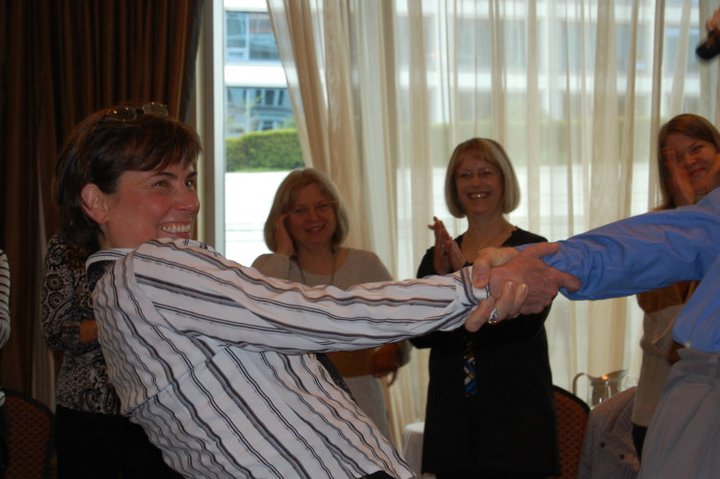
Not all team building activities are created equal. Some are like eating at a buffet—pleasant in the moment, but nothing changes afterward. A bit of team bonding, some relaxation, and an informal event. On the other hand, high-impact team building is closer to learning chef skills.
Instead of consuming the experience, teams practice the behaviors that drive real collaboration: speaking up, coordinating roles, making decisions, and following through on commitments. They practice behaviors that sharpen collaboration skills.
Effective programs strengthen four vital layers of teamwork.
Layer 1: Psychological Safety
Many teams appear collaborative in meetings, but without psychological safety, people hold back what they actually think. Maybe a developer spots a flaw in a plan but stays quiet. Or it could be that marketing sees a timeline risk but lets the meeting move forward.
Teams only work well together when everyone feels safe to speak up, without worrying about being judged.
Psychological safety grows when teams face challenges that require open communication and shared problem-solving.
In Survival X – Corporate Castaways, teams must coordinate survival tasks such as building shelter, gathering resources, and defending their territory. Progress depends on people speaking up, sharing ideas, and trusting each other’s judgment under pressure.
Discover how the Survival X team building activity can strengthen reliance on other team members, where speaking honestly stops feeling risky and starts feeling necessary.
Layer 2: Role & Ownership Clarity
Work slows, and projects stall when ownership is unclear. Here’s a typical scenario:
- Product thinks engineering will take the next step.
- Engineering assumes the product has already been approved.
- The decision drifts to another meeting.
Structured team building activities place participants in situations where individuals must take ownership of specific tasks.
Take the Elevated Raceway challenge: teams design and build a racetrack out of cardboard and whatever else is lying around. Progress depends on clear roles—someone leads the design, others build, others test. If someone takes ownership early, things move fast. If not, the whole thing grinds to a halt.
Include the Elevated Raceway challenge so team members can learn what it really means to take ownership and collaborate.
Layer 3: Decision Friction
Some teams spend more time discussing decisions than making them. Options are debated, revisited, and postponed as the deadline approaches. It seems like everyone is busy, but nothing is happening.
Structured team building challenges expose that friction quickly. Teams must evaluate information, agree on a direction, and act before time runs out.
In the Rocket Challenge, teams design and launch a bottle rocket that has to keep an egg safe on the way down. Every choice—structure, stability, parachute—needs a decision. Teams that hesitate lose time. Teams that decide and adjust quickly get their rocket off the ground.
Discover how the Rocket Challenge can help to improve decision-making processes during meetings.
Layer 4: Accountability Loops
Many team workshops end with enthusiasm but little change. Teams enjoyed the experience, but there is no mechanism to carry the insights back into daily work.
Accountability loops close that gap. Teams must reflect on what slowed them down, what worked, and what behaviors need to change moving forward.
The Clear and Productive Feedback module builds that habit right into the team building session. People practice giving honest, useful feedback, and just as importantly, learn how to take it. That way, teams can fix problems as they go, instead of repeating the same mistakes.
Incorporate the Clear and Productive Feedback module in your next in-person team building event to learn the principles of building a company culture based on constant improvement.
What Effective In-Person Team Building Looks Like

Many organizations invest in team building, expecting a boost in morale. But morale alone doesn’t improve how work gets done. Effective programs are built differently. They place teams in situations that mirror real business dynamics—coordination, pressure, conflicting priorities, and shared accountability.
At FullTilt Team Development, activities are designed to surface real team behaviors and translate those lessons back into everyday work. The goal isn’t entertainment. It’s measurable improvement in how teams communicate, decide, and execute together.
Real Business Simulations
High-impact activities copy what happens at work. Teams have to manage resources, juggle priorities, and get things done when the pressure’s on.
In Spuds of Thunder, teams build and defend strategic fortresses while forming alliances and negotiating resources with other groups. The challenge mirrors real organizational behavior—competing priorities, negotiation, and coordination across teams.
See how the Spuds of Thunder business simulation forces teams to negotiate resources, form alliances, and execute strategy under pressure.
Conflict Resolution Frameworks
Strong teams know how to manage friction productively. Differences in approach or timing are inevitable when multiple teams work together.
The Domino Effect Challenge makes those interdependencies visible. Each group builds a section of a larger chain reaction machine. If one part fails, the entire sequence collapses—forcing teams to communicate clearly, resolve issues quickly, and align their work with others.
Explore how the Domino Effect Challenge reveals how to resolve conflict and collaborate better so small coordination failures don’t cascade across a project.
Accountability Mapping Exercises
Teams often struggle because people misunderstand how colleagues think, communicate, or prioritize work. Those invisible differences slow collaboration.
The 360 Degree Behavior Matrix helps teams recognize communication styles and behavioral patterns across the group. Participants gain a clearer understanding of how colleagues approach work, helping teams assign responsibilities and collaborate more effectively.
Learn how the 360 Degree Behavior Matrix helps teams understand communication styles and assign responsibilities more effectively.
Communication Reset Workshops
Sometimes teams simply need to reset how they interact. Miscommunication builds gradually until small misunderstandings turn into persistent friction.
Communication-focused workshops help teams step back and examine how information moves within the group—who speaks, who listens, and where messages get lost. Once those patterns become visible, teams can rebuild communication habits that support faster collaboration.
Post-Session Implementation Plans
The strongest programs extend beyond the activity itself. Teams identify specific behaviors that improved performance during the session and translate them into workplace practices.
That final step turns a single event into lasting behavioral change. Instead of a temporary boost in energy, teams return to work with clearer roles, stronger communication habits, and a shared understanding of how to execute together.
Why Collaboration Problems Grow as Organizations Scale
In a start-up, resolving problems usually requires speaking to the person across the desk. As organizations grow, collaboration becomes increasingly important. Larger companies mean more teams appear, communication becomes fragmented, responsibilities shift, and decisions move through more layers.
What once worked through quick conversations now requires coordination among multiple groups. Without a clear collaboration architecture, small communication gaps begin to multiply.
Silos Form as Teams Specialize
As organizations scale, teams naturally optimize for their own goals. Marketing focuses on campaigns. Engineering focuses on product delivery. Operations focuses on efficiency.
Each team becomes better at its own work—but visibility across teams shrinks. Priorities drift apart, and collaboration slows as groups lose sight of the larger system.
Dependencies Multiply Across Teams
In smaller organizations, one team usually completes projects from start to finish. Organizational growth means that projects span multiple groups—sometimes across buildings or even countries. One team’s output becomes another team’s input.
This creates hidden dependencies. A small delay in one area quietly triggers downstream delays across the organization.
Decisions Travel Through More Layers
Growth in an organization inevitably introduces additional approval layers. Decisions that once happened in minutes now move through multiple stakeholders and meetings.
The result isn’t better alignment—it’s slower execution. Work pauses while teams wait for clarity.
Ownership Becomes Harder to See
As cross-functional projects expand, responsibility spreads across teams. Everyone contributes, but no one clearly owns the outcome.
The collaboration architecture post highlights that scaling organizations must deliberately design how teams coordinate work, not just what work they perform. Without that structure, collaboration problems are almost guaranteed to appear as companies grow.
When Team Building Isn’t Enough

Team building can help people work together, but sometimes the real problem is deeper. If the same issues keep coming back—conflict, slow progress, unclear ownership—it’s usually a structural problem. In those cases, leaders need to rethink how work flows between teams, not just how teams communicate with each other.
Repeated Conflict Between the Same Functions
When the same departments clash repeatedly, responsibilities are usually overlapping or competing. Marketing may promise timelines that engineering can’t meet, or the product department may change scope without operational input.
Solution: Map how work moves between teams, and make it clear where each team’s responsibilities start and end. Clear handoffs mean less conflict, because everyone knows what’s theirs.
Low Ownership
Projects stall when tasks drift between teams, and no one’s really in charge. Everyone helps, everyone’s busy, but no one owns the result.
Solution: Assign a single owner for every major deliverable. Supporting teams can contribute, but one person must be responsible for moving the work forward and resolving blockers.
Slow Decisions
Work slows down when decisions need sign-off from too many leaders. Teams end up waiting for direction instead of getting things done.
Solution: Decide up front who gets to make which decisions, and when things need to be escalated. Faster decisions mean teams can keep moving.
Leadership Misalignment
If senior leaders send mixed messages about priorities, teams get confused about what actually matters.
Solution: Get leaders on the same page before big projects start. When priorities are clear, teams can work together rather than fight for attention.
When these structural problems show up, team building on its own won’t fix them. Companies need to rethink how work moves between teams—making ownership, decisions, and collaboration clear so improvements actually last.
How to Measure ROI of Team Building
HR leaders don’t usually have trouble justifying team building. The hard part is showing it actually works. When programs are linked to real behaviors—like decision-making, communication, and accountability—the results are easier to measure.
Instead of just looking at satisfaction surveys, the real way to measure return on investment is to track actual changes in how teams work together.
Reduction in Meeting Time
Teams that work well together spend less time clearing up misunderstandings or going over the same topics again and again.
How to measure it: Track how many project meetings happen, and how long they last, before and after the session. If roles and communication improve, meetings usually get shorter or disappear altogether.
Faster Decision Cycles
Decision friction is one of the biggest hidden costs in any organization. When teams hesitate or escalate decisions too often, everything slows down.
How to measure it: Track how long it takes to make key decisions—from the first discussion to final approval. The best teams cut down the number of meetings needed to reach a decision.
Clearer Role Ownership
When people aren’t clear about responsibilities, it leads to delays, duplicated work, and gaps in accountability.
How to measure it: After the program, check project plans or workflow tools to see if every major deliverable has a clear owner. Fewer gaps mean stronger accountability.
Post-Session Action Implementation Rate
The real value of team building shows up after the session, when teams actually use what they learned in their daily work.
How to measure it: List the specific actions teams agreed to during the session—like process changes, new ways of communicating, or decision rules—and see how many are put in place over the next month or two.
When team building is linked to real, measurable changes like these, it stops being just an employee engagement and morale booster and becomes a real investment in performance.
How to Choose the Right In-Person Team Building Activities for Companies
Not every team building activity fits every organization. The right choice depends on the team’s structure, the outcome you want to achieve, and the time available. Leaders should start with the business objective first, then select activities that reinforce the behaviors they want teams to practice.
Choose Based on Team Size
Group size shapes how teams interact. Small teams benefit from deeper collaboration exercises, while large groups require activities that coordinate multiple teams working toward a shared outcome.
How to choose:
- Small groups (6–15 people): Choose activities that emphasize discussion, problem-solving, and communication.
- Mid-size teams (15–40 people): Look for challenges that require clear delegation and role ownership.
- Large groups (40+ people): Select multi-team simulations that involve coordination between groups as part of the challenge.
Explore team building examples for smaller teams in this guide.
Choose Based on Objective
Effective programs start with a clear objective. Teams may need to strengthen trust, improve decision-making, or resolve cross-functional friction.
How to choose:
- Collaboration improvement: Select activities requiring shared problem-solving.
- Leadership development: Use challenges that require delegation and decision-making.
- Cross-team alignment: Choose simulations where multiple groups depend on each other’s work.
- Communication reset: Look for activities that highlight how information flows between participants.
Choose Based on Time Available
Time constraints influence how deep the experience can go. Short sessions introduce new behaviors, while longer programs allow teams to practice and reflect on what they learn.
How to choose:
- 60–90 minutes: Focus on a single collaboration challenge.
- Half-day programs: Combine experiential challenges with structured reflection.
- Full-day sessions: Include multiple activities plus facilitated debriefs that connect lessons to real workplace dynamics.
High-Impact Corporate Team Building Workshops

Organizations often search for corporate team building workshops when collaboration problems start affecting performance. But not all workshops deliver measurable change. High-impact team development programs focus on specific business problems—communication breakdowns, unclear ownership, or decision friction—and place teams in structured situations where those behaviors can be observed and improved.
The examples below show how outcome-focused team building workshops address common organizational challenges and translate those insights into everyday work.
When Communication Breakdowns Are the Main Problem
Everyone thinks their team communicates well—until projects start crossing departments. Messages get diluted, instructions change, and teams begin working with different versions of the same plan.
The result is predictable: duplicated work, missed details, and frustration that spreads across functions.
In a FullTilt Scavenger Hunt, teams race through checkpoints, solve clues, gather information, and make decisions under time pressure. The fast pace means teams have to communicate, delegate, and listen as they work together—instead of staying in their own corners.
Outcome: Stronger cross-boundary communication and faster coordination between teams.
Book the Scavenger Hunt as an effective in-person team building event to reset communication habits and reconnect departments through hands-on collaboration.
When Ownership and Accountability Are Unclear
Work rarely fails because teams lack talent. It fails when everyone assumes someone else is responsible. Tasks drift between departments, deadlines slip, and decisions stall because no single person feels accountable for the outcome.
The Authentic Leadership Workshop places participants in repeated team challenges where leadership roles must emerge naturally. As responsibilities shift during the exercises, participants learn how ownership, delegation, and accountability influence execution under pressure.
Outcome: Clearer ownership, stronger leadership behaviors, and teams that step forward instead of waiting for direction.
Develop confident leaders and restore accountability through the Authentic Leadership workshop as part of an experiential team building program.
When Teams Struggle With Collaboration Under Pressure
Plans often unravel when deadlines get tight. Teams that communicate well in meetings suddenly start competing for resources, talking over each other, or rushing decisions. Pressure has a way of exposing gaps in coordination that would otherwise remain hidden.
In the Cardboard Boat Build Challenge, teams design and build a working boat from limited materials, then put it to the test on the water. Success depends on quick planning, smart delegation, and real-time collaboration as the clock ticks down.
Outcome: Stronger coordination, faster problem-solving, and teams that execute together under pressure.
Put collaboration to the test with the Cardboard Boat Build Challenge, an in-person team building event that boosts productivity and collaboration.
When Leadership Alignment Is the Issue
Teams lose momentum when leaders send mixed signals. One manager pushes for speed, another urges caution. Employees get conflicting directions, and progress slows as everyone waits for clarity.
The Mandala Leadership Challenge requires multiple groups to design and build interconnected sections of a larger visual structure. Leaders must align vision, coordinate decisions, and ensure every section contributes to the final outcome.
Outcome: Clearer leadership alignment and stronger cross-team direction.
Use the Mandala Leadership Challenge to help your leadership team get on the same page as part of a team building workshop.
Building Team Performance Through Experiential Team Development

Is it possible to make team building actually effective? That happens when structured activities replicate real work dynamics. We’re talking shared decisions, role ownership, time pressure, and accountability. Experiential team development places participants in real-world situations within a safe environment.
At FullTilt Team Development, the goal isn’t simply to organize “fun” activities. It’s to design the best in-person team building activities for companies that lead to stronger performance back at work.
The learning happens in three stages.
- First, teams face a practical challenge that requires coordination and problem-solving.
- Second, facilitators guide reflection on what helped—or slowed—the team.
- Third, those insights turn into real workplace habits—how meetings run, how decisions get made, and how teams coordinate across departments.
If you want better collaboration, faster decisions, and clearer ownership, don’t start by booking a fun event.
Start by figuring out what’s actually slowing your team down.
Skip the fun event. Instead, book a Team Effectiveness Strategy Call with FullTilt to get to the bottom of your team’s real collaboration challenges and design a program that actually improves how your teams work together.