

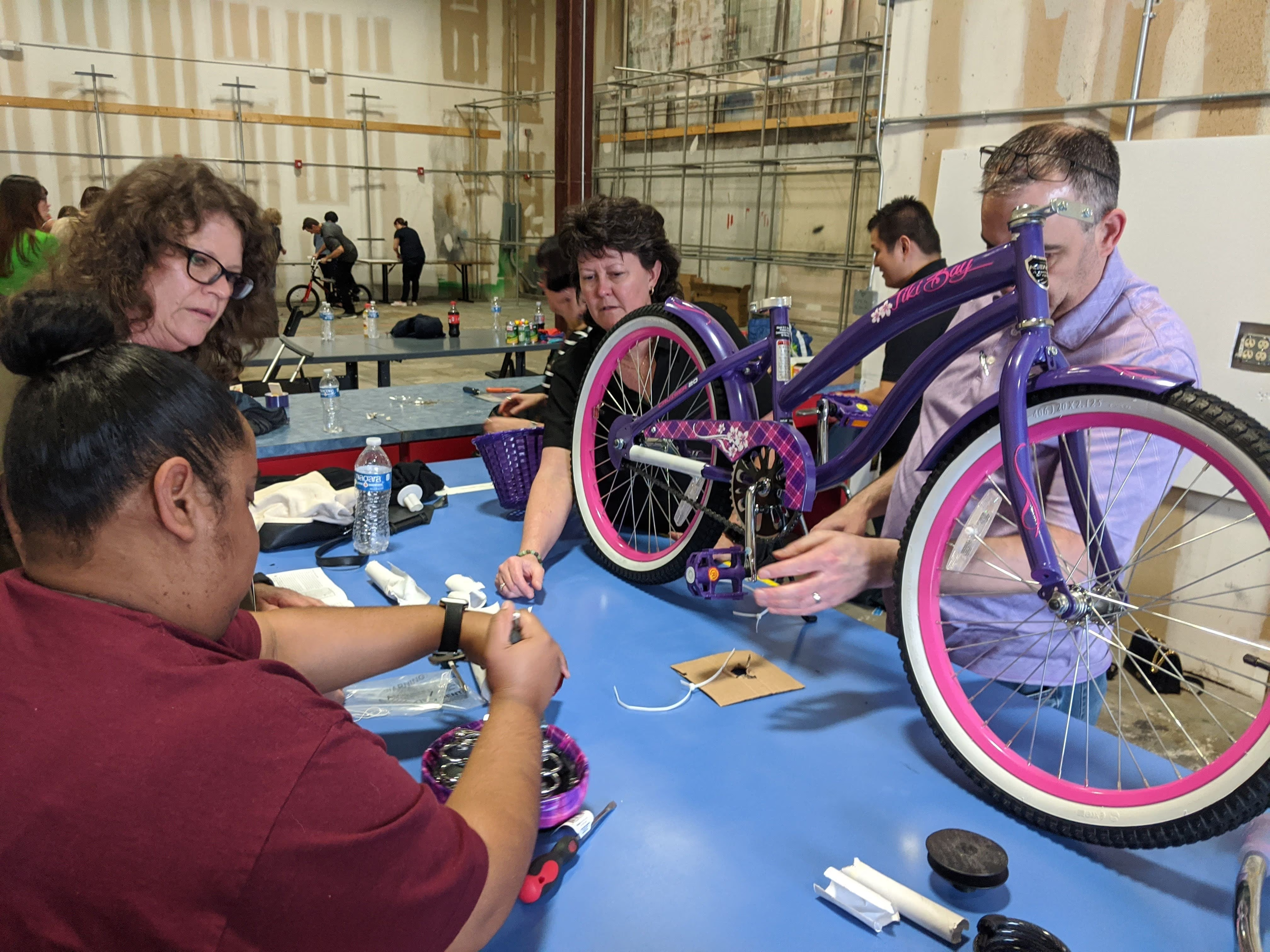
Ask people who run corporate events which format produces the strongest reaction they've ever seen in a room, and you'll keep hearing the same answer — and it isn't the biggest game show or the most spectacular finale. It's the moment at the end of a bike build when the doors open and the kids come in.
Until that moment, the event has been excellent in familiar ways: teams competing through challenges to earn parts, the comedy of executives reading assembly diagrams, the satisfying click of a build coming together, quality inspections performed with sudden, genuine seriousness — because somewhere mid-build every participant has quietly realized a child is going to ride this. Then the handover happens, and something no trust fall ever achieved occurs at scale: a room full of colleagues experiences, together, the unarguable fact that their afternoon mattered. People cry at bike builds. Executives cry at bike builds. And the photos from that hour do more for how employees feel about their company than most internal culture campaigns manage in a year.
This guide is the complete picture of the format — the psychology of why it works this hard, the run-of-show, the donation logistics most planners worry about unnecessarily, group sizes from 20 to 500, and where it fits in your calendar. (For the full landscape of giving-based formats beyond bikes, the master reference is the charity team building guide.)
Why this format outperforms everything else (the mechanics of the magic)
- Tangibility. The modern knowledge worker can go years without producing an object. The bike is an object — shiny, functional, unarguable — and the pride of physical completion lands on people who'd forgotten it existed. (It's the same force behind all build formats, from chain reactions to boat builds — here amplified by the next three properties.)
- Real stakes create real teamwork. Mid-event, the vibe shifts: the brakes get checked twice, the handlebar alignment becomes a debate, someone insists on a test of the training wheels. That shift — from playing a game to doing a job that matters — is the deepest team behavior an event can evoke, and it happens by itself.
- The handover. When recipient kids attend the finale (coordinated with the partner organization whenever possible), the event delivers something corporate life almost never provides: unmediated, visible impact. Nobody in that room needs a debrief slide to explain why the afternoon mattered. When recipients can't attend, the presentation to the organization's team carries real weight too — but if you can get the kids there, get the kids there.
- The identity dividend. Every event produces photos; this one produces evidence — of values employees actually watched their company enact. In an era where belonging drives retention (the research is stacked in the statistics library), "I was there when we built those bikes" is the sentence culture programs dream of installing.
How the event actually runs
The format's genius is that it's a competition wrapped around a build wrapped around a gift — here's the standard 2.5–3 hour arc of the FullTilt Bicycle Build Challenge:
- Briefing and team formation (15 min). Mixed-department teams of 4–8, engineered rosters, the mission revealed — often the charity reveal is held back as a mid-event surprise, which produces its own memorable moment.
- The challenge gauntlet (60–75 min). Teams compete through rounds of games and problem-solving to earn their bike parts, tools, and accessories. This is where the energy lives — the competition means teams arrive at the build phase already bonded, already loud, already invested in their machine. (No challenge success, no front wheel: the economy is motivating.)
- The build (45–60 min). Assembly with facilitator support at every station. No mechanical experience needed or expected — that's what crew oversight and final professional safety inspection are for. This phase is where the tone deepens: teams personalize their bikes, write cards to the recipients, and the quality obsession kicks in.
- Inspection and reveal (15 min). Every bike passes a professional safety check — participants love watching their work get certified — and the fleet lines up for the reveal photo that ends up everywhere.
- The handover (15–30 min). The organization's team — and whenever logistics allow, the kids themselves — receive the bikes. Bring tissues; we're not joking. A short facilitated close ties the experience to the team's own story: what you just did together, you do every day in smaller ways.
Logistics, sizes, and the questions planners actually ask
- Group size: 20 to 500+. The math is roughly one bike per team of 4–8; large events run multiple build zones with wave scheduling — a 300-person conference session producing a 40–60 bike fleet is a genuinely spectacular sight (large-scale mechanics: the large-groups guide).
- Space: any large room — your office's biggest space, a hotel ballroom, a parking structure, outdoors weather permitting. The office-delivered model works perfectly here; the crew brings everything and hauls away everything except the bikes, which leave the right way.
- The charity partnership: the piece planners worry about most and need to worry about least — a professional provider coordinates the recipient organization (local youth programs, Boys & Girls-type clubs, family services), the delivery-or-attendance logistics, and the compliance details. If your company has an existing nonprofit partner, events integrate with them; if not, we bring the relationship. Either way the giving is real, local, and documented.
- Budget: charity builds price in the premium tier because the materials are the donation — the bikes, helmets, and accessories your budget purchases become the goods that leave with the kids. Market context sits in the cost guide; the framing for finance is that this line does double duty as event and CSR spend, which is why CFOs approve it faster than either alone (the ROI template covers the double-count argument).
- Timing: year-round, with four power slots — the holiday season (the strongest December format there is, per the holiday party guide: run the build as Act One, celebrate as Act Two); conference agendas (the day-2 afternoon slot that transforms an SKO or summit — see conference team building); milestones (acquisitions, anniversaries, record quarters — moments that deserve more than cake); and CSR program anchors (the flagship event of a corporate social responsibility program).
The charity build family: when bikes aren't the fit
The bike build is the flagship, but the give-back architecture — compete, build, donate, hand over — powers a whole family of formats, each with its own best-fit scenario:
- Mission Incredible: Backpack & Care Kit Build — the highest-throughput option: hundreds of care kits for students or families in a single session, ideal for very large groups and back-to-school timing.
- End Hunger Games — competitive food-bank stocking; the fastest-deploying charity format and a favorite for last-minute giving pushes.
- Charity Guitar Building — instruments for school music programs; the arts-and-culture crowd's bike build.
- The Wheelchair Connection — the most emotionally profound variant, building mobility for recipients whose lives change on the spot.
- Helping Hands — prosthetic-hand assembly for a global recipient network; the format for teams who want their afternoon to cross borders.
Choosing between them usually comes down to cause resonance (kids? hunger? mobility? music?), group size, and season — a five-minute conversation in the planning call. And for companies that fall in love with the category, the natural evolution is a rotating annual giving anchor inside a recurring program: bikes in December, care kits in August, the food-bank games in spring — a calendar employees start looking forward to the way they once dreaded the trust falls.
The bottom line
Most team building asks people to pretend the stakes are real. The bike build doesn't have to ask — the stakes roll in on training wheels at the finale. If you want the event that produces the photo on the lobby wall, the story in the all-hands, and the afternoon your most cynical engineer describes as "actually incredible," this is the one. Competition for the energy, the build for the bond, the handover for everything else.
FullTilt runs charity bike builds and the full giving-event family — fully managed, charity partnership included, at offices and venues across North America. Tell us your headcount and city — we respond in 15 minutes.