

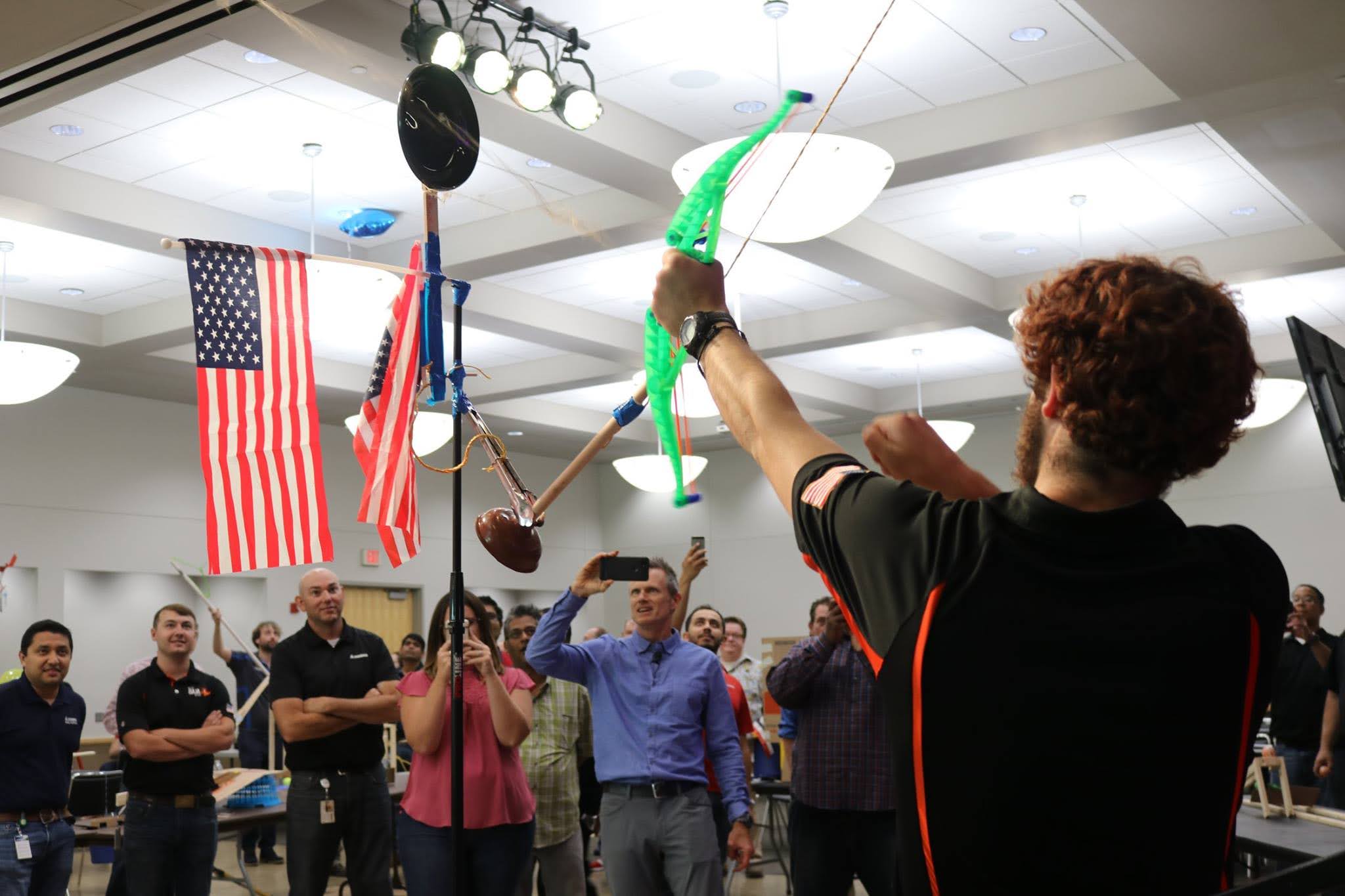
There's a moment in every Domino Effect event that no other team building format produces. The room goes quiet. Someone — usually the most skeptical person in the company — tips the first domino. And then everyone watches their own work trigger someone else's work, section after section, team after team, across the entire room. Ball runs, ramps, bridges, flags, the works. When the final flourish fires, the noise is genuinely something.
That moment is why the Domino Effect has quietly become FullTilt's single most-booked program — delivered at more than 200 corporate events, from 15-person leadership teams to company-wide gatherings in the hundreds. Not because dominoes are trendy, but because the format does something most team building only claims to do: it makes interdependence physical. Your section can be perfect, and it means nothing unless it connects to the section built by the team next to you.
This guide covers how a chain-reaction event actually works, why it teaches collaboration better than nearly any format we run, who it's for, how it scales, and how to plan one. If you want to go straight to the program itself: the Domino Effect Challenge.
What is Domino Effect team building?
Think of it as a Rube Goldberg machine built by your whole company at once. Each team gets a build zone, materials, and design constraints. Some elements are engineered for reliability, some for showmanship — a company-logo reveal, a flag drop, a finale everyone argues about happily. The room plans, tests, fails, re-tests, negotiates handoff points with the teams beside them, and finally steps back for one take. The cameras come out on their own; nobody has to ask.
The format sits inside the broader family of collaborative build events — cousins to our Cardboard Boat Build and Cardboard Train-ing Express — but with one structural difference that changes everything: in most build events, teams build competing things. In the Domino Effect, teams build one connected thing. That single design choice is why it teaches what it teaches.
How the event actually runs
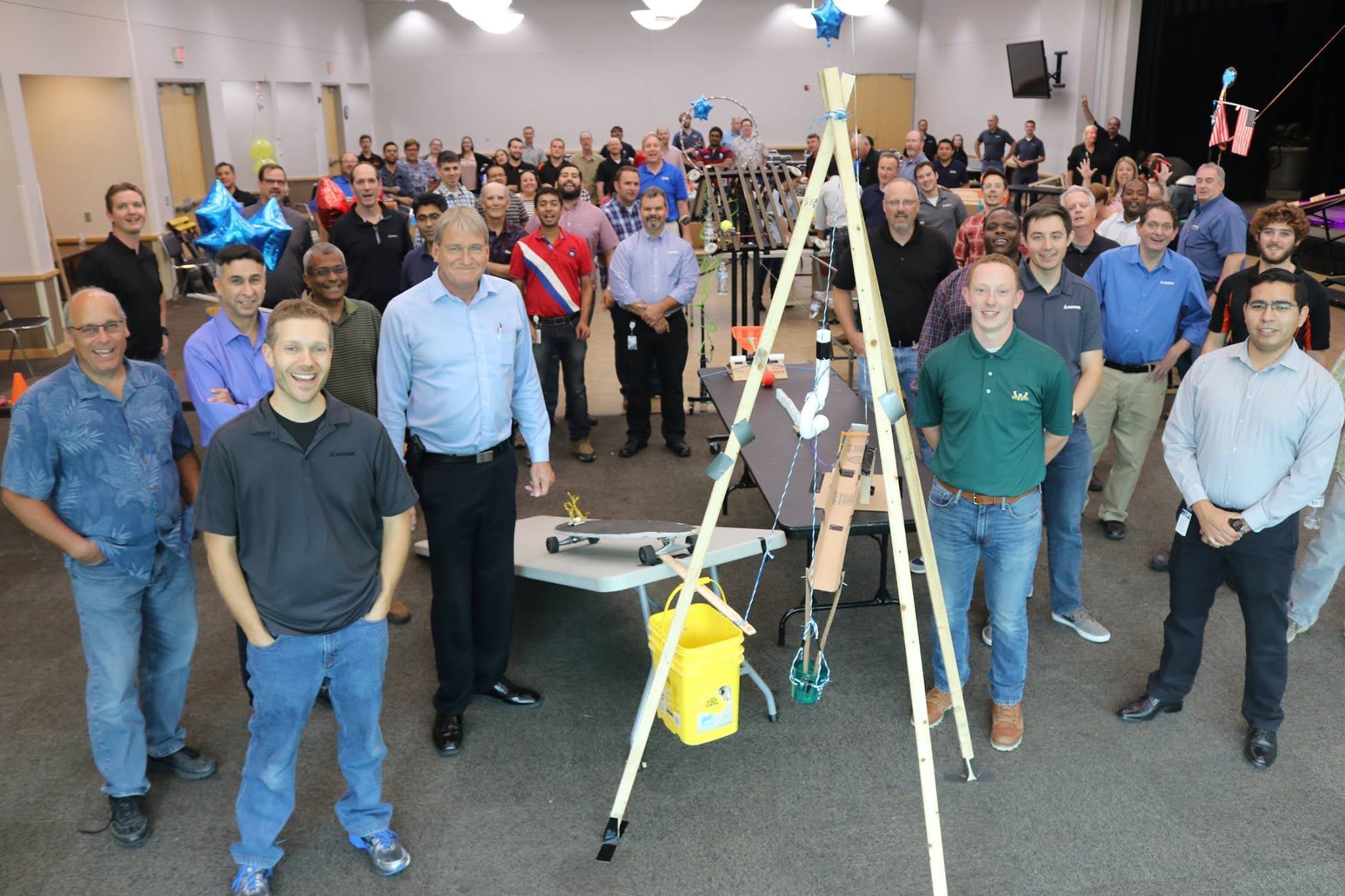
- Briefing (15 min). Facilitators frame the challenge, the constraints, and the connection rule: your section starts where their section ends. Teams of 6–10 get their zones and materials.
- Design sprint (20–30 min). Each team plans its section — the reliable backbone and the creative flourish — and, critically, negotiates its two interfaces with the neighboring teams. This is where the silos start dissolving whether people notice or not.
- Build & test (60–90 min). Construction, mini-tests, failures, redesigns. Facilitators keep energy up, referee constraints, and quietly make sure the interfaces are honest.
- The connection walk (10 min). Teams verify every handoff in sequence — the tensest, funniest part of the day, and the moment quality-ownership becomes personal.
- The reaction (2 minutes that justify the whole event). One push. The chain travels the room. Every team owns exactly one part of a success only everyone could produce.
- Debrief (10–15 min). The facilitated close: where did handoffs nearly fail, who over-engineered alone versus tested with neighbors, what does this map to on the actual team? This is where the event converts into Monday-morning behavior — the same mechanism we describe in experiential learning for teams.
Why chain reactions teach collaboration better than almost anything
Most team building creates parallel experiences — teams compete side by side, and the "teamwork" happens inside each team. Chain-reaction formats create serial interdependence, which is much closer to how real companies actually work:
- Your output is someone else's input. Marketing hands to sales, engineering hands to support — and Team 4's last domino hands to Team 5's first. The event rehearses the exact skill most organizations struggle with: the handoff. It's the physical version of what we teach in cross-boundary communication training.
- Quality becomes visible and shared. A section that "mostly works" stops the whole chain. There's no hiding a weak link and no glory in over-polishing your own zone while ignoring the interface — a lesson entire quality cultures are built on.
- Planning under constraints beats improvising. Teams that sprint into building without agreeing interfaces always — always — rebuild. The debrief writes itself.
- Everyone participates, nobody performs. There's a role for engineers and decorators, planners and testers, the loud and the quiet. No athleticism, no trivia knowledge, no stage. It's among the most genuinely inclusive formats we run — a design principle we unpack in inclusive team building.
- The payoff is collective by construction. Nobody remembers which team's section was prettiest. Everyone remembers the reaction completing. That shared-win memory is the connective tissue engagement surveys try to measure — and with U.S. engagement at roughly 31%, an 11-year low (Gallup, 2026), shared wins are scarcer than ever.
Who it's for — and when to pick something else
The Domino Effect is the right call when:
- Silos are the problem. Cross-department events where the goal is getting teams that hand work to each other to actually talk. Mix the sub-teams across departments and the metaphor becomes practice.
- You need everyone included. Mixed ages, abilities, cultures, and seniority — from intern to CFO, everyone builds.
- It's a conference or all-hands energizer. The format slots into a 2–3 hour block, runs in the ballroom you already have, and gives a distributed company one shared physical memory — the thing post-remote culture rebuilding is starving for.
- Leadership wants a debrief with teeth. Few formats produce cleaner material about how your teams really plan, hand off, and own quality.
Pick something else when:
- You want outdoor energy and movement — a field-day format like Beach Olympics or a city-wide Amazing Race fits better (full menu in the outdoor guide).
- The goal is giving back — choose a charity build like the Bicycle Build Challenge or End-Hunger Games (guide: charity & CSR team building companies).
- You have 45 minutes, not two hours — grab a quick zero-prep activity instead and save the chain reaction for a real block.
Group sizes: how it scales from 15 to 500+
15–30 people: 3–4 sections, intimate and design-rich — a favorite for leadership teams and offsites, where the interface negotiations get delightfully political. Pairs well inside a fully facilitated offsite.
30–100 people: the sweet spot our data says companies book most — 6–12 sections, a chain that crosses a whole ballroom, and enough teams that cross-department mixing really works. Average groups at our events run around 70–80 people.
100–500+ people: the room-scale spectacle. Dozens of parallel build zones, facilitator density scaled to headcount, and a reaction that takes a genuinely long, loud time to travel the room. Chain-reaction formats are among the best large-group options precisely because everyone builds simultaneously — the planning math lives in our large-groups guide and large-group programs. For the biggest gatherings, ask us about multi-chain and arena-scale variants.
Space, venue and logistics
- Indoors, almost always: office floor, hotel ballroom, or conference hall — chain reactions and wind are enemies. That makes it a reliable choice year-round and the classic answer for winter dates and rainy-season backups (more indoor options: the best indoor events).
- Space rule of thumb: long tables or floor runs per team plus walking room — a standard ballroom handles 100+ comfortably. We adapt the layout to your room, not the other way around.
- Fully managed delivery: materials, tables protection, facilitation, setup and teardown all arrive with us — the model explained in what turnkey team building includes. Your organizer's job is to show up.
- Timing: 1.5–3 hours end to end depending on group size and ambition. It slots cleanly into a conference afternoon or the experience block of a corporate event.
Domino Effect vs other build formats
Closest cousin: Elevated Raceway, which keeps the connected-sections structure with an engineering flavor — many companies alternate the two year over year. If you can't decide, tell us the goal and we'll match the format; that goals-first matching is the whole premise of planning activities everyone will love.
Planning and booking a Domino Effect event
- Pick the date and room — any decent indoor space works; we'll confirm the layout from a photo or floor plan.
- Tell us the goal — silo-breaking, conference energizer, celebration — and we'll tune team mixing, constraints, and the debrief to it.
- Book 4–8 weeks out (longer for 150+ or peak fall/January dates). Popular program, honest warning.
- Event day: we arrive early, set up everything, run the full arc, and pack out. One all-in per-person quote — materials, facilitators, travel, setup.
- After: photos, the finale video your team will share anyway, and debrief takeaways your managers can actually use — pair with the framework in measuring team building ROI.
The bottom line
Companies talk about collaboration in every all-hands. The Domino Effect is two hours where nobody has to talk about it — they build it, connect it, and watch it work, or watch exactly where it doesn't. That's why it's the program our clients book more than any other, and rebook most.
See the Domino Effect Challenge, or send us your headcount, city, and date — we'll bring the chain reaction to you.