

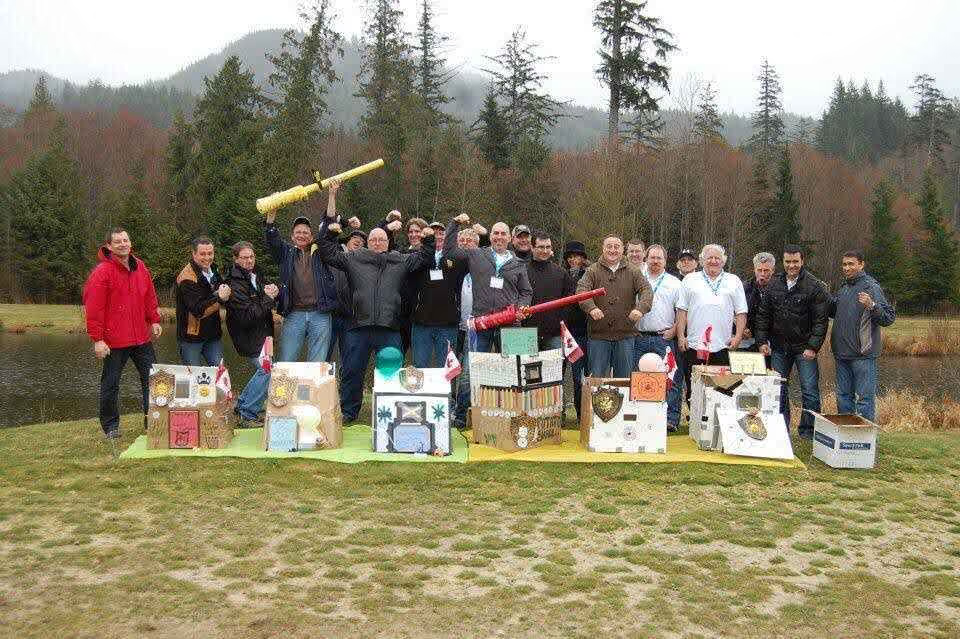
There's a pattern in who gets the most from team building, and it isn't about budget size. It's about structure. Companies that treat team building as an occasional purchase — a scramble each time morale dips or a milestone looms — get decent events and short-lived lifts. Companies that treat it as a program — a planned annual arc with a partner who carries the history — get something categorically different: culture that compounds.
The difference shows up everywhere once you look for it. The one-off buyer re-explains their company to a new vendor every time, re-runs procurement, re-rolls the dice on quality, and re-starts the team's story from zero. The program buyer has a partner who already knows the office layout, the inside jokes from last quarter's event, which VP needs a competitive format and which team needs a gentle one — and every event builds on the last, the way season two of anything beats a pilot episode.
This guide makes the full case for the recurring model and then gets practical: the annual program structures that work, quarter-by-quarter cadences, what a partner should handle so HR doesn't inherit a second job, and the questions to ask before committing to one. It draws on the cadence research in how often should you do team building and the month-by-month planning detail in the annual calendar guide — this is the strategic layer above both.
The case for recurring over one-off
Start with the research reality every HR leader is managing: Gallup's 2026 reporting puts U.S. employee engagement near 31% — an eleven-year low — while organizations in the top engagement quartile show roughly 23% higher profitability. The uncomfortable corollary for event planning: single interventions don't move sustained numbers. Engagement responds to rhythms — the predictable, repeated experiences that tell employees what the company actually values, as opposed to what it says once a year. That's the deep argument of continuous team building, and the annual program is its operational form.
Then there's the quality mechanism, which nobody talks about because it flatters no one: the first event with any provider is the hardest one. They don't know your space, your ratio of enthusiasts to skeptics, your CEO's tolerance for silliness, or that engineering and sales need to be split up (or forced together). By event three, all of that is known — and the events show it. One-off buying means paying the first-event tax every single time.
What compounds — and what resets
The recurring model's real product is accumulation. Here's what builds from event to event with a standing partner, and what a one-off approach discards each time:
- Context compounds. The partner arrives knowing the loading dock code, the ballroom's ceiling height, which formats this team has done, and what last quarter's winning team will demand a rematch of. Every logistics question answered once stays answered — the operational memory that makes office events in particular run friction-free by round two.
- Story compounds. Trophies get defended. Rivalries (the friendly kind) carry across quarters. "Remember the boat race" becomes company vocabulary. This narrative layer — teams having a shared serialized story rather than disconnected episodes — is where belonging actually forms, and it's structurally impossible to buy one event at a time.
- Program design compounds. A partner watching your team across events can sequence deliberately: a competitive format this quarter, a collaborative build next, a charity event for year-end — a designed arc, not a series of coin flips. Format variety on purpose, per the menu in the corporate event ideas guide.
- Feedback compounds. The post-event retrospective ("more time on the finale, shorter briefing, marketing wants harder puzzles") actually goes somewhere — into the next event — instead of into a survey no future vendor reads.
- What resets in the one-off model: all of it. Plus procurement, plus onboarding a vendor, plus the risk premium of an unknown crew walking into your office.
What an annual program looks like
The standard program is simpler than most HR leaders expect — it's 2–4 anchor events across the year, planned once, with the partner managing everything between:
- The quarterly program (most common): four anchors, one per quarter, format rotated across the year — typically an office event, an outdoor tournament, a signature build, and a charity or holiday-season event. Each follows the anchor-event structure from the half-day guide: usually a meeting-plus-afternoon shape that costs employees no extra travel or evenings.
- The semi-annual + summit program: two big anchors (a summer event and a winter celebration) plus the company's conference or kickoff, with the partner running the conference experience layer as part of the same relationship.
- The distributed-company program: for hybrid and multi-office companies, the program is the gather calendar — quarterly fly-in days built around a signature event, the model from the hybrid guide, plus per-office events run consistently across cities (the nationwide-delivery advantage covered in the turnkey guide).
- The layered program: everything above, plus a leadership tier — an annual executive offsite and manager-level development using training modules, so the program develops the top of the org while it connects the whole of it.
A quarter-by-quarter cadence that works
Q1 — The alignment anchor (January–February)
The year opens with the event attached to your kickoff or first all-hands — the highest-leverage slot on the calendar, because it sets the tone the other three quarters build on. Kickoff-specific design: the SKO guide.
Q2 — The energy anchor (April–June)
Spring weather opens the outdoor menu: field-day tournaments, city races, parking-lot Olympics. This is the quarter for pure competitive fun — the deposit in the goodwill account that the busier quarters draw on.
Q3 — The connection anchor (September–October)
Post-summer re-entry, new-hire waves from summer starts, and the industry's genuine peak season — the reason program clients get priority dates while one-off buyers discover everything's booked (why fall fills first). The strongest quarter for a signature build — a chain-reaction event that becomes the year's most-photographed hour.
Q4 — The meaning anchor (November–December)
Close the year with weight: a charity build with the donation handover as the finale, or the holiday event that replaces the standard dinner with an experience. Teams remember how the year ended — this anchor decides that memory.
Between anchors, the program's connective tissue is light and internal: the meeting games and micro-moments your managers run themselves — many program clients ask us to equip managers with exactly these toolkits as part of the annual relationship.
What the partner handles (so HR doesn't inherit a second job)
- The calendar: dates held a year out, reminders ahead of each planning window, peak-season priority.
- Format design: rotation planned across the year so no two events feel alike, difficulty tuned to your team's history, new-hire integration built into each roster (teams engineered so every new wave gets mixed in — the onboarding function detailed in team building for new hires).
- Every event's delivery: the full turnkey standard — crew, equipment, setup, facilitation, reset — at your office, venue, or conference hotel.
- The retrospective loop: a short debrief with HR after each event, feeding the next one's design.
- Scale flexibility: the program flexes with you — the 60-person Q1 event and the 200-person Q3 event live under the same relationship, priced at program rates (the operations behind the big ones: the large-groups guide).
What HR keeps: the strategy conversation (what does the culture need this year?) and the internal comms. What HR sheds: everything else. For most program clients, the annual time investment after the kickoff conversation is under a day — total.
How HR sets it up: the one-conversation method
- Bring three inputs: headcount (and its growth curve), the fixed calendar points (kickoff, all-hands, conference, holiday window), and the one cultural goal that matters most this year — integration after a merger, retention in a specific org, energy post-RTO (the RTO playbook).
- Set the anchor count honestly. Two great anchors beat four rushed ones. Start with the number your calendar can protect; programs expand easily, and per the cadence research, quarterly is the ceiling most companies need.
- Map formats to quarters with the partner, using the Q1–Q4 logic above — thirty minutes of decisions that replace a year of scrambles.
- Lock the dates and the budget as one line. A single annual program line survives budget season far better than four separate event requests competing with everything else in the quarter they're proposed.
- Announce the rhythm to the company. The program's power is partly its predictability — "we do this every quarter" is itself a culture statement. Then let the first event make the argument.
Questions to ask a prospective annual partner
- "Who is our account's consistent point of contact, and does the crew repeat?" The compounding depends on humans who remember you.
- "How many formats do you deliver — will year two repeat year one?" A deep catalog is what keeps a multi-year program fresh; browse what that should look like on team building events.
- "Can you deliver in every city we have people?" Distributed companies need one standard across offices, not a different vendor per metro.
- "What does the retrospective process look like?" If there isn't one, the events won't compound — you'll just be pre-paying for one-offs.
- "How does program pricing work versus per-event?" A committed calendar should be rewarded; ask how.
- "What happens between events?" The best partners equip your managers for the in-between — toolkits, meeting formats, seasonal ideas — because they're invested in the program working, not just the events happening.
The bottom line
Culture isn't built by an event; it's built by a rhythm — and rhythms need an owner. Give the year a structure (four anchors, formats rotated, one planning conversation), give the structure a partner who accumulates your context instead of billing you to relearn it, and let the compounding do what compounding does. The one-off buyer purchases afternoons. The program buyer builds a company people talk about.
FullTilt runs annual team building programs across North America — one conversation, a year of fully managed events, every office covered. Tell us your team and your calendar — we respond in 15 minutes.