

Let's answer the question the industry likes to hide behind "contact us for pricing." Corporate team building in the US and Canada in 2026 typically runs $25 to $150 per person for professionally facilitated standard events, with premium and signature experiences reaching $75–$250+ per person, and most providers carrying event minimums between roughly $1,500 and $5,000. A 50-person company should expect a well-run half-day facilitated event to land somewhere in the $2,500–$7,500 range, all-in, depending on format and city.
Those are honest market ranges, not teaser rates — and the rest of this guide breaks down exactly where inside them your event will fall, because the spread isn't random. Price moves with five specific factors (group size, format, location, duration, and what's included), and understanding them does two things for you: it lets you budget before you ever talk to a vendor, and it makes you dangerous in the quoting conversation — you'll recognize both a fair price and a padded one on sight.
One note on method: the numbers here reflect broad market pricing across the industry, drawn from what corporate buyers encounter when quoting events in 2026. Every provider prices differently (and should — the deliverables differ wildly). For your exact number, the fastest route is a real quote against your headcount, date, and city: tell us those three things and you'll have it in 15 minutes.
2026 price ranges by event type
Here's the market broken into the tiers buyers actually encounter, with what pushes an event toward each tier's top or bottom:
- Tier 1 — Light programming ($15–$50/person). Facilitated icebreaker blocks, trivia, and meeting-embedded games under 90 minutes. Cheap because equipment and setup are minimal. (Below this tier is DIY using free resources — our icebreaker and meeting-games libraries exist for exactly that — but see the ROI section for when DIY stops being free.)
- Tier 2 — Standard facilitated events ($25–$100/person). The industry's center of gravity: game-show tournaments, scavenger hunts, city races, field-day Olympics. Professional crew, equipment, 2–3 hours, delivered at your office or venue. Position in the range depends mostly on group size and city.
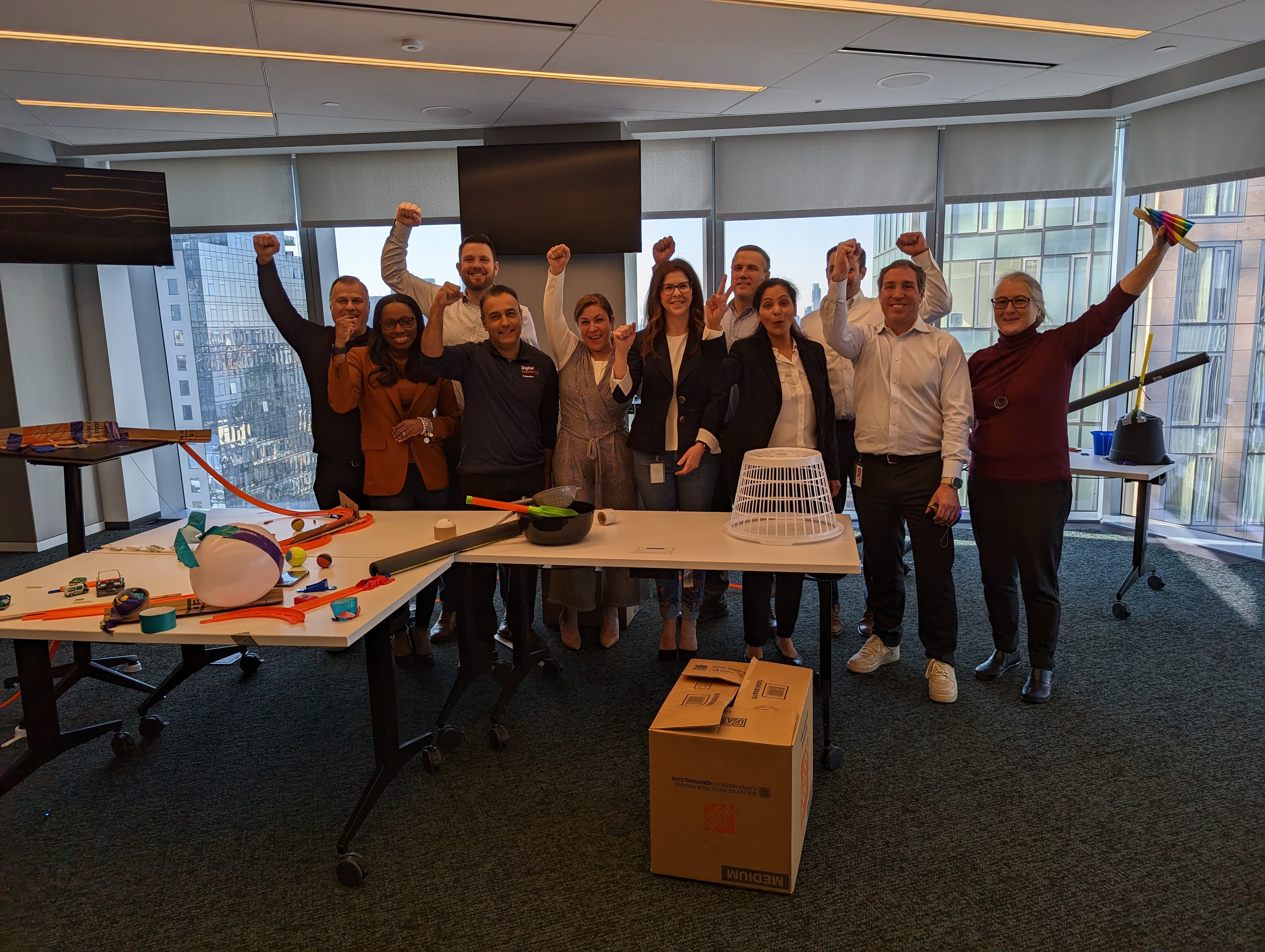
- Tier 3 — Signature builds and premium experiences ($50–$150/person). Physical-production events: chain-reaction builds, boat builds, culinary competitions. More equipment, more crew, more spectacle — the events that become company legend.
- Tier 4 — Charity events ($60–$150/person). The premium partly is the donation: bikes, care kits, and similar builds where materials become real goods for real recipients. Budget guidance: the charity guide.
- Tier 5 — Executive and training-led programs ($100–$300+/person). Smaller groups, senior facilitators, assessment work, and designed debriefs — priced like the professional development it is. What that buys: the executive guide and training programs.
Virtual events run cheaper ($10–$50/person typically) but carry engagement costs no invoice shows — the honest accounting is in the the virtual pros-and-cons analysis.
The five factors that actually move the price
1. Group size — the biggest lever, and it works in your favor
Facilitated events carry heavy fixed costs (crew, equipment, transport, setup) that spread across headcount. The practical effect: per-person price falls steeply as groups grow. A 20-person event might quote at $85/person while the same format for 200 lands under $40/person. This is also why minimums exist — below roughly 15–20 people, fixed costs make per-person pricing meaningless, so providers quote a flat event fee instead. Large-group operations have their own economics (zones, wave scheduling, facilitator ratios) covered in the the large-groups guide.
2. Format — production weight is price weight
A trivia hour needs a host and a screen; a chain-reaction build needs cases of equipment and a crew that arrives hours early. When comparing quotes across providers, compare production weight, not event names — "scavenger hunt" spans everything from a PDF checklist to a app-run, facilitator-staffed city race with challenge stations.
3. Location — city and venue
Two separate effects. City: major metros (NYC, SF, Toronto) price 15–30% above national averages — labor and logistics, same as everything else there. Venue: the single most avoidable cost in the entire budget. Hosting at your own office eliminates venue rental entirely — often $1,000–$5,000 saved — which is why the office-delivered model keeps winning (the full case).
4. Duration — but not linearly
A 3-hour event doesn't cost 3x a 1-hour event; setup and crew costs are already sunk. This is why the half-day format is the value sweet spot — enough time for a full experience arc, priced well below full-day retreat territory (offsites add venue, catering, and often travel).
5. What's included — the quote-comparison trap
The cheapest quote is frequently the most expensive event. A true turnkey price includes design, crew, all equipment, setup, facilitation, awards, and teardown. A stripped quote can exclude any of those — then bill them back. The checklist for reading a quote is in the inclusions section below.
Reading the table: three planning rules
- Budget per event, not per person, under 25 people. Minimums dominate at small sizes — which paradoxically means small teams should consider better formats, since the floor price buys more than they expect. Small-group strategy: the small-groups guide.
- The 50–100 band is the value zone. Fixed costs fully absorbed, complexity premiums not yet triggered — companies in this range get the industry's best per-person economics.
- Above 200, buy operations, not activities. At scale the price is really paying for logistics: parallel zones, wave starts, crew density. Judge quotes on operational plan, not format name.
- Budget annually, not per event. Four quarterly anchors bought as a program cost less than four separately procured events — and survive budget season better as one line. The full argument: the team building partner guide.
What should be included — and the hidden fees to catch
A complete, professionally priced quote includes: event design consultation, professional facilitators and crew, all equipment and materials, transport and load-in, full setup and teardown, event management on the day, and awards/prizes where the format calls for them. When a quote is surprisingly low, one of those is usually missing. The classic add-backs to ask about before signing:
- Travel and delivery fees — reasonable for remote venues; a red flag when vague ("plus travel, TBD").
- Equipment or materials surcharges — the build event that arrives without enough materials to actually build.
- Facilitator count — one facilitator per 60 people isn't facilitation, it's an emcee. Ask for the ratio; quality standards are in the the facilitator qualities list.
- Setup/teardown labor — excluded, it becomes your facilities team's surprise afternoon.
- Weather backup — outdoor events need a written plan B that doesn't cost extra to invoke.
- Insurance and liability coverage — professional providers carry it; confirm rather than assume.
- Guarantees — the strongest pricing signal in the industry is a provider willing to put money behind the outcome. (FullTilt backs events with a $500 guarantee — that's confidence you can price.)
Seven legitimate ways to lower the cost (without lowering the event)
- Host at your office. Eliminates venue rental — the single largest optional line. The delivery playbook: office team building.
- Attach to an existing gather. If people are already in the building for an all-hands or conference, travel and venue are already paid for — the event rides free on the logistics.
- Book the half-day, not the full day. Most of the impact, a fraction of the cost — see why 3–4 hours is the optimal window.
- Buy the year, not the event. Program pricing beats à-la-carte, and it removes four procurement cycles — the annual program economics.
- Go midweek and off-peak. September–November and December book out first and price firmest (why fall fills first); a Tuesday in February is a buyer's market.
- Grow the group. Counterintuitive but real: inviting a second department can lower per-person cost while doubling the cross-team value.
- Cut scope, never facilitation. If budget forces a choice, shorten the event or simplify the format — don't drop the professional crew. An unfacilitated premium format underperforms a facilitated simple one, every time (the facilitator case).
Is it worth it? The ROI math HR can take to finance
Put the cost against what it's buying. Gallup's 2026 reporting has U.S. employee engagement at roughly 31% — an eleven-year low — while organizations in the top engagement quartile show about 23% higher profitability than bottom-quartile peers. Meanwhile the standard HR math on turnover puts replacement cost at one-half to two times an employee's annual salary once recruiting, ramp, and lost productivity are counted. Against those numbers, a $5,000 event for 50 people — $100 a head — needs to contribute to retaining one mid-level employee ever to pay for itself several times over.
The honest caveat: a single event doesn't move annual engagement metrics by itself — cadence does, which is the argument for programs over one-offs (the data-backed cadence answer). And the DIY alternative isn't free: an HR manager spending 30 hours planning an internal event costs more in loaded salary than most facilitation fees, and delivers a first-timer's event. That full comparison — when DIY genuinely wins, and where it flips — is in DIY vs hiring a team building company. For measurement frameworks: team building ROI.
How to get an exact quote fast
Three data points produce a real number: headcount (approximate is fine), date or date range, and city plus venue situation (your office? hotel? outdoor space?). Add your goal — celebrate, integrate, energize a conference, onboard a cohort — and format recommendations come with the price. That's the entire input; anything a provider claims to need beyond it, they're prospecting, not quoting. Send us those three things and pricing for your event is in your inbox in 15 minutes — browse the full events menu if you want format ideas first.
The bottom line
Team building pricing isn't mysterious — it's five variables, and now you hold all of them. Standard facilitated events: $25–$100 a head. Signature experiences: up to $150. Minimums: $1,500–$5,000. Your biggest levers: host at your own office, book the half-day, buy the year. And judge every quote by what's inside it, because the cheapest number on the spreadsheet is routinely the most expensive event in the room.
FullTilt delivers fully managed events at offices and venues across North America — exact pricing for your headcount, date, and city in 15 minutes, $500 guarantee behind every event. Get your number.