

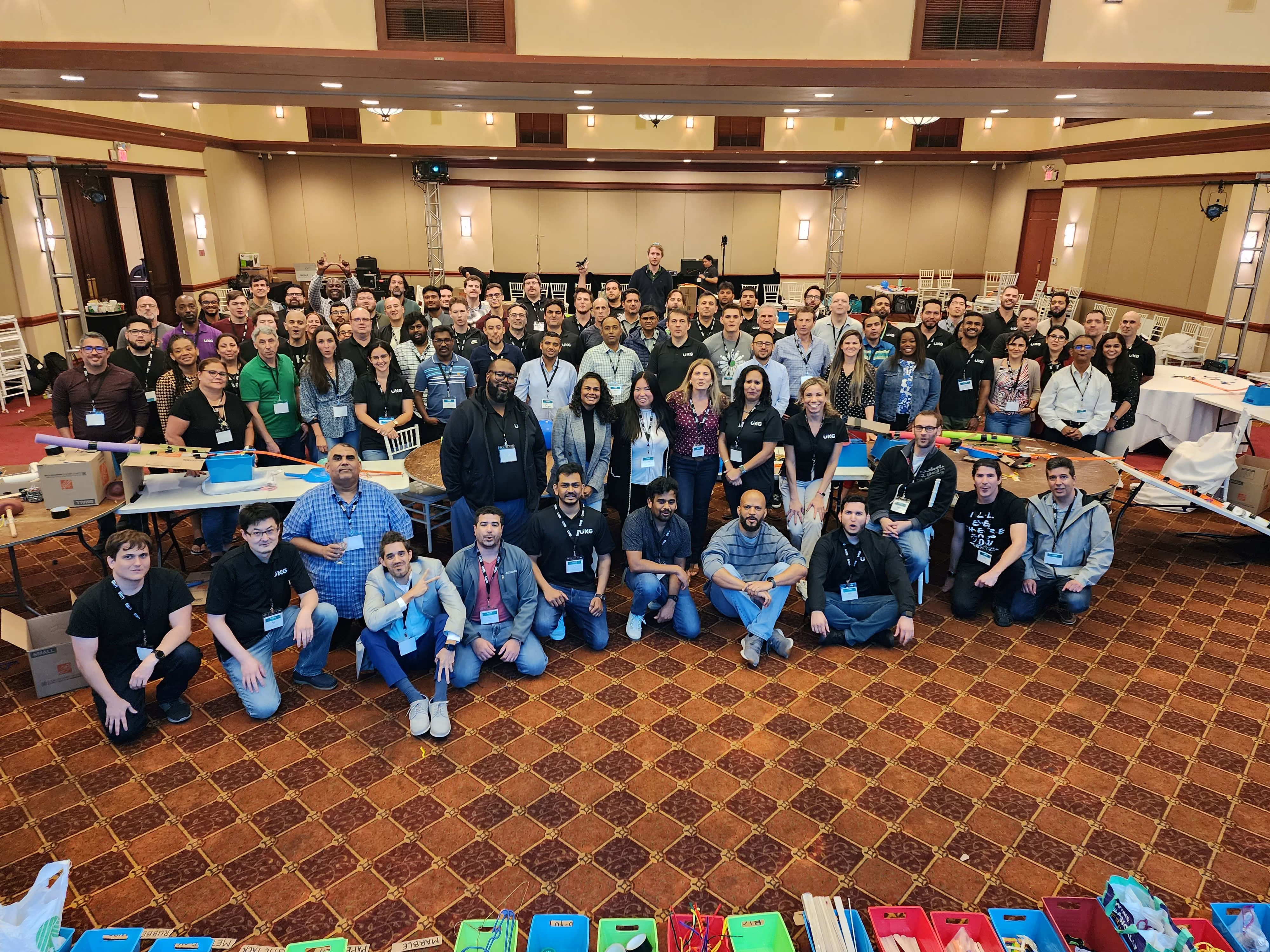
Somewhere right now, an HR manager is planning a team event on top of a full-time job. She's comparing venues, renting equipment, recruiting volunteer "facilitators" from her own department, building a run-of-show in a spreadsheet, and quietly dreading the moment 80 colleagues turn to her and ask what happens next.
Turnkey team building exists to delete that entire paragraph. One provider designs the event, brings the equipment and professional facilitators to your location, runs the whole experience, and packs it all out — while you attend your own event as a participant. That's the promise. The problem is that "turnkey" has become a label anyone can claim, and the gap between a shipped box of props and a fully staffed program is enormous.
This guide defines what turnkey actually means, breaks down what a fully managed program includes, compares the delivery models honestly, and gives you the evaluation checklist we'd use ourselves. FullTilt Team Development runs fully managed programs nationwide — browse the events here — but the framework below applies whoever you book.
What does "turnkey team building" actually mean?
The term borrows from real estate and manufacturing, where a turnkey project is handed over ready to use. Applied to team building, the test is simple: on event day, does your internal organizer produce anything, or do they participate? If they're hauling supplies, explaining rules, or nervously watching the clock, the event wasn't turnkey — whatever the brochure said.
The distinction matters more than it sounds. Corporate events fail most often not because the activity was wrong but because the execution wobbled: unclear instructions, dead air between segments, equipment shortfalls, nobody managing energy in the room. Professional facilitation is precisely the layer that prevents this — it's the difference our clients notice most, and it's why we've written before about why the best events need an expert outside facilitator and what separates great facilitators.
What's included in a fully managed program
A genuinely fully managed program covers seven things. Use this as your inclusion checklist when comparing quotes:
- Event design and customization. A consult on your goals, group profile, and constraints — then a program shaped to them, not a one-size template. (Objectives-first design is the core of organizing effective events.)
- Professional facilitation, scaled to headcount. Trained facilitators who run briefings, manage energy, keep timing tight, and handle the unexpected. Staffing ratio matters: one facilitator can't run 200 people.
- All equipment and materials. Delivered, set up, and removed. For charity builds, materials include the donated goods themselves.
- Location delivery. The event comes to your office, hotel, park, campus, or conference — with the provider handling load-in logistics.
- Run-of-show management. A minute-by-minute plan owned by the provider: arrival flow, briefing, activity arc, awards or reveal, close.
- Contingency plans. A weather backup for outdoor events, spare equipment, and staffing redundancy — agreed before event day, in writing.
- One all-in price. A per-person quote covering staff, materials, travel, and setup. If the "extras" arrive after you commit, it wasn't all-in.
The four delivery models, compared honestly
Everything sold as team building fits one of four delivery models. None is universally wrong — but they carry very different risk on event day, and they're often priced closer together than their differences justify.
A note of fairness: kit and venue models aren't scams — a shipped trivia kit can be a fine Friday hour, and escape venues suit a six-person outing. The problems start when those models are stretched over the events that matter: a 150-person all-hands, a kickoff, a date the leadership team will judge. That's where the fully managed model earns its keep, and where the "everyone hates team building" horror stories usually trace back to under-supported execution — a pattern we've dissected in how to avoid the events everyone hates and why team building fails.
When turnkey is worth it — and when it isn't
Turnkey earns its cost when:
- Your group passes ~25 people. Above that line, parallel activity streams and real staffing stop being optional. By 100+, they're the whole game — see the planning math in our large-groups guide.
- The date is high-stakes: kickoffs, all-hands, executive gatherings, client-facing events.
- Your organizer has a day job. The true cost of DIY is a skilled employee spending 20–40 hours producing an event instead of doing their work — then missing the event itself.
- You have multiple locations. One provider delivering the same program in Chicago, Dallas, and Toronto beats three separate local scrambles.
- The event has a goal beyond fun — communication repair, post-reorg trust, onboarding cohorts. Facilitated debriefs are where the goal actually gets met.
Skip it (honestly) when:
- You're 8 people grabbing an activity hour — a zero-prep quick activity or a local venue outing is proportionate.
- The gathering is purely social with no program needed — book the restaurant.
- Culture-building is your daily habit rather than an event — micro-moments and year-round rhythms matter more than any single day. (Cadence guidance: how often to do team building.)
How "delivered in any city" actually works
The phrase every provider uses — "we come to you" — hides real operational differences. Here's what national delivery looks like when it's real:
Coverage without franchising drift. A national provider should run the same program to the same standard in every market. FullTilt delivers across the United States, Canada, and Mexico — same programs, same facilitation standard, whether the event is in Manhattan or a suburban office park.
Any venue type. Truly location-flexible means office floors, hotel ballrooms, public parks, beaches, campuses, and conference centers — with the provider adapting the program to the space rather than forcing your group to a fixed site. (Choosing that space is its own craft — our venue guide covers it — though with a delivered event, a modest space usually works fine.)
Multi-city programs. The underrated advantage: companies running the same event across regional offices get consistency, one contract, and comparable outcomes — impossible to replicate with per-city vendors.
Travel baked into the price. If delivery is genuinely turnkey, travel and logistics live inside the per-person quote, not in a surprise invoice.
What fully managed programs look like in practice
Turnkey is a delivery model, not an activity type — nearly any format can be delivered fully managed. A sampler across the main categories, all run by FullTilt facilitators at your location:
High-energy competitions
Beach Olympics field days, Minute to Win It tournaments, and Amazing Race city challenges — parallel-station formats that keep 20 to 500+ people active at once.
Build challenges
Cardboard Boat Builds, Domino Effect, and Pit Stop — problem-solving arcs with a finale worth filming.
Charity builds
Bicycle Build Challenge and End-Hunger Games — fully managed including the nonprofit partnership and donation handover. The full picture is in our charity & CSR companies guide.
Culinary and creative
Iron Chef cook-offs and Junkyard Orchestra — formats where the facilitation carries groups who'd never call themselves "creative."
Training-integrated events
For teams that want development woven into the day, facilitated events pair with team building training modules — from cross-boundary communication to productive feedback.
Browse the complete catalog on the all programs page, filtered by indoor, outdoor, charitable, or large-group formats.
How to evaluate turnkey providers: the 8-point checklist
Quotes rarely fail on the activity — they fail on the execution details buried underneath. Ask every provider these eight questions (they extend the framework in our 8 questions to ask before you book):
- Who exactly runs event day, and how many of them? Ask for the facilitator-to-participant ratio at your headcount. "A lead facilitator plus support staff scaled to your group" is the right shape of answer.
- Is the price all-in? Per person, covering staff, materials, travel, setup, and teardown. Get "no additional charges" in writing.
- What's the weather/venue backup? Confirmed in writing before booking, not improvised on the morning.
- What's the real scale range? A provider whose largest event was 60 people is a risk at 300. Ask for examples at your size.
- How is the program customized? Goals conversation before the proposal, or a catalog PDF? The order tells you everything.
- Where do you deliver — and is my city standard or exceptional? "Anywhere" should come with proof: recent events near you.
- What happens in the debrief? If your event has a development goal, the close matters more than the game. Facilitator-led debriefs are the tell of a serious provider.
- How fast do you respond? Pre-sale responsiveness predicts event-week responsiveness. (Our standard: 15 minutes.)
What turnkey team building costs
Fully managed programs are priced per person, and the honest answer on numbers is that they move with four levers: headcount (per-person rates typically improve at scale — the fixed costs of staff and equipment spread), format (build-based and charity events carry materials costs; for charity builds that cost is the donation), location (travel distance from staff hubs), and duration.
Rather than anchoring on a generic figure, compare providers on the same all-in basis: one per-person price, everything included. The comparison trap to avoid: a kit-shipped "per person" price looks cheaper until you add your organizer's 30 hours, rented AV, and the risk premium of an unfacilitated room. Fully managed pricing looks bigger on the invoice and smaller in total cost — particularly measured against what the event is for. On that measurement question, our team building ROI guide gives you the framework, and the engagement stakes are real: Gallup's 2026 research puts U.S. engagement at roughly 31% — an 11-year low — with engaged teams linked to 23% higher profitability.
Booking timeline and planning steps
- 6–8 weeks out (2–3 months for 150+ or December dates): shortlist providers, share goals, headcount, city, and date. High season — fall and holidays — books first.
- After the consult: compare all-in quotes using the 8-point checklist; confirm backup plans in writing.
- 4 weeks out: lock venue/space details; provider handles logistics from here.
- 1 week out: send your team one logistics email — time, place, dress code, what to expect. That's your whole job.
- Event day: attend your own event. Genuinely — that's the product.
- After: run a two-question pulse and capture the stories. (Planning depth: how to plan the best team building day.)
The bottom line
"Turnkey" should mean your organizer's only event-day task is showing up. Hold every provider to that standard: professional facilitation scaled to your headcount, delivery anywhere, written backups, and one all-in price. Get those four right and the event itself — the laughing, the stories, the team that works differently on Monday — takes care of itself.
FullTilt Team Development delivers fully managed programs across the US, Canada, and Mexico for groups of 10 to 500+ — tell us your city, headcount, and date, and we'll design the event and send an all-in quote.