

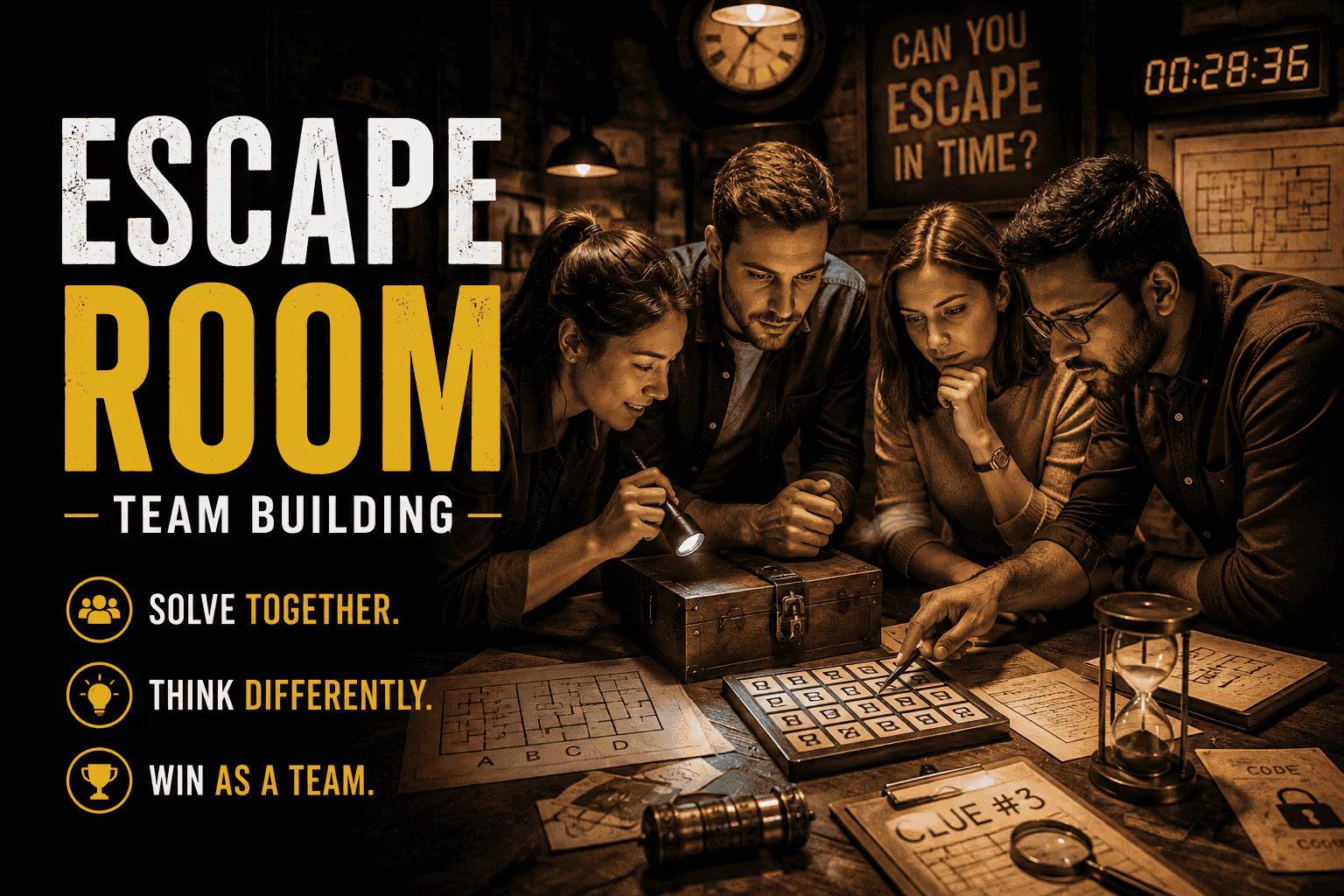
Let's start by giving escape rooms their due, because they've earned it. In fifteen years the format went from a novelty to a global industry for one reason: it reliably produces the thing team building chases — a small group under time pressure, forced to communicate, divide labor, share discoveries, and celebrate (or commiserate) together. An escape room is a sixty-minute teamwork simulator with a built-in narrative, and for a team of six to eight people, it genuinely works.
So why does the corporate version so often disappoint? Because almost nothing about the format survives contact with corporate scale. The room fits eight; the company brings sixty. The venue is across town; the schedule had one free afternoon. The fast solvers dominate; half the team spends the hour watching someone else open locks. The escape-room experience is excellent — the escape-room logistics were designed for birthday parties and date nights, not for an organization trying to build culture across departments.
This guide plays it straight down the middle: what the format genuinely teaches, exactly where it breaks for corporate groups (with the group-size math), how to make a venue escape room work if you're set on one, and the puzzle-driven formats that keep everything escape rooms do well while fixing everything they don't — delivered at your office, for your whole headcount at once.
What escape rooms genuinely teach teams
Credit where due — a well-designed escape room reliably produces four things trainers spend whole workshops chasing:
- Communication under pressure. Information in an escape room is distributed by design — the code you found means nothing without the lock someone else found. Teams that don't announce discoveries lose; sixty minutes of that rewires "I'll mention it later" into "say it now."
- Role discovery. Rooms surface who systematizes, who searches, who tracks time, who synthesizes — often revealing capabilities job titles hide. (The quiet analyst who cracks the cipher is an escape-room cliché because it keeps happening.)
- Fast failure recovery. Wrong theories die in minutes, not quarters. Teams practice abandoning a bad hypothesis without ego — a genuinely transferable habit.
- A shared win (or a shared near-miss). Either outcome bonds; "we escaped with forty seconds left" is a story a small team retells for years.
This is the same mechanism behind all experiential learning: compressed, observable, emotionally sticky practice of the exact behaviors work requires. The escape room isn't a gimmick. It's a good format — with a hard ceiling.
Where the format breaks for corporate groups
- The capacity wall. Physical escape rooms cap around 8–10 players; beyond that, people literally can't reach the puzzles. A 40-person team means four or five separate rooms — different puzzles, different outcomes, different stories — or worse, staggered time slots where half the company waits.
- The split-experience problem. Team building's core asset is the shared story — everyone in one arc, one finale, one debrief. Split across rooms, your company has four small stories instead of one big one, and the departments you hoped to mix stay exactly as siloed as they arrived (self-sorted into rooms with their friends, usually).
- The spectator gradient. Even inside one room, participation is unequal: two or three assertive solvers drive; the rest orbit. There's no facilitator watching for the quiet ones — the game master's job is hints, not inclusion. Compare that to professionally facilitated formats, where drawing everyone in is the actual job (a difference the turnkey guide unpacks).
- The logistics tax. Venue across town, transportation, waivers, staggered bookings, dinner reservations that don't match the last room's finish time — for a tight corporate schedule, the overhead often exceeds the event. (The general case for skipping all of it: the office team building guide.)
- No debrief, no transfer. The room ends with a photo and a leaderboard. The conversation that converts the experience into working insight — who noticed what, which habits showed up, what maps to Monday — isn't part of the product.
The group-size math (the honest table)
Here's the decision in one paragraph of arithmetic. 6–10 people: book the escape room; it's the format's home turf. 10–16: two rooms, same venue, works acceptably — accept the split stories, plan a combined meal after. 16–40: the format is now fighting you — three-plus rooms, self-sorted groups, staggered logistics; a single facilitated puzzle event for everyone will beat it on every axis. 40+: the escape room is the wrong tool, full stop; you need formats built for parallel scale — the operational tier covered in the large-groups guide and delivered through large-group programs.
If you're set on a venue escape room: the corporate playbook
Sometimes the escape room is the right call — a small team, a milestone, a genuine puzzle-loving crew. Five rules that fix most of the corporate failure modes:
- Assign the rooms; never self-sort. Mixed-department rosters or the event mixes nothing.
- Book identical or difficulty-matched rooms. Comparable experiences make the post-game comparison a conversation instead of a bragging asymmetry.
- Build the shared moment yourself. The rooms are the middle of the event, not the event: gather everyone before for a briefing (and a warm-up round — the brain teasers library is purpose-built for it), and reconvene after for awards and a real debrief.
- Run the debrief the venue won't. Fifteen minutes, three questions: what did your team do well, what pattern surprised you, where does it show up at work — the missing conversion step.
- Protect the schedule. Escape venues run on the hour, hard. Build travel and briefing buffers, or the event's first shared experience will be waiting in a lobby.
The scalable alternatives: same DNA, no ceiling
Everything that makes escape rooms work — distributed clues, time pressure, aha moments, a finale — exists in formats engineered for corporate scale and delivered at your location. The escape-style menu:
The city or campus race
An Amazing Race is an escape room turned inside out: instead of one locked room, the puzzle field is your neighborhood, campus, or conference city — checkpoints, ciphers, photo missions, route strategy — with every team playing simultaneously and one finish-line finale. Capacity: effectively unlimited via wave starts.
The challenge-station scavenger hunt
A facilitated scavenger hunt with puzzle stations is the closest one-to-one substitute: teams work through clue chains and challenge stations at their own pace, everyone plays at once, and facilitators actively pull quiet members in. Design patterns and variations: the scavenger hunt guide and 17 hunt ideas.
The mission event
Mission Incredible runs teams through a narrative gauntlet of timed challenges — the escape-room story arc without walls, scaled to a ballroom or your whole office floor.
The strategy build
For teams whose favorite part is out-thinking the designer, competitive engineering formats — The Dragon Throne, STEM builds — deliver the same problem-solving high with a physical payoff, and the room-wide Domino Effect Challenge adds what no escape room can: a single finale the entire company watches together (why that finale outperforms almost everything).
All of these run fully managed at your office, hotel, or conference venue — the delivery model in the office guide, in the half-day window most companies want, including inside a conference agenda. Browse the full menu: team building events.
Choosing by situation
- Intact team of 6–10 celebrating something: venue escape room — with the five-rule playbook above.
- Department of 20–60 that loves puzzles: challenge-station hunt or mission event at your office — everyone in one game, facilitated inclusion, real debrief.
- Cross-department mixing goal (any size): never split rooms; one shared-field format with engineered rosters.
- Conference or all-company (100+): race with wave starts or a room-wide build; the escape room isn't in the running at this scale.
- Recurring program: rotate the puzzle DNA across the year — hunt one quarter, build the next — inside a standing annual program so each event's stories compound.
The bottom line
The escape room deserves its reputation and its niche: six to ten people, one door, one great hour. Corporate team building just usually needs what the format can't give — everyone in one story, facilitation that includes the quiet half, a debrief that travels back to work, and logistics that fit a Tuesday. Keep the puzzle; lose the walls. Book the version built for your whole company.
FullTilt delivers escape-style challenge events — races, hunts, missions, and builds — fully managed at offices and venues across North America, 10 to 500+ people. Tell us your headcount and space — quote within 15 minutes.