

A build challenge gives a team a brief, a box of materials, a deadline and a test that cannot be argued with. The boat floats or it sinks. The egg survives the landing or it does not. The chain reaction runs from end to end or stops at someone's section. That honesty is why build challenges suit corporate groups: the result is visible, the roles appear without being assigned, and the debrief has real material to work with.
This guide is for the HR lead, executive assistant or event planner comparing build-style programs. It explains how a build challenge runs, compares eleven FullTilt build programs on the facts their own pages state, shows how to choose one by goal and by room, and covers the questions planners ask most: what about people who do not want to build, and how competitive should it be?
How a build challenge runs, from brief to debrief
Every good build challenge follows the same seven stages. The program changes the object; the arc stays the same. Knowing it helps you judge any proposal and plan your agenda around it.
- Brief. The facilitator sets the mission, the rules and the win condition in a few minutes. "Cardboard and tape only" for the Cardboard Boat Build; "launch high, then land the egg safely" for the rocket.
- Teams. Most programs use teams of 4 to 6 or 4 to 8. Mix departments deliberately; teams formed by desk location rebuild the org chart.
- Roles. Some programs build roles into the format; in others they emerge. Either way, name them early so quieter people are not left holding the tape.
- Materials. FullTilt provides the materials. In some programs, such as the Bicycle Build Challenge, teams earn parts and tools through challenges before they can build.
- Build. The longest stage. Facilitators circulate, answer questions and keep time.
- Test. The moment of truth: the float, the launch, the race, the trigger or the quality check.
- Debrief. A facilitated conversation connecting what happened to how the team works. This is where the event earns its budget; the team building debrief questions in this series give you prompts by goal.
From a facilitator's chair, the failure points are predictable. Teams that spend the whole session planning run out of build time; teams that skip planning rebuild twice. A short planning window followed by a test-and-fix round is the rhythm most programs use, and the Cardboard Boat Build page states the lesson plainly: teams that plan well and act early finish strongest.
FullTilt build programs compared
The table uses only what each program page states. Where a page does not mention something, the table says so; ask in your quote rather than assume. Durations and sizes are customisable.
What each build involves
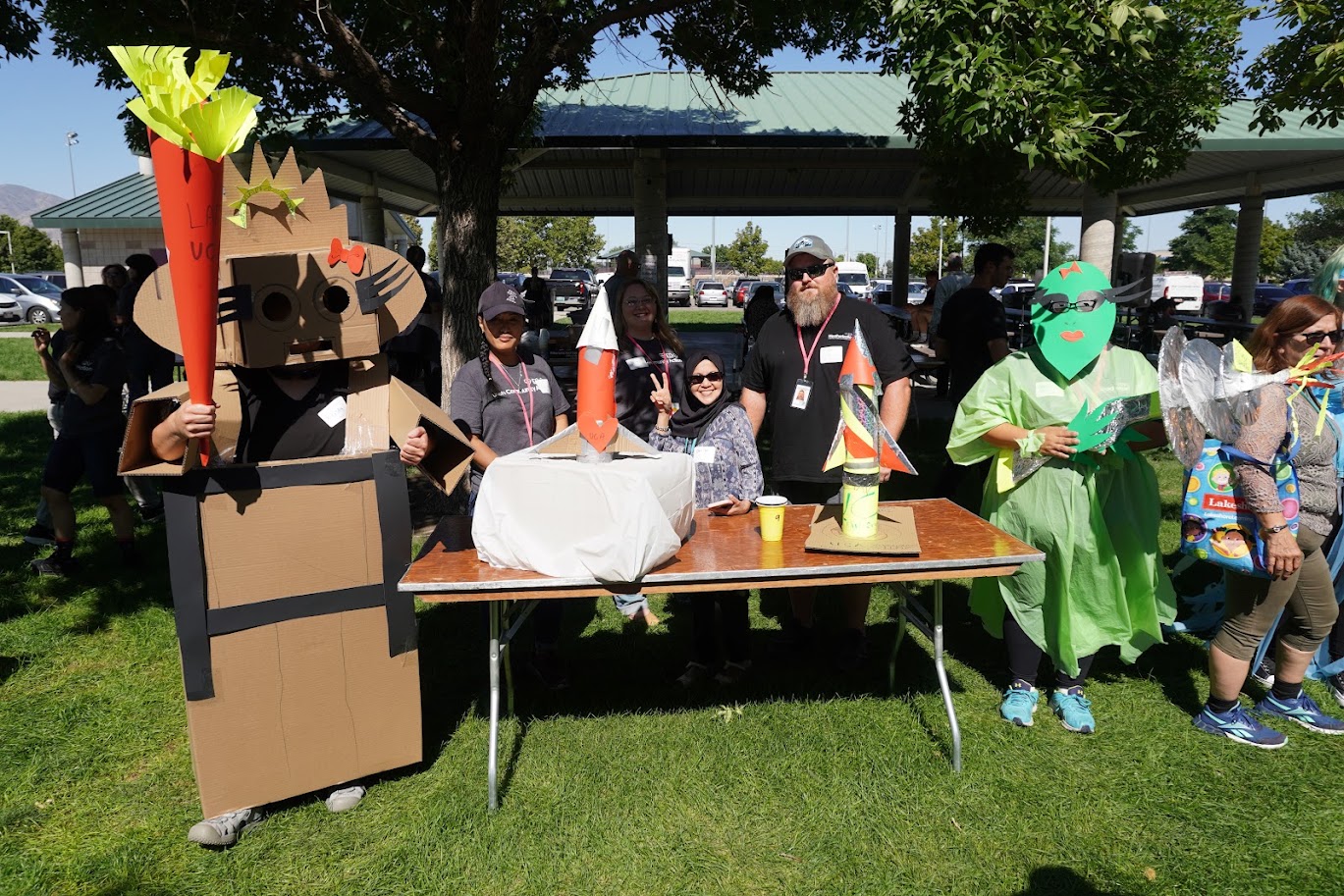
Rocket Challenge. Teams build a rocket from a 2-litre bottle, cardboard and tape that must launch a raw egg and bring it down intact with a parachute or braking device. It needs outdoor open space. The egg makes the result visible to everyone.
Domino Effect Challenge. Each team builds its own section of one giant Rube Goldberg machine, and every section links into a single chain reaction set off by one trigger. It scales further than any other build here. The domino effect team building guide explains why the finale works so well.
Elevated Raceway. Teams engineer sections of one cardboard racetrack, test and refine their run, then race remote-control cars to the finish. The theme is different teams, one seamless track.
Cardboard TRAIN-ing Express. Teams build a full-sized cardboard train, locomotive to caboose, able to carry every person on the team. It rewards a shared vision and clear delegation.
Art of Flight. Teams engineer an aircraft from cardboard and tape, then test, adjust and fly it. The page frames it as the build, test and improve cycle compressed into one session.
Maker's Fair Bootcamp. Open-ended prototyping: teams brainstorm, build and showcase inventions, and each participant leaves with something they made.
Beehive Building. Teams assemble hive equipment from kits following build instructions, with a sustainability theme. If you want a donation, the recipient and the ongoing care of a working hive are agreed in advance.
The bike, STEM kit and guitar builds are covered under charity builds below. One program sometimes grouped with builds is not included: The Dragon Throne is a strategy and negotiation challenge, not a build.
STEM and engineering team building activities
Searches for "STEM team building activities" and "engineering team building activities" usually come from two buyers: technical teams who want a real problem rather than a party game, and companies that want a science or education angle. Builds suit both.
For engineers and analysts, choose a build with a hard, measurable test and a design constraint: the rocket's egg payload, the boat's waterline, the raceway's connected run or the chain reaction's hand-offs. These reward iteration over talk. The guide to team building for engineers covers what technical rooms respond to, and the round-up of problem-solving team activities adds non-build options.
For an education or STEM-outreach angle, STEM Kit Building is the direct fit: teams of 4 to 6 assemble science, technology, engineering and maths kits that are donated to underprivileged youth. No technical skills are needed, so it suits mixed teams where only some people are engineers.
Choosing a build by goal
Start with what you want people to leave with, then check the room.
If the goal is a conference energiser for hundreds, look first at the Domino Effect Challenge, which lists up to 2,700 people, and read FullTilt's large group team building page. For a leadership offsite of a dozen, almost any build works; the boat and the rocket give the sharpest debrief material.
Room and space requirements
The room decides more bookings than the goal does. Check these before you shortlist.
- Per-team floor space. Several program pages state about 100 to 150 square feet per team. Hypothetical planning example: not a FullTilt client case, delivered program or quote. A group of 60 in teams of 6 is ten teams, so roughly 1,000 to 1,500 square feet of build space before walkways, a materials table and a test or showcase area.
- Tables. Most builds need one table and chairs per team, usually from your venue. The Cardboard Boat Build page specifies a 6 ft rectangular table; the TRAIN-ing Express lists five or more tables.
- Water. The boat finale needs a pool, lake or ocean for about the last 20 minutes. FullTilt coordinates pool use with the venue, but confirm the hotel allows it before you announce the event.
- Outdoor open space. The Rocket Challenge needs a grassy field or open parking lot. Have a weather plan; the guide to outdoor team building activities for work covers contingencies.
- Floor protection and clean-up. Program pages do not state mess levels. Cardboard builds produce offcuts and tape; ask your provider and venue who clears up and whether floor covering is needed in a carpeted ballroom.
- Meeting rooms. If you are booked into a hotel meeting room already, see team building in a booked hotel meeting room. Browse FullTilt's indoor team building programs or outdoor team building programs by setting.
Roles for people who do not want to build
Not everyone wants to hold a glue gun, and nobody should have to. A good build has more jobs than hands. Name these roles at the brief, and let people choose:
- Project lead or planner: keeps the design on track and the team on time.
- Designer: sketches the plan before anyone cuts.
- Quality inspector: tests joints, checks the waterline, signs off before the final test.
- Timekeeper: calls the checkpoints so the team does not run out of build time.
- Negotiator or trader: in programs where parts are earned, works the challenges or trades with other teams.
- Presenter: tells the story of the build at the showcase.
- Recorder: notes what worked and what failed, which feeds the debrief.
These roles also help people with mobility limits, injuries or sensory needs take full part, seated if needed. The team building accessibility checklist and the guide to team building activities for introverts cover the wider planning.
Making it competitive without making it divisive
Competition is what makes a build tense in the right way. It turns divisive when the scoring feels arbitrary, when the same team wins everything, or when departments are pitted against each other.
What keeps it friendly, from a facilitator's view:
- Mix teams across departments. Never let a team be one department; the rivalry then follows people back to work.
- Award more than one prize. Best engineering, best design, best team story and the most spectacular failure. Several winners keep the room generous.
- Make the test the judge. Floating, flying, landing or triggering is a fact, not an opinion.
- Use a shared finale. In connected builds, such as the Domino Effect Challenge and Elevated Raceway, every team's work is part of one result. The competition is inside a common goal.
- Let the facilitator manage the edges. A good facilitator spots a team that is struggling and steps in before it becomes embarrassing.
For another competitive format with a lighter touch, see the game show team building guide in this series.
Builds that give something back
Several builds end with a donation, which turns the test into a handover. The bike build has its own charity bike build guide. On the program pages: bikes go to children in need; STEM kits go to underprivileged youth; Charity Guitar Building ends with a ceremony where a representative from a musical charity or underfunded school speaks to the group; and in the Helping Hands Program teams assemble prosthetic hands donated to people who have lost a limb. The Domino Effect Challenge and Elevated Raceway can add a food donation.
FullTilt's charity team building and CSR activities page lists every giving format. For a December event, the holiday giving ideas for work guide shows how to combine a charity build with the holiday party.
Planning and booking
Most build challenges run 1 to 3 hours, which fits an afternoon slot at an offsite or a conference. Build the agenda around the seven stages above and protect the debrief; it is the first thing cut when a morning session overruns. The team building run-of-show template helps you time it.
FullTilt brings the materials and facilitators to your office, hotel or venue across the US and Canada; on-site and off-site team building explains how. Compare builds with other formats on FullTilt's most popular programs or across all team building events. When you have a date, headcount and city, request a proposal from FullTilt.