

Every engineering manager has lived this moment: the company announces team building, and the standup goes quiet in a very specific way. Someone asks if attendance is mandatory. Someone else has a suspiciously immovable dentist appointment. The team that argues passionately about tabs versus spaces for forty minutes has collectively decided, without a word, that two hours of forced fun is a threat to be managed.
The conventional reading is that engineers "hate team building." The accurate reading is more useful: engineers hate bad inputs, and most team building is a bad input. It asks people to perform sociability without a purpose, to share personal information on command, and to spend focused-work hours on activities with no observable output. Those aren't introvert objections — they're engineering objections. The same person dodging the trust-fall retreat will happily spend a Saturday at a hackathon, argue for an hour about a puzzle, or stay late to make a marble run work. The appetite for shared challenge is enormous. The appetite for manufactured mingling is zero.
Which means the fix isn't persuading technical teams to like what they don't like. It's giving them the version built for how they already work: problems first, talking as a side effect. This guide is that version — the design principles, the specific formats ranked by how technical rooms actually receive them, the remote adaptations for distributed dev teams, and the measurement that convinces a skeptical team the time was worth it.
Why standard team building fails technical teams (a root-cause analysis)
Run the five-whys on the groan and you land on four specific failure modes:
- No problem statement. "Get to know each other" isn't a spec. Engineers engage with defined challenges and disengage from ambiguity dressed as freedom — the same reason unstructured mixers die and structured activities don't, documented across every room type in why experiences are replacing icebreakers, but felt most acutely in technical ones.
- Forced disclosure. "Share a fun fact about yourself" converts a social activity into a performance review with worse criteria. The fix isn't skipping questions — it's structure and opt-in: pairs before circles, light before deep, per the escalation architecture in the question library.
- No output. A technical team's culture venerates shipping. An afternoon that produces nothing observable reads as waste even when it was pleasant. The best technical team building ends with an artifact — a machine that runs, a structure that stands, a bike a kid rides away on.
- Charisma scoring. Formats where the most extroverted person "wins" tell your quiet systems architect the event isn't for them. Competence-neutral or competence-celebrating formats flip this — suddenly the person who thinks in dependency graphs is the MVP.
The stakes of getting this right are higher for technical orgs than most: engineering salaries make regretted attrition brutally expensive (replacement runs one-half to two times salary — the math is in the statistics library), cross-team silos between engineering and everyone else are the classic dysfunction (why cross-functional teams fail), and Google's own Project Aristotle research found psychological safety — not talent density — to be the strongest predictor of team effectiveness. Connection is an engineering-performance input. It just has to be built with engineering-grade tools.
The four design principles for technical rooms
- Problem first, people second. The activity's surface must be a legitimate challenge. Conversation happens through the problem — "hand me the small dominoes" becomes "wait, you worked at a robotics startup?" — which is exactly how engineers prefer to meet people: sideways, mid-task, with something else to look at.
- Constraints make it interesting. Unlimited resources bore builders. Limited materials, fixed time, physics that doesn't negotiate — constraints are what turn an activity into a problem worth arguing about. The best formats have rules teams immediately try to optimize against (and a facilitator who enjoys the rules-lawyering).
- Roles for every operating style. Good technical formats need planners, builders, testers, and systems thinkers simultaneously — real jobs for the whiteboard person AND the hands person AND the "have we considered the failure mode" person. Nobody is decoration.
- Debrief like a retro, not a therapy session. Technical teams already have a ritual for extracting lessons from shared experience: the retrospective. Frame the debrief exactly that way — what worked, what surprised us, what maps to how we ship — and the same people who dodge "share your feelings" will run the discussion themselves. This is experiential learning in native dialect.
The format rankings: what technical teams actually enjoy
Tier 1 — Engineering builds (the home turf)
Physical engineering challenges are to technical teams what karaoke is to sales teams — the format that needs no persuading:
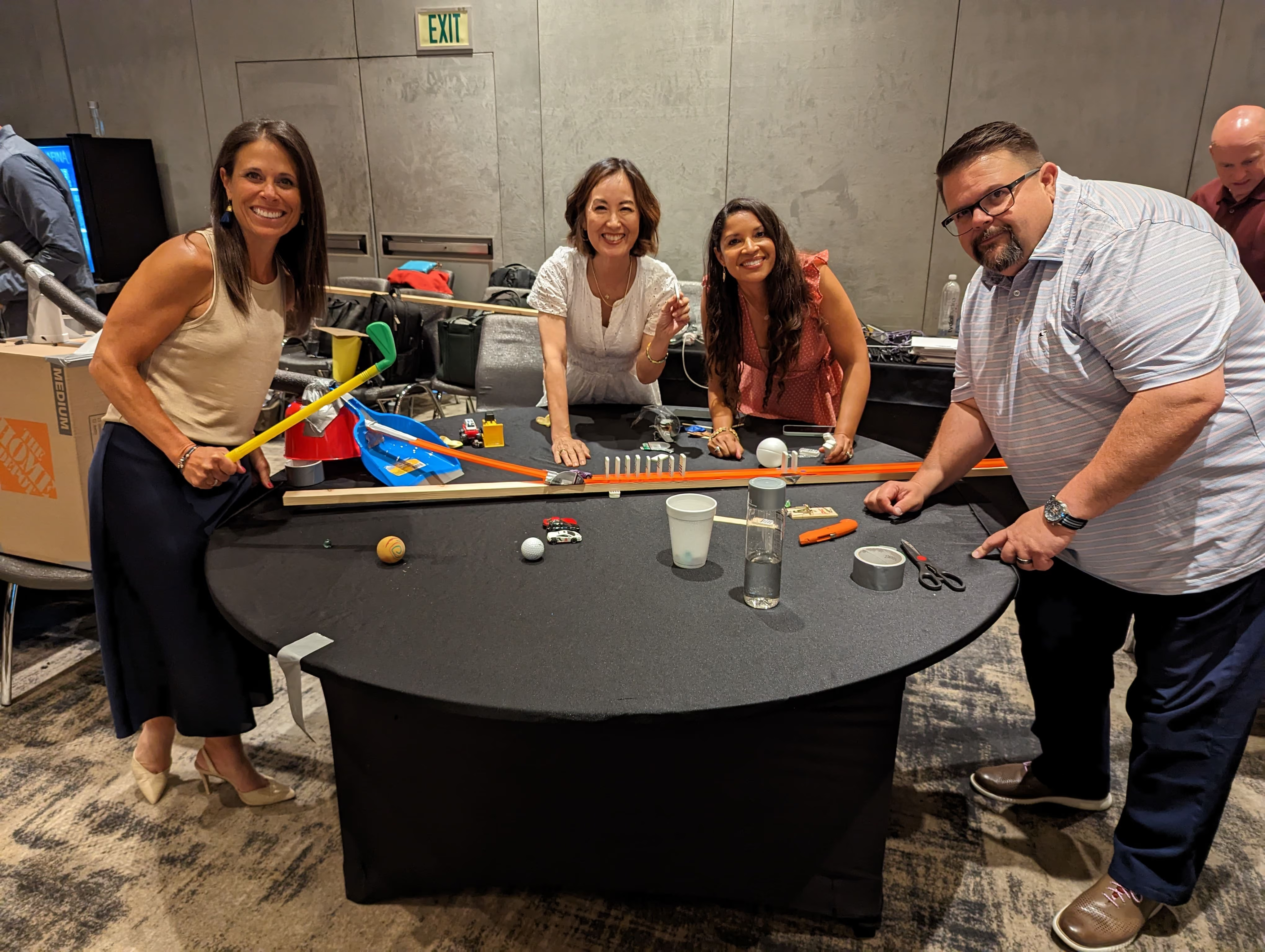
- The chain-reaction build. The Domino Effect Challenge is the single most requested format for engineering orgs, and the reasons are structural: it's a distributed-systems problem made physical. Every team owns a segment; every segment must interface with its neighbors; one integration failure breaks the run. Teams discover they're literally debugging handoffs — and the all-or-nothing finale produces the collective held breath no software launch quite matches (why the chain reaction outperforms everything).
- Rocket and flight builds. Interstellar Rocket Challenge and Art of Flight — design under aerodynamic constraints, test flights, iterate. It's the build-measure-learn loop with cardboard.
- Racetrack and vehicle engineering. Elevated Raceway (design and race cardboard tracks — project management disguised as play) and the Cardboard Boat Build, where the test environment is water and the failure mode is gloriously public.
- Maker formats. Maker Bootcamp and STEM kit challenges for teams that want tools in hand and a bench to work at.
Tier 2 — Logic and strategy competitions
Puzzle-driven formats work because they let engineers socialize through argument — the most comfortable channel available. Clue-chain scavenger hunts and Amazing Race formats with cipher checkpoints; The Dragon Throne for teams that want game theory with physical pieces. For meeting-scale versions, run table-based puzzle rounds from the 75 brain teasers library — built specifically for analytical rooms, with the pairs-not-quiz method that keeps fast solvers from playing solo. (And if the team keeps asking for escape rooms, read the honest escape-room analysis first — the format's ceiling arrives fast at company scale.)
Tier 3 — Competence-neutral chaos (the cross-team mixer that works)
When the goal is mixing engineering with sales, marketing, and ops, pure-skill formats can backfire — you want games where being technical confers zero advantage: Minute to Win It brackets, field-day olympics, Spuds of Thunder. The playing field levels, the org chart dissolves, and the intern beats the CTO at cup-stacking in front of everyone — which is precisely the point.
The charity build — the format that surprises managers most
Technical teams respond to charity bike builds and care-kit missions more strongly than almost any other audience — because the format satisfies every engineering value at once: real specs (the bike must work), real QA (a child will ride it), and an output whose usefulness is beyond argument. More on why in the charity guide.
Remote and distributed dev teams: the hard mode
Engineering went remote harder than any other function, and the connection bill is coming due: distributed teams hold their within-team ties but lose the cross-team network (Microsoft's Work Trend research documented the shrinking-network effect across exactly this population), and remote engineers are the workforce's most isolated professionals by most measures. What works:
- Make the quarterly gather day non-negotiable — and make it a build. One in-person day per quarter, anchored by a physical challenge no video call can replicate, does more than a year of virtual happy hours. This is the hybrid model's core move, and for engineering teams the build format is what makes flying in feel worth it — nobody books a flight for forced fun, but they will for the domino run.
- Between gathers, run structured micro-formats. A weekly brain-teaser round in standup (symmetric on video — the screen is everyone's equal seat), themed demo days, code-golf challenges. Structure substitutes for hallway; the toolkit is micro-moments plus the icebreakers hub's low-cringe tier.
- Never run hybrid-spectator events. A laptop on a chair pointed at the office fun is worse than nothing. If the event can't be symmetric, run parallel real events — the failure modes are cataloged in why employees hate virtual team building.
- Time onboarding to gathers. Remote engineering hires report the weakest early belonging of any group; scheduling start dates so new hires hit an in-person build in their first quarter is free retention (the new-hire playbook).
The engineering manager's playbook
- Sell it like a project, not a party. "We're doing a chain-reaction build — each squad owns a segment, integration is the hard part" gets a fundamentally different reception than "team bonding afternoon!" State the problem, the constraints, and the format. Engineers respect a spec.
- Never surprise the room. Announce format and structure in advance. Ambiguity is what triggers the dentist appointments; a known, bounded, opt-in-personal event defuses them.
- Mix rosters deliberately — across squads, and (for company events) across functions in competence-neutral formats. Self-sorted teams reproduce the org chart and mix nothing.
- Protect the quiet contributors structurally. Fixed think-time, one-answer-per-team rules, and facilitators briefed to distribute airtime — inclusion by mechanism, not exhortation. (This is half of what professional facilitation is for; the other half is in what facilitators actually do.)
- Run the retro, close the loop. Fifteen minutes, retro format, one insight captured where the team will see it again. Then let the artifact live — the winning rocket on the shelf does quiet culture work for months.
- Cadence over blowouts. One quarterly anchor plus light weekly rituals beats an annual mega-event — the frequency evidence is in the cadence research, and the logistics of the low-lift version are the half-day at the office: no travel, no evenings, back at their desks by four.
Budget note for the skeptical director: professionally run build events price like everything else in the market — the ranges are public in the 2026 cost guide — and against engineering-salary replacement costs, the math ends quickly. One retained senior engineer funds a decade of quarterly builds.
The bottom line
Technical teams don't need convincing that connection matters — they've all shipped through a launch night that bonded them more than any offsite. They need the offsite that works the same way: a real problem, honest constraints, a role for every kind of mind, and something at the end that runs, stands, flies, or rides away. Build that, run the retro, and the team that once scheduled dentist appointments will ask when the rematch is.
FullTilt delivers engineering-friendly build events — chain reactions, rockets, racetracks, regattas, and charity builds — fully managed at offices and venues across North America. Tell us your team size and city — we respond in 15 minutes.