

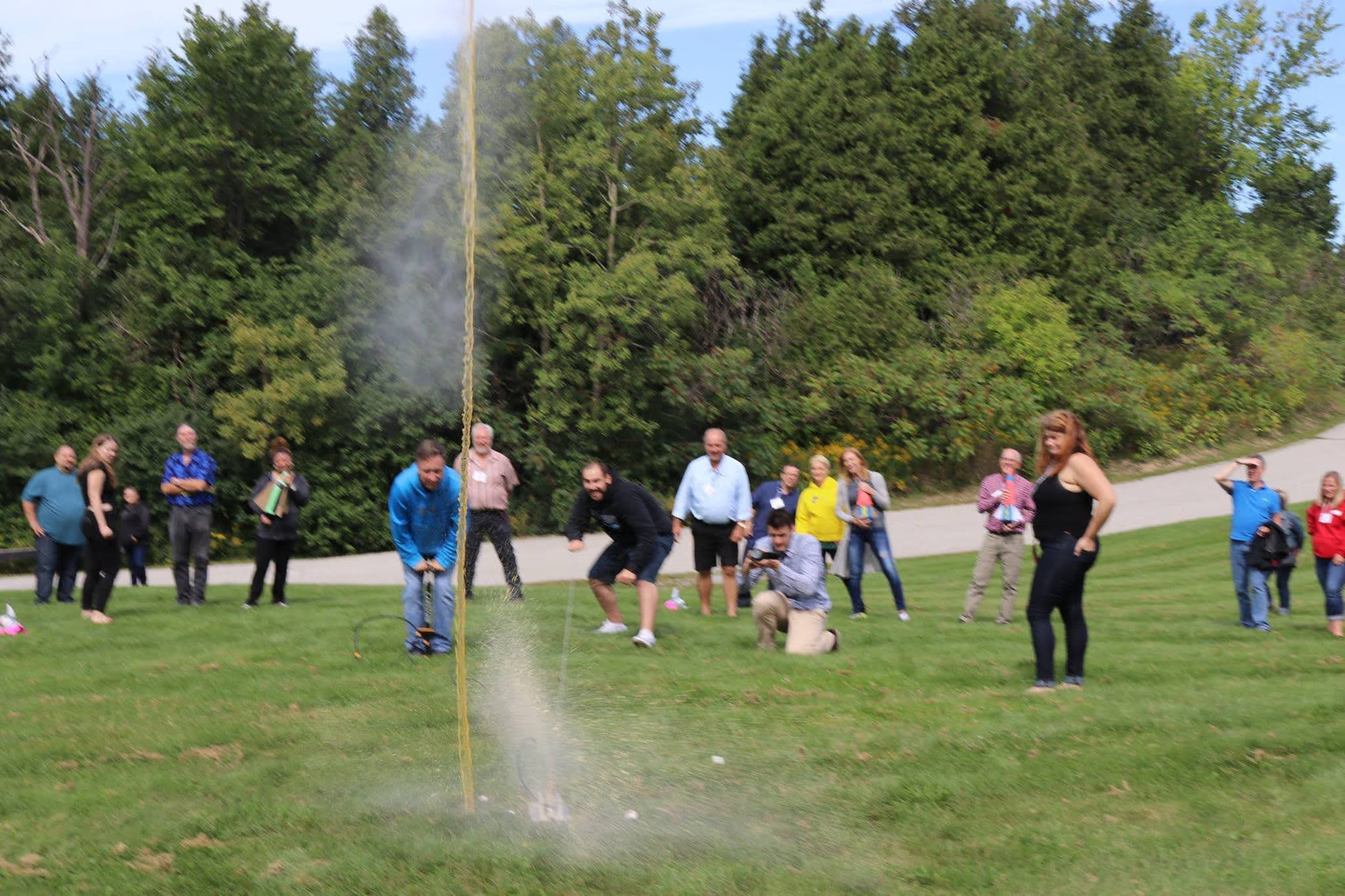
Here's the scene every hybrid company has produced at least once: twenty people laughing in a conference room, a TV on the wall showing six remote colleagues in a Zoom grid, and someone occasionally shouting "you guys playing along at home?" The in-room people remember a fun afternoon. The remote people remember watching other people have one.
We're going to be blunt in this guide, because we've been blunt about this before — in the pros and cons of virtual events, why employees hate virtual team building, and the negatives no one wants to discuss. Hybrid is harder than fully remote, not easier, because it creates two classes of participant by default. But hybrid teams still need connection — arguably more than anyone, which is the whole argument of rebuilding team culture after remote work. So this guide covers what genuinely works: the three models, the formats for each, and the planning rules that keep both cohorts as first-class citizens.
Why hybrid events fail by default
The failure isn't about effort — it's physics. In-room energy is spatial: side chats, shared props, physical momentum. A screen transmits none of it. Worse, hybrid events amplify the exact two-tier dynamic hybrid companies already fight daily: proximity bias, where in-office people get the visibility and remote people get the recording. An event that dramatizes that split does negative work — one of the mistakes that genuinely damage teams.
The three models that work
Every hybrid event that succeeds is secretly one of these three designs. Pick deliberately:
- Symmetric: everyone — in-room and remote — plays the same game on genuinely equal footing.
- Split-cohort: each cohort gets its own complete, parallel experience, connected by a shared outcome (one leaderboard, one combined result, one cause).
- Gather: skip hybrid formats entirely; concentrate the budget into fewer, better fully-in-person days.
Model 1: Symmetric events — everyone on equal footing
Symmetric means the format itself doesn't care where you sit. That rules out most physical activities and rules in:
- Trivia and game-show tournaments where every player answers on their own device — in-room people play on phones too, so nobody has a hardware advantage. Team scores mix cohorts deliberately.
- Digital-first challenges — photo hunts, puzzle races, and app-based missions where the "field" is the same everywhere. (A city-race variant works if every team, in-office included, actually leaves the building.)
- Structured conversation formats — facilitated rounds built on question games, run in mixed video breakouts of 4–5 where a screen is everyone's equal seat. Our icebreaker questions and meeting games libraries are built for exactly these blocks.
- Skill sessions and workshops — creative classes and training modules translate to symmetric delivery better than games do.
The symmetric rule of thumb: if the in-room cohort would enjoy the event with their cameras off, it isn't symmetric. The screen must be the venue for everyone, or for no one.
Model 2: Split-cohort events — parallel experiences, shared outcome
Often better than symmetric, because each cohort gets a format that's actually great for its context instead of a compromise for both:
- The office cohort runs a real physical event — a Minute to Win It bracket, a build challenge — while the remote cohort runs its own synchronized version with kits or digital equivalents, both feeding one company leaderboard revealed together.
- Charity split: office teams pack kits or build bikes on-site; remote teams complete sponsored challenges that add to the same donation total. One cause, two formats, zero spectators — the model we detail in the charity team building guide.
- Multi-hub events: if "remote" really means "three smaller offices," give each hub its own facilitated event on the same day with linked scoring — a genuine strength of nationwide delivery (how multi-city turnkey delivery works).
This is also the right model for hybrid kickoffs — we cover the SKO-specific version in the sales kickoff guide.
Model 3: The gather model — usually the winner
Here's the honest math most hybrid teams eventually arrive at: one genuinely great in-person day per quarter builds more connection than a monthly hybrid event that half the team dreads. Screens transmit information; rooms transmit belonging. If the team is distributed, the highest-ROI move is usually to concentrate the team building budget into gather moments — a quarterly fly-in day, a twice-yearly fully facilitated offsite, an annual all-company gathering — and make those days exceptional.
When the team gathers, the event carries unusual weight: it may be the only shared physical memory of the year, and it has to work for people meeting face-to-face for the first time. That argues for exactly the formats built for mixing strangers into teams — a chain-reaction build where sub-teams are deliberately cross-located, a city race through the gathering city, a charity build finale. Between gathers, keep connection alive with lightweight rituals — micro-moments and the cadence in continuous team building — rather than big hybrid productions.
With engagement at roughly 31% nationally — an 11-year low per Gallup's 2026 research — and connection consistently the thing distributed employees say they miss most, the gather day isn't an indulgence. It's the culture budget doing its actual job.
Planning rules for hybrid teams
- The spectator test. Walk through the plan asking: at any moment, is one cohort watching the other have fun? If yes, redesign.
- Time-zone honesty. A 4pm ET "afternoon social" is a 1pm interruption in LA and a 9pm obligation in London. Rotate the pain or split the sessions.
- Mix cohorts in every team. The event's job is dissolving the office/remote divide, not formalizing it into team rosters.
- Give remote participants real logistics. Shipped kits that arrive on time, a dedicated remote facilitator, and tech-checked platforms — remote experience quality is a budget line, not an afterthought.
- Anchor the year on gathers. Whatever monthly rhythm you run, put real in-person moments on the calendar and treat them as the main event — the framework in how often to do team building and the annual planning calendar.
- Debrief both cohorts. Ask remote participants specifically how the event felt. They'll tell you the truth the in-room energy hid.
The bottom line
Hybrid team building has one commandment: no spectators. Run formats where the screen is everyone's venue, give each cohort its own real experience — or better, put the budget into gather days that make the flights worth it. Your remote people don't want to watch the party through a window. They want a seat at it.
When your team gathers, FullTilt makes the day count — fully managed events in any North American city, engineered for teams meeting in person for the first time. Tell us your city, headcount, and date.