

Every HR team has watched it happen: a great hire, a strong interview loop, a competitive offer — and ninety days later, a resignation that blindsides everyone. The exit interview says "it just wasn't the right fit," which is usually code for something simpler and more fixable: they never connected. They learned the systems, met their manager, shipped their starter project — and ate lunch alone in week six, still waiting for the relationships that make a job a place you belong.
The research on this is unambiguous and HR leaders know the shape of it: early attrition concentrates in the first year, onboarding quality is one of its strongest predictors, and the social dimension — does this person have working relationships and a sense of belonging — predicts retention at least as strongly as the process dimension of laptops and logins. Yet most onboarding programs are 90% process and 10% connection, because process is easy to checklist and connection feels like it should "just happen."
It doesn't just happen — but it can be engineered, cheaply and reliably. This playbook covers the full integration arc: the 90-day timeline, the right activity at each stage (from two-minute question rounds to cohort experience events), the special cases (remote hires, acquisitions, summer classes), and how to measure whether it's working. It's built to be handed to whoever owns onboarding and executed as written.
The retention case: why this is HR's cheapest lever
Frame it the way finance would: turnover is one of the largest controllable costs in the P&L, early-tenure turnover is its most concentrated segment, and belonging is that segment's most under-managed driver. The engagement backdrop makes it sharper — with Gallup's 2026 data showing engagement at roughly a decade low of 31%, new hires are joining teams that may themselves be running on fumes, which means integration left to "organic" chance is integration left to the least-resourced part of the culture. The companies getting this right aren't spending dramatically more; they're spending deliberately earlier — front-loading connection into the window when a new hire is deciding, mostly subconsciously, whether they've made a good decision.
The three rules of new-hire integration
- Pairs before circles. Answering a question to one person is a conversation; answering it to a seated circle of twelve strangers is a performance review. Every early-stage format runs pairs-first, then small tables, then (only once comfort exists) the full group. This one structural choice eliminates most of what people hate about onboarding activities.
- Light before deep. Depth is earned on a schedule the new hire controls, not the calendar. Week-one questions are coffee orders and hometowns; month-three questions can touch working styles and ambitions. The full escalation architecture — with 110 questions organized by trust tier — is in our get-to-know-you questions library.
- Shared doing before scheduled socializing. A happy hour asks a new hire to manufacture small talk with strangers; a shared activity gives everyone a task, a team, and something to talk about. Structure is kindness — the entire argument of why experience-based team building is replacing icebreakers, applied at the moment it matters most.
Days 1–7: land them gently
Week one's social job is small and specific: the new hire should end it able to name five colleagues, feel unweird about messaging three of them, and have eaten lunch with humans at least twice. The toolkit:
- The pairs-first introduction (day one). Replace the spotlight intro ("tell us about yourself!") with two-minute pair conversations that rotate twice, then optional volunteer shares. Use day-one-safe prompts — favorite first-job story, best local lunch recommendation — from the Tier-1 set in the question library.
- A named buddy, with a script. Buddy programs fail when the buddy's job is vague. Make it concrete: lunch on day one, a 15-minute check-in on days 3 and 7, and one standing invitation per week for a month. The buddy is deliberately not the manager — new hires need one relationship with no performance stakes.
- The team question round (first team meeting). One light question, everyone answers including the veterans — because the round's secret function is showing the new hire who these people are, fast. A rotation of options: icebreaker questions and would-you-rather formats, governed by the craft rules in the icebreakers hub.
- Lunch logistics, handled. Assign the first three lunches explicitly (buddy, team, cross-team). "Grab lunch with anyone!" is how new hires end up at their desk with a sandwich and a growing doubt.
Weeks 2–4: the first team event
Sometime in the first month, the new hire should experience the team doing something that isn't work — because that's where they'll finally see the personalities under the job titles, and where the team stops treating them as a guest. Two design notes that make it work:
- Time it to arrivals, don't create it for them. If the team runs a regular rhythm — the monthly anchor from a standing annual program, a recurring games block from the meeting formats library — new hires simply land inside it. This is one of the recurring program's quiet superpowers: onboarding integration comes free with the cadence.
- Engineer the roster. The new hire goes on a team of well-mixed veterans — never a "new people's table" — in a format where being new carries zero disadvantage: a Minute to Win It bracket, a scavenger hunt, a build challenge. Competence-neutral formats let a week-two hire contribute equally with a ten-year veteran — which is precisely the memory you want them forming.
If the team has no rhythm to land in, the first month is the reason to start one: a simple office event — the logistics playbook is the office team building guide — in the half-day format that costs no travel and no evenings.
Quarter one: the cohort experience event
For companies hiring in waves — quarterly classes, post-funding sprints, seasonal ramps — the cohort event is the single highest-impact intervention in this playbook. The insight it's built on: a new hire's most durable early relationships are usually with other new hires. They share the same questions, the same imposter flickers, the same freedom from existing cliques. A cohort that bonds becomes a peer support network that spans departments — exactly the cross-functional web the org chart can't create — and cohort friendships are among the strongest retention anchors a company can install.
The format: a 2–3 hour facilitated experience for the hiring class (plus, ideally, a sprinkling of embedded veterans as culture carriers), 4–8 weeks after the class starts — late enough that they have context, early enough that habits haven't hardened. What works:
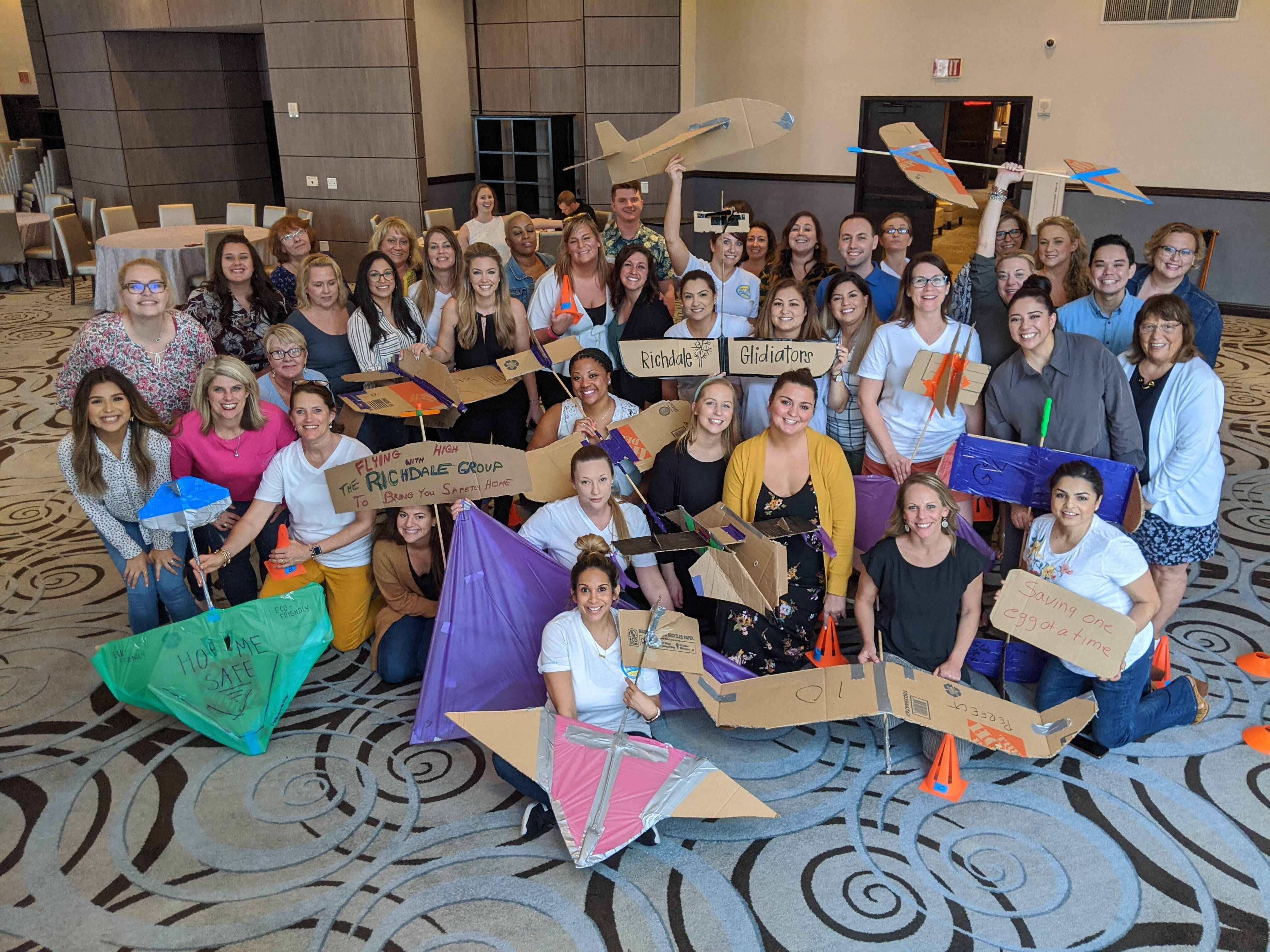
- Build challenges — a Domino Effect build or STEM kit challenge where cross-department squads produce something together; the chain-reaction finale doubles as the class's origin story (why this format bonds strangers fastest).
- City or campus races — an Amazing Race around the office neighborhood, which sneaks in workplace-geography learning while it mixes the class.
- Charity builds — a care-kit mission that makes the cohort's first collective act a generous one; a values statement no slide deck can match (the charity guide).
Close every cohort event the same way: a short facilitated debrief plus one structural output — cohort channel created, monthly cohort lunch scheduled, done. The event lights the connection; the ritual keeps it burning.
Remote and hybrid new hires
Remote joiners face the integration problem at maximum difficulty: no hallway, no lunch table, no ambient osmosis — and the research on distributed culture (see rebuilding team culture after remote work) says the missing ingredient is exactly what onboarding needs most. Adaptations:
- Double the structure. Everything ambient must become explicit: more scheduled pairs, a buddy with a tighter script, cameras-on team question rounds using symmetric formats where the screen is everyone's equal seat (the hybrid playbook).
- Get them in the room once, early. One in-person gather in the first quarter — timed to a team anchor event or cohort day — does more integration than three months of video. If the company runs gather days, new-hire start dates should be scheduled with them in mind; it's free leverage.
- Never let them spectate. If the office runs an event a remote hire can't attend, they get a real parallel role or a different real moment — not a laptop on a chair pointed at the fun. The spectator experience is bad for anyone; for a week-three hire it's a resignation letter with a delay timer.
Special cases
Acquisitions and mergers
Acquired teams are onboarding cohorts with feelings — they didn't apply to be here. Integration events for them lean collaborative (never acquirer-vs-acquired competitive), mix rosters aggressively across the old boundary, and come early: the first ninety days decide whether "us and them" hardens or dissolves.
Interns and early-career classes
The intern class is a cohort event on an accelerated clock — run it in week two, not month two, and bias toward high-energy formats; the generational engagement notes in multigenerational team building apply doubly here. The summer-class event is also a recruiting asset: it's the photo the interns post, and next year's class applies partly because of it.
Large classes (50+)
Big onboarding waves — new offices, seasonal ramps — get the full parallel-operations treatment: multi-zone events, wave scheduling, facilitator density scaled to headcount, per the large-groups guide.
The new manager
A new hire who arrives as the boss inverts the whole playbook — their integration runs through listening structures and earned trust, and it has its own complete guide: team building for new managers.
Measuring whether it's working
- 90-day pulse, three social questions: "I have people at work I'd ask for help" / "I feel part of my team" / "I've had non-work conversations with colleagues from outside my team." Score these separately from process-onboarding questions — they move differently and matter more.
- First-year attrition, cohort-cut. The headline metric. Compare classes that got the full playbook against historical baselines; the delta is the program's ROI statement.
- Network spread. Cheap proxy: in month three, can the new hire name a working contact in three departments? If integration is working, cross-functional threads appear without being assigned.
- Buddy program completion. Leading indicator — when buddy check-ins quietly stop happening, the social layer is decaying before the surveys will show it.
The bottom line
Hiring gets someone in the building; integration decides whether they stay. Engineer it like the retention system it is: pairs before circles in week one, a real team event in month one, a cohort experience in quarter one, and double structure for anyone remote. None of it is expensive. All of it is cheaper than the resignation you didn't see coming.
FullTilt runs onboarding cohort events and team integration experiences at offices across North America — fully managed, from a 20-person hiring class to a 200-person new-office launch. Tell us your class size and timeline — we respond in 15 minutes.