

By sector · Nonprofit and mission-driven
Nonprofit teams already have the thing most companies pay team building to create: a shared purpose. What they lack is recovery time, cross-program trust, and a budget that survives a board meeting. This guide is built around those three realities, with ideas that cost nothing, ideas that cost a little, and a case for the ones that cost more.
FullTilt Team Development · Updated September 2026 · 15 min read
Corporate team building spends a lot of effort manufacturing something nonprofits have by default: a reason to care. Nobody working at a food bank, a shelter, an advocacy organization or a community health clinic needs an exercise to discover shared purpose. What they need is very different, and most team building content, written for companies, misses it entirely.
Mission-driven teams run on purpose and run out of everything else. They work with thin budgets, heavy caseloads, chronic understaffing and constant scrutiny of every dollar spent on anything that is not the program. The mission becomes both the reason people stay and the reason they never take a break. Gallup's 2026 reporting puts U.S. employee engagement at 31%, an eleven-year low; in nonprofits, the risk is rarely disengagement. It is exhaustion, and the quiet resignation of a program lead whose replacement will take nine months to find and train.
This guide is written for executive directors, program directors, operations leads and HR generalists at nonprofits and other mission-driven organizations (social enterprises, foundations, faith-based service groups, public agencies). It covers the three problems purpose does not solve, 28 activities sorted by cost, formats for boards and volunteers, how to pay for it and justify it, and how to measure the result. It is a companion to, not a repeat of, our guides to charity team building for corporate HR leaders, which are about companies giving back; this one is about the teams who do the giving for a living.
Why mission-driven teams need different team building
The mission is the motivator and the trap
Purpose is a powerful reason to work hard. It is also, in many organizations, the unspoken reason nobody is allowed to be tired. "We do this for the clients" becomes the answer to every request for a lighter week. Team building that adds one more obligation, however well-intentioned, makes this worse. Team building that gives people a sanctioned, structured break with colleagues, and comes back to the mission with something made, makes it better. The mental-health dimension is covered in how team building can improve mental health at work.
Programs compete more than they collaborate
In most nonprofits, programs are funded separately, reported separately and, quietly, ranked against each other by funders. Development staff and program staff often see each other as obstacles: one asks for stories and numbers, the other resents being interrupted for them. This is the nonprofit version of the silo problem in why cross-functional teams fail, and it is the single biggest opportunity for team building in the sector.
The board is a report, not a relationship
Most staff meet the board through a quarterly slide deck. Most board members understand operations through that deck. A once-a-year event where they build something together changes the tone of every subsequent board meeting.
Every dollar is watched
Overhead ratios, funder restrictions and public scrutiny make a line item called "team building" politically risky in a way it is not for a company. The guide takes that seriously: ten ideas below cost nothing, eight cost very little, and the section on paying for it is written for a board conversation.
The three problems purpose does not solve
- Recovery. Structured time away from cases, campaigns and crises, with colleagues, that leaves people more capable rather than more behind.
- Cross-boundary trust. Between programs, between development and program staff, between headquarters and field sites, and between staff and board.
- Recognition beyond the number. Nonprofits celebrate campaign totals and grant wins. The case manager who kept a family housed and the operations coordinator who fixed the intake form rarely get a moment. Recognition rituals have to be built for them.
Every activity that follows maps to at least one of the three.
Zero-cost activities (1 to 10)
1. The mission-moment round
15 min · any size · recovery, recognition
Open a staff meeting with each person sharing, in one minute, a specific moment from the past month when the mission became real. Not metrics; a moment. It reconnects people to why they are tired, which is different from being told to push through.
2. Cross-program shadowing
2 hours · pairs · trust
A development officer sits with a case manager for a morning; the case manager joins a donor call. Nothing builds respect between programs faster, and it costs a calendar invite.
3. The "what I wish you knew" exchange
30 min · two teams · trust
Two programs each write three things they wish the other understood about their work, then swap and discuss. Facilitated by whoever is most neutral. Uncomfortable for ten minutes, useful for a year.
4. Peer recognition with a rule
10 min weekly · any size · recognition
A standing slot where anyone can recognize a colleague, with one rule: name the specific action. "Maria rewrote the intake form and cut client wait time." Separate this entirely from fundraising results. Mechanics in employee appreciation week ideas.
5. Quick games in the staff meeting
5 to 15 min · any size · recovery
Low-stakes, fast, and they reset the room after a hard update. Forty options in 40 quick team building activities; prompt libraries in icebreaker questions and get-to-know-you questions.
6. Client-voice reading
10 min monthly · any size · recognition
Read three pieces of unsolicited client or community feedback aloud, naming the staff involved where appropriate. Nonprofits collect this for funders and rarely share it with the people who earned it.
7. The problem-swap
45 min · mixed teams of 4 · trust
Each program brings one stuck operational problem; a mixed team from other programs works on it for 20 minutes and presents options. Fresh eyes, and a reminder that the organization has more collective ingenuity than any single team.
8. Walking meetings with a purpose
30 min · pairs · recovery
Pair people across programs for a walk with one prompt: what is one thing that would make your week easier that I might be able to help with? Ideas in micro team building moments.
9. Story bank build
45 min · any size · trust, recognition
Program staff and development staff together turn recent client outcomes into three short, consented stories for grant reports. Development gets what it needs; program staff see their work presented well. The friction between the two teams drops noticeably after one session.
10. The gratitude exchange
20 min · any size · recognition
Everyone writes one specific note to a colleague in another program. Read aloud or delivered privately, by choice. The same mechanics as the rituals in Thanksgiving team building, and they work in any month.
Low-cost activities (11 to 18)
11. Potluck with a purpose
90 min · any size · recovery
A shared meal where each program presents one thing it is proud of this quarter, in three minutes, with no slides. The food is the excuse; the presentations are the point.
12. Office scavenger hunt across programs
45 min · any size · trust
Clues that require visiting every program's space and learning one thing from each. Ideas in 60 office scavenger hunt ideas.
13. Trivia night about the organization
60 min · any size · trust
Rounds on the organization's history, each program's work, and the community served. Staff learn more about each other's programs in an hour than in a year of all-hands. Format in trivia team building.
14. Mixed-team build with donated materials
90 min · teams of 5 · trust, recovery
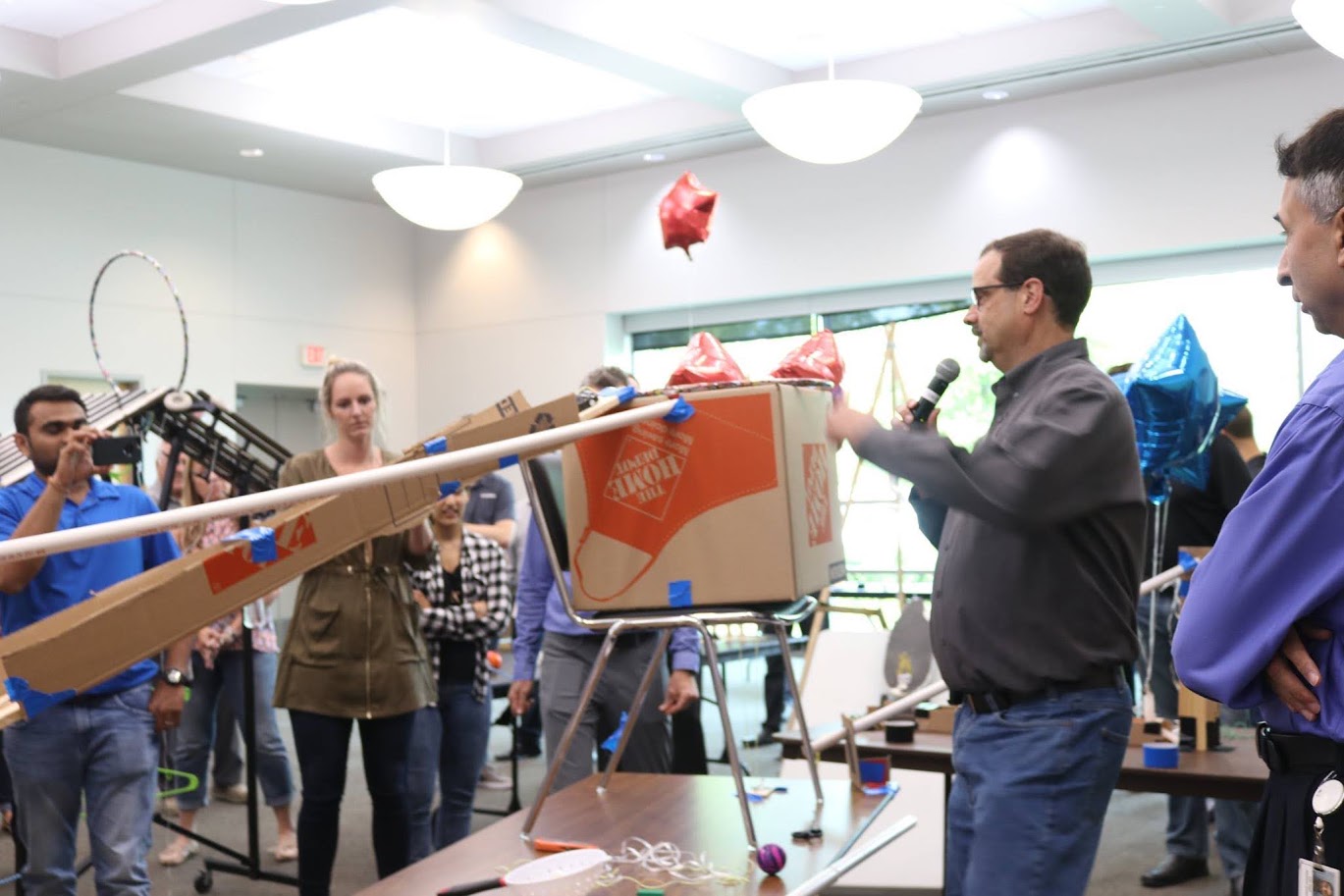
Cardboard, tape and a design brief (a shelter model, a bridge, a device for a client need). Cheap, absorbing, and it puts a program director and an intake coordinator on the same team with a clock running.
15. Office Olympics
90 min · 20 to 200 · recovery
Desk-native competitions with no venue cost. Rulebook in Office Olympics.
16. Wellness challenge by program
4 weeks · any size · recovery
Team-level, not individual, so nobody is exposed. Options in wellness activities for employees.
17. Skill-share afternoon
2 hours · any size · trust, recognition
Staff teach 20-minute sessions on something they are good at, work-related or not. It surfaces talents hidden by job titles and gives quiet experts a moment.
18. The half-day away, at a partner's space
3 to 4 hours · full team · recovery
Borrow a partner organization's community room, a library meeting space or a supporter's office for a change of scene, then run two or three of the activities above. The half-day model keeps program coverage intact.
Facilitated programs worth the spend (19 to 24)
There is a point, usually somewhere past 30 people or after a merger, leadership change or a hard year, where a professionally facilitated program is worth the money because nobody on staff has the capacity to run a great event and also participate in it. The honest comparison is in DIY vs hiring a team building company. For nonprofits, the strongest formats are the ones whose output goes somewhere.
19. Build for another cause
2 hours · 20 to 500
A team that serves one community builds bikes, care kits or prosthetic hands for another. It is restorative in a specific way: for once, the staff are the givers with no reporting obligation. See Bicycle Build Challenge, Mission Incredible: Backpack Care Kit and Helping Hands.
20. Domino Effect Challenge
2 hours · 20 to 300
Each program builds one section of a chain reaction; the finale only works if every handoff connects. There is no better metaphor for a multi-program organization, and the debrief writes itself. Program details.
21. Cardboard Boat Build
3 hours · 20 to 200
Design under constraint, then a race. Cardboard Boat Build is the format staff describe as "the first time I laughed at work in months."
22. Amazing Race through the community you serve
2 to 3 hours · 20 to 300
Stations at partner sites, community landmarks and the organization's own locations. Our Amazing Race can be routed through the neighborhoods the mission touches.
23. Junkyard Orchestra
2 hours · 30 to 300
Instruments from junk, a composition, a performance. Junkyard Orchestra is pure recovery, and it works for any budget venue with a big room.
24. A leadership offsite that produces decisions
1 to 2 days · leadership team
For executive teams facing strategy, succession or a merger. Agendas in leadership retreat ideas; the difference between an offsite and a retreat in this guide.
Board, staff and volunteer formats (25 to 28)
25. The annual board-and-staff build
2 hours · 20 to 100
Deliberately mixed teams (two staff, one board member, one volunteer leader) tackle a shared build. Board members learn what the frontline is like; staff learn that board members are people. The relationship change is visible at the next board meeting. Any of the facilitated formats above work.
26. The operational reality tour
2 hours · board members in pairs with staff
Board members shadow a program for a morning, then a shared lunch with a single question: what surprised you? Cheaper than a retreat and often more useful.
27. Volunteer appreciation with a build
90 min · any size
After a volunteer shift, a short facilitated challenge or recognition ceremony with specific stories about what volunteers made possible. Keep it optional and free for volunteers; ideas in employee appreciation day ideas translate directly.
28. The merger or restructure reset
half day · full team
Nonprofit mergers and program restructures are common and rarely supported with anything beyond an all-hands. A facilitated mixed-team program in the first 90 days does more for integration than a year of joint meetings; the principles in team building after layoffs and team building for new managers apply.
Paying for it: budgets, timing and the board case
Making the money work
- Use your own space or a partner's. Venue cost is the easiest line to remove; see office team building.
- Ask providers about nonprofit pricing. Many event companies adjust for registered nonprofits; ask directly.
- Share a session. Two small organizations can split one facilitated program and its minimum, and the cross-organization mixing is a bonus.
- Choose low-season dates. January to March and mid-summer are often easier to book and sometimes cheaper; avoid your own campaign peaks.
- Fund it from the right line. Professional development, staff wellbeing or retention lines, or a restricted gift from a board member who wants to support the team, are more defensible than general overhead.
- Know the market range. Facilitated programs typically run $25 to $150 per person with minimums of $1,500 to $5,000; cost drivers are in how much team building costs.
Timing around the nonprofit calendar
Do not schedule against year-end giving, a grant deadline, a gala or a program launch. The best windows are usually after a campaign closes, in the quiet weeks of late January and February, and in early summer before program peaks. Map it once against your own calendar and it becomes an annual line; the template in the annual team building calendar adapts easily.
The board case in five sentences
"We lost [n] staff last year at an estimated replacement cost of [$] each, and [program] has [a specific relationship problem]. This is a [$] program, funded from [line], to reduce turnover and improve collaboration between [teams]. We will measure [retention, pulse score, cross-program project time] against a baseline and report at the [month] meeting. We considered doing nothing and running it ourselves; here is why this option is the better use of staff time. I am asking for approval by [date]." The full framework, including answers to the objections you will hear, is in how to get team building approved.
Measuring what changed
Frameworks in team building ROI and measuring the ROI of team building; for citable figures, team building statistics.
Mistakes to avoid
- Making it a fundraiser. A staff event that becomes a donor event is not a staff event. Keep the two separate.
- Mission as the agenda. If the day is another strategy session with snacks, it adds to the load. Purpose is the context, not the content.
- Mandatory attendance for exhausted people. Opt-in, always, and cover programs so nobody is choosing between clients and colleagues.
- Ignoring field sites and remote staff. Distributed programs need a hosted track of their own; see hybrid team building.
- Treating it as a fix for understaffing. It is not. The list of what it cannot do is in seven things team building will never fix.
- One event, then silence. The free rituals above are what make a single facilitated event stick.
The bottom line
Mission-driven teams do not need to be reminded why the work matters. They need permission and structure to recover, relationships across the boundaries that funding creates, a working connection with their board, and recognition that has nothing to do with the year-end total. Most of that is free. Some of it is worth paying for, once a year, and the board case for it is retention. Design for the three problems purpose does not solve, schedule around the campaign calendar, and measure what changed.
FullTilt Team Development runs facilitated programs for nonprofit staff, boards and volunteer groups across North America, at your space, a partner venue or an outdoor site, for 15 to 500 or more participants, with formats whose output can be directed to another cause. Tell us about your team and your budget; you will have options and a price in 15 minutes.