

Sales gets a kickoff. Everyone else gets a calendar invite that says "2027 Planning" and a slide deck. Here's the January reset every other department deserves: the four-part framework, formats that work for non-sales teams, goal-setting that survives February, re-onboarding a team that scattered over the holidays, and the 90-day rhythm that keeps the energy from evaporating by Valentine's Day.
Every January, sales organizations fly everyone to a hotel, put on a show, hand out awards, announce the number, and send people home fired up. It works — which is why the sales kickoff is one of the few corporate rituals nobody argues about (the full architecture: SKO team building).
Meanwhile, engineering, operations, finance, marketing, customer success, and HR return from the holidays to... an inbox. Maybe a departmental planning meeting where someone reads goals off a slide. The year starts not with a starting gun but with a slow, ambient resumption — and the team that fractured over three weeks of staggered PTO simply never formally reassembles. By the time everyone's fully back in rhythm, it's February, and whatever momentum January could have generated has quietly expired.
This is a genuinely strange asymmetry, because the psychology January offers isn't sales-specific. Behavioral researchers call it the fresh start effect — the well-documented tendency for temporal landmarks (a new year, a new month, a birthday) to increase people's willingness to pursue change. January is the single largest fresh-start landmark on the calendar, and most departments spend it on housekeeping. This guide is the fix: a reset framework any team can run, formats that fit non-sales cultures, goal-setting that doesn't dissolve, and the rhythm that carries the momentum into Q2.
Why January matters more than the calendar suggests
The fresh start effect is real, and it expires
Research on temporal landmarks consistently finds that people are more willing to pursue goals and change behavior right after a meaningful date boundary. January 1 is the largest such boundary in the working year — which means the same conversation about how the team wants to operate lands very differently on January 12th than it does on March 12th. The window is genuinely open in early January and genuinely closes by February; a team that gets its reset done inside it is working with the current instead of against it.
Holiday breaks fracture teams quietly
The end-of-year period scatters everyone on different schedules for three-plus weeks. Nothing dramatic happens — but the informal ties that daily proximity maintains (the hallway questions, the ambient awareness of what others are working on, the shared jokes) go dormant, and they don't automatically restart. Distributed and hybrid teams feel this hardest, since they had less connective tissue to begin with (the hybrid playbook). A reset event is the deliberate reassembly that a return-to-inbox January never provides.
January rhythm becomes the year's rhythm
Whatever the team does in the first weeks tends to stick: if January is meetings-as-usual, that's the year's default. If January includes a real gathering, explicit norms, and a stated cadence, the team spends the year inside that structure instead. With U.S. engagement near an eleven-year low (Gallup's 2026 reporting puts it around 31%), the cost of a default January is higher than it used to be — and the upside of a deliberate one is correspondingly larger.
The four-part reset framework
Part 1 — Close the old year properly
Most teams never formally end a year; they just stop working in December and start again in January. A proper close takes thirty minutes and does real work: name what the team shipped (specifically — people forget their own wins), name what was hard and what it cost, and recognize individual contributions by name. This is the retro applied at annual scale, and if your November included a gratitude program (the November playbook), January's close is where it pays off — you already have the material. Skipping this step is why teams carry unprocessed frustration into the new year: nothing was ever declared finished.
Part 2 — Reconnect the team (the half most resets skip)
This is where a planning meeting becomes a reset. After three weeks apart, a team needs to be a team again before it can usefully plan together — which is what a shared experience does and what a slide deck cannot. Formats that fit January well:
- Indoor tournaments. January is brutal weather in most of North America, which makes Minute to Win It brackets and similar game-show formats the month's workhorse — any room, any headcount, instant energy.
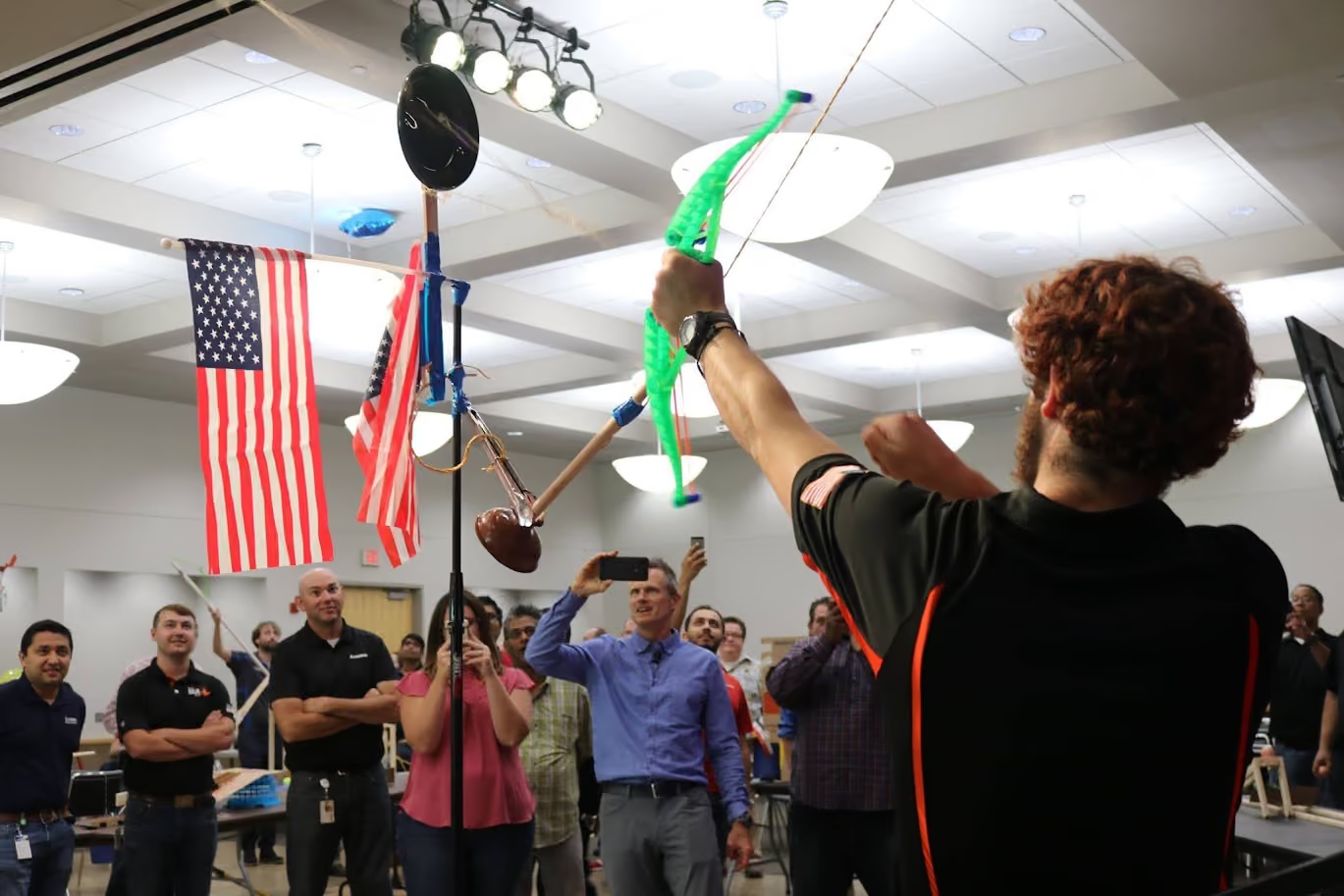
- Build challenges. The Domino Effect Challenge is a superb January event because the metaphor is the year itself: independent segments, one shared outcome, every handoff mattering (why chain reactions land so hard). Rocket builds and racetrack challenges work the same way for smaller rooms.
- Charity builds. Starting the year by giving sets a tone no mission-statement slide can — and January is when donation organizations are quietest after the December surge (the charity guide).
- Culinary competitions. A warm, indoor, January-appropriate format that ends in a shared meal — Iron Chef battles for the energy, a wine experience for leadership groups.
More January-specific options in new year team building experiences and, for the weather-constrained, winter event planning.
Part 3 — Set direction together
The difference between goals a team receives and goals a team shapes shows up in July. Practical structure: leadership brings the non-negotiables (the company's actual priorities — don't pretend otherwise), the team works in small mixed groups on how those translate into their work, and the session ends with 3–5 team-level commitments in the team's own words, plus explicit working norms (how we run meetings, how we handle handoffs, what we stop doing). The "what we stop doing" line is the most valuable and most skipped — every team is carrying processes that made sense in 2024.
Part 4 — Establish the rhythm
The reset's final act is scheduling its own follow-through: quarterly team anchors on the calendar now, monthly manager-run rituals, and a stated review point. Teams that leave January without dates on the calendar are relying on motivation, which decays; teams that leave with a cadence are relying on structure, which doesn't. The evidence for cadence over intensity is in the frequency research, the year-round architecture is in continuous team building, and the practical way to lock four dates in one decision is the annual partner model.
Reset formats by department
- Engineering and technical teams: lead with a build. Problem-first formats work where feelings-first formats fail, and January's goal-setting lands better after a chain-reaction build than before it — the full audience guide is team building for engineers.
- Finance and accounting: the cruelest January in the building — year-end close plus audit prep plus tax season looming. The move is a pre-season reset in the first half of January before close consumes everything, kept short and deliberately unrelated to spreadsheets (team building for finance teams).
- Customer success and support: January brings renewal surges and post-holiday ticket floods. Short high-energy formats scheduled around shift coverage, plus recognition for the invisible saves nobody logs.
- Marketing: planning-heavy in January by nature — which makes the connection half easy to skip and important to protect. Creative-competitive formats (film-making challenges) match the culture.
- Cross-functional and whole-company: the highest-value version. January is when annual priorities require teams that barely speak to collaborate — and the handoff seams between them are where the year's plans usually die (why cross-functional teams fail). Mixed rosters, no home-field advantage, scale operations for the headcount (large-group mechanics).
- New managers and leadership teams: January is the natural moment to invest in the layer that carries culture all year (executive team building, and the gap this addresses: the manager training gap).
Re-onboarding: the people January forgets
Two groups need extra attention in a January reset. People who joined in Q4 onboarded into a company that was already winding down — they met a fraction of the team, missed the rhythm, and returned in January still functionally new. Give them roles in the reset event rather than observer status; the integration playbook is team building for new hires. And anyone who joined remotely during the holiday period is, statistically, the least-connected person in the building — January's gathering is their real first day, and treating it that way is among the cheapest retention moves available.
Making it stick past February
- Leave with dates, not intentions. The quarterly anchors go on the calendar during the reset, not "sometime soon."
- Give the norms a home. The working agreements the team wrote need to live somewhere visible and get referenced in month two, or they were theater.
- Assign the rituals to managers. Weekly two-minute openers and monthly light formats carry the connection between anchors — the toolkit is micro-moments, the icebreakers hub, and meeting games. These cost nothing and are the difference between a program and an event.
- Book the Q2 anchor before Q1 ends. The mid-Q2 slot is the first place a January reset's energy visibly needs topping up; a half-day at the office is the standard refill.
- Measure something. A five-question pulse in January and again at the end of Q1 — connection, clarity, belonging — turns "that was nice" into evidence that funds next year (the ROI business case).
Booking note: January is the busiest month in the corporate events calendar — kickoff season fills provider capacity nationwide, and the good dates go in the fall. Book your January reset by November; if you're reading this later, ask anyway, because standing-crew providers can often still deliver (the short-notice playbook). Budget context: the 2026 cost guide.
The bottom line
Sales figured this out decades ago: a year that starts with a gathering beats a year that starts with an inbox. Everything the SKO does — close the chapter, reassemble the humans, agree on where you're going, put dates on the calendar — works exactly as well for engineering, finance, ops, and marketing. January's fresh-start window is open for about three weeks, it's the same window every year, and it's the cheapest momentum a team will get all year. Spend it on purpose.
FullTilt runs January reset events for every kind of team — indoor tournaments, build challenges, charity builds, and culinary competitions, fully managed at your office or venue across North America. Tell us your team and your January week — exact pricing in 15 minutes.