

The Peninsula has the highest concentration of engineering talent on Earth, the best year-round event weather in the Bay Area, and corporate campuses that make better venues than most hotels. It also has the most icebreaker-resistant workforce anywhere. Here's the guide that takes all three seriously: 30 activities built for technical teams, venues from Stanford to Mountain View to Santa Clara, the microclimate calendar, and how campus-delivered events work when your headcount is 20 or 2,000.
Team building in Silicon Valley has a specific reputation problem, and it's earned. The region's workforce has sat through more mandatory-fun offsites than any population in corporate history — enough that "team building" as a phrase triggers a reflexive eye-roll in most Palo Alto conference rooms. Engineers, product teams, and the operations people who support them have developed a finely tuned detector for activities with no problem statement, no output, and a facilitator saying "let's go around the room."
Which is why the events that actually work here are built differently. Problem first, talking second. A chain-reaction machine that only runs if every team's segment integrates. A rocket that has to fly. A bike that a child will actually ride. Formats where the engineer's instinct to optimize is the point rather than an obstacle — and where connection forms sideways, mid-task, the way technical people prefer to meet each other anyway. Run a Peninsula event on those principles and the same room that dodged the last offsite will ask when the rematch is.
This guide is built for that reality: 30 activities selected and sequenced for technical audiences, the venue map from Palo Alto's downtown to the Mountain View shoreline to the Santa Clara convention corridor, the Peninsula's genuinely excellent year-round weather (with the microclimate caveats), and the campus-delivered model that fits how Valley companies actually operate. FullTilt Team Development runs fully managed team building across Palo Alto, Menlo Park, Mountain View, Sunnyvale, Cupertino, Santa Clara, and San Jose — at corporate campuses, hotels, and parks — for groups of 15 to 500+.
Why Silicon Valley teams need different team building
Four design principles that separate events Valley teams attend from events they invent dentist appointments to avoid — the full reasoning is in team building for engineers and technical teams:
- Problem first, people second. The surface of the activity must be a legitimate challenge. Conversation happens through the problem — "hand me the small dominoes" becomes "wait, you worked at that robotics startup?"
- Constraints make it interesting. Limited materials, fixed time, physics that doesn't negotiate. The best formats have rules teams immediately try to optimize against.
- Roles for every operating style. Planners, builders, testers, systems thinkers — real jobs for the whiteboard person and the hands person and the "have we considered the failure mode" person.
- Debrief like a retro. Technical teams already have a ritual for extracting lessons: the retrospective. Frame the close that way and the room runs it themselves.
10 engineering and build challenges (the home turf)
1. Domino Effect Challenge
15–500+ people · 2.5–3 hours · any large indoor space · year-round
The single most-requested format for engineering organizations, and the reason is structural: it's a distributed-systems problem made physical. Every team owns a segment, every segment must interface with its neighbors, one integration failure breaks the run — teams discover they're literally debugging handoffs. The all-or-nothing finale produces the collective held breath no software launch quite matches. Domino Effect Challenge; the case in full: why chain reactions outperform everything.
2. Interstellar Rocket Challenge
15–150 · 2–3 hours · build indoors, launch on a lawn · year-round
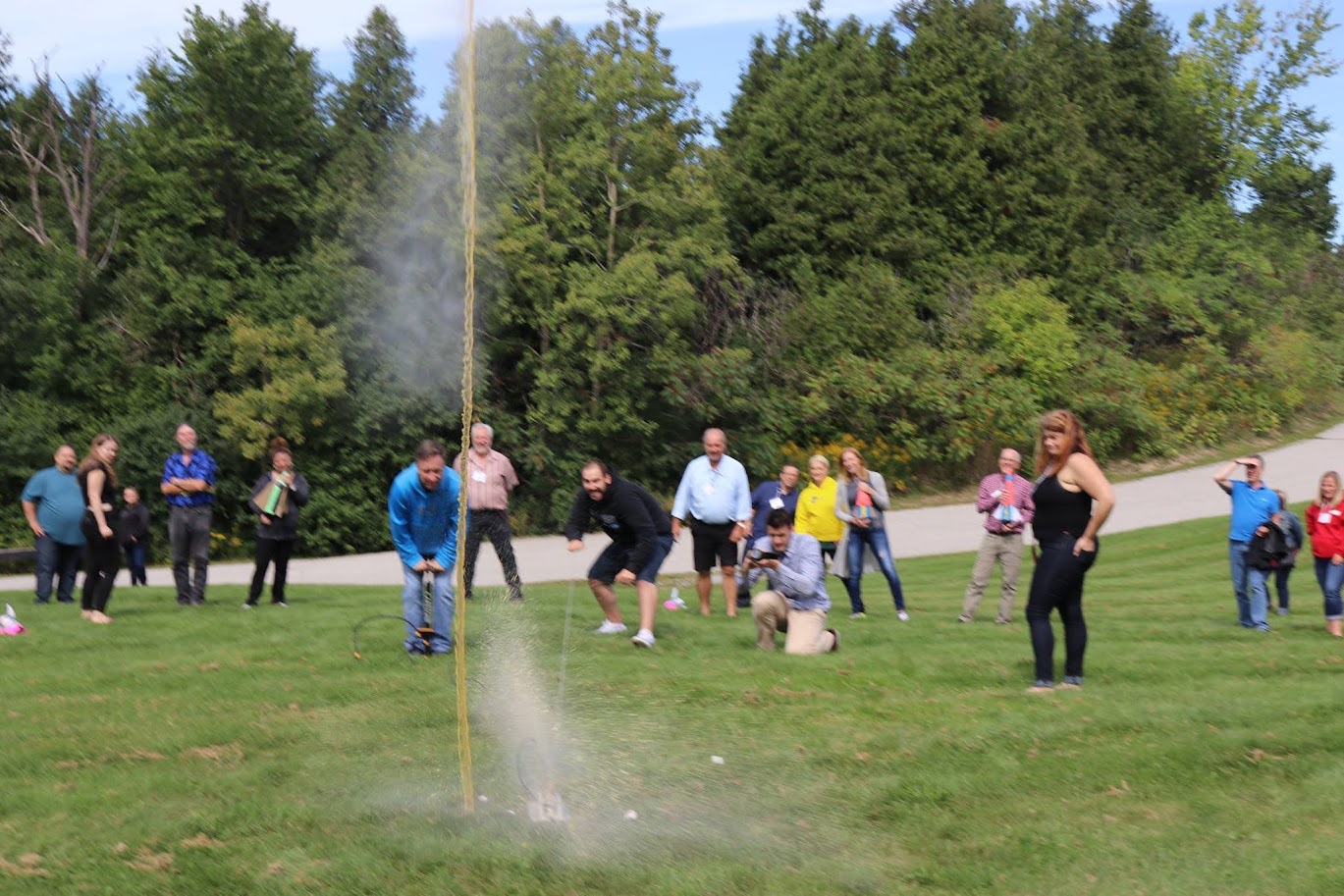
Design under aerodynamic constraints, test flights, iterate. The build-measure-learn loop with cardboard — and a launch on a campus lawn is the finale. Interstellar Rocket Challenge.
3. Elevated Raceway
20–150 · 2–3 hours · indoor · year-round
Design, budget, build, and race cardboard tracks — project management disguised as play, with a real deadline and a public test. Elevated Raceway.
4. Cardboard Boat Build
20–200 · half-day · needs a pool · March–October
The test environment is water and the failure mode is gloriously public. Peninsula hotel pools make this easy to stage. Cardboard Boat Build.
5. Maker Bootcamp
15–80 · 2–3 hours · indoor · year-round
Tools in hand, bench to work at, real fabrication. For hardware-minded teams and anyone who misses the shop. Maker Bootcamp.
6. STEM Kit Building
15–100 · 2 hours · indoor · year-round
Kit-based engineering challenges that run on delivered materials — the fastest-deploying build format for a campus conference room. STEM Kit Building.
7. Art of Flight
15–120 · 2 hours · indoor · year-round
Airworthy craft from basic materials, judged on distance and accuracy. A lighter aeronautics format for mixed rooms. Art of Flight.
8. Pit Stop Challenge
20–150 · 2 hours · indoor or outdoor · year-round
Optimize a repeatable process against the clock, heat after heat. Ops and platform teams see their own work in it immediately. Pit Stop Challenge.
9. Cardboard Train-ing Express
20–200 · 2–3 hours · indoor · year-round
Linked train cars that must couple and run as one — collaborative engineering with a mandatory integration test. Cardboard Train-ing Express.
10. Inukshuk Challenge
20–150 · 2 hours · indoor or outdoor · year-round
Structural balance and collaborative construction; a quieter build with a strong identity payoff for the team. Inukshuk Challenge.
6 logic, strategy, and race formats
Puzzle-driven formats let technical people socialize through argument — the most comfortable channel available.
- The Amazing Race: Palo Alto — clue chains and cipher checkpoints along University Avenue, around Stanford's edges, and through the downtown grid; or built entirely inside a corporate campus for security-conscious companies (The Amazing Race).
- Treasure hunt with a cipher ladder — sequential clues, each in a different encoding, so teams solve as a unit rather than splitting up. Format design in the treasure hunt guide.
- The Dragon Throne — game theory with physical pieces and real stakes; the format for teams that argue about optimal strategy recreationally (The Dragon Throne).
- Brain-teaser gauntlet — lateral-thinking puzzles under time pressure, solved in pairs so fast solvers don't play solo. Material in 75 brain teasers for work.
- Campus scavenger hunt — app-run, scalable to hundreds, with photo challenges that only make sense at your company (Scavenger Hunt).
- Trivia with an estimation round — Fermi questions reward reasoning over recall, which is the round where a room of engineers actually leans in. Rules and 150+ questions in the trivia guide.
8 outdoor and campus activities (March through November)
The Peninsula's climate is the Bay Area's best-kept secret: while San Francisco fogs in, Palo Alto and points south run warm and clear for most of the year.
- Beach Olympics at the Baylands or Shoreline — station-based competition on the lawns at Palo Alto Baylands or Mountain View's Shoreline Park, with the bay behind you (Beach Olympics).
- Campus field day — the office-olympics format on your own lawn or parking structure, with relays, absurd stations, and a medal podium. Planning in the corporate field day guide and the office olympics guide.
- Spuds of Thunder — potato-fortress warfare on any open lawn. Maximum comedy, zero skill required, the great equalizer for cross-functional groups (Spuds of Thunder).
- Survival X: Corporate Castaways — island-style tribal challenges; Shoreline's lakeside lawns and the bayside parks are ideal (Survival X).
- Human Dog Sled — raw collective hauling against the clock; a campus-lawn favorite (Human Dog Sled).
- Mini Golf Masters — teams build the holes, then everyone plays the course; runs on a lawn in summer or an atrium in winter (Mini Golf Masters).
- Raising the Tiki Bar — build competition with a reception at the end, the natural closer for a campus summer event (Raising the Tiki Bar).
- Peacock Picnic — competitive outdoor games with a picnic finale, built for company-wide summer days (Peacock Picnic).
More options in outdoor team building activities and summer team building events.
6 charity and culinary formats
Charity builds land harder on technical teams than almost any other audience, because they satisfy every engineering value at once: real specs, real QA, and an output whose usefulness is beyond argument.
- Bicycle Build Challenge — compete for parts, build real bikes, donate them to Peninsula and South Bay youth organizations, often with recipients present (Bicycle Build Challenge; the full anatomy in the charity bike build guide).
- Mission Incredible: Backpack & Care Kit Build — hundreds of kits in one session; the format for company-wide events of several hundred (Mission Incredible).
- Helping Hands — prosthetic-hand assembly for a global recipient network; the format where the afternoon's output crosses borders (Helping Hands).
- End Hunger Games — competitive food-bank stocking with a real haul delivered locally (End Hunger Games).
- Iron Chef Challenge — teams cook under a mystery constraint, judges score, the competition food becomes the meal. Clear rules, defined constraints, judged output — engineers approve (Iron Chef).
- Divine Wine Experience — a structured tasting for leadership groups and client-facing teams; the Peninsula's wine-country adjacency makes it a natural fit (Divine Wine Experience).
Full charity landscape: the charity team building guide.
Venues from Palo Alto to San Jose
Your campus (the venue most Valley companies already have)
The Peninsula's defining venue feature is that most companies here have better event space than any hotel: cafeterias, atriums, courtyards, lawns, parking structures, and all-hands rooms built for hundreds. A delivered event brings crew, equipment, and facilitation to that space, runs the program, and resets it — no venue rental, no transport, no security-badge complications for visitors, and the team is back at their desks by four. For a region where venue rental runs at some of the highest rates in the country, this is usually the decisive economic argument (the office team building guide; the format that fits the workday is the half-day).
Palo Alto and Menlo Park
- • Downtown Palo Alto — University Avenue and the surrounding grid for race and hunt formats; walkable, dense with checkpoints, and adjacent to Stanford's edges.
- • Palo Alto hotels — the Sheraton and Westin Palo Alto, Nobu Hotel, and the Clement for mid-size events near downtown; the Four Seasons Silicon Valley in East Palo Alto for larger and executive-tier groups.
- • Rosewood Sand Hill (Menlo Park) — the venture-corridor property for leadership and board-level events (executive team building).
- • Palo Alto Baylands and Byxbee Park — bayside lawns and trails for outdoor formats and hunts.
- • Mitchell Park and Rinconada Park — neighborhood parks with fields and picnic areas for mid-size outdoor days.
Mountain View and Sunnyvale
- • Shoreline Park — the standout outdoor venue in the South Bay: lakeside lawns, trails, and space for large field days and olympics.
- • The Computer History Museum — after-hours event rental in a venue tech teams genuinely want to visit; ideal for build-challenge formats.
- • Downtown Mountain View (Castro Street) — hunt territory with a dense restaurant row for a food-stop finale.
- • Sunnyvale and Cupertino hotels and campuses — the corporate corridor where office-delivered events dominate.
Santa Clara and San Jose
- • Santa Clara Convention Center and the hotel cluster — the region's conference infrastructure; for large-scale, agenda-attached events (conference team building).
- • Levi's Stadium — club spaces and event rooms for big-stage energy events, particularly sales kickoffs (the SKO guide).
- • Downtown San Jose — the San Jose McEnery Convention Center, the Fairmont and Signia hotels, and Plaza de César Chávez for hunts. Full San Jose coverage: the San Jose team building guide and team building in San Jose.
Up the Peninsula and into the city
For companies split between the Valley and San Francisco, or with teams in Redwood City, San Mateo, and Foster City, the same delivered model covers the whole corridor — see Bay Area team building, the San Francisco and Bay Area guide, and team building in San Francisco. East Bay teams: Oakland.
The Peninsula calendar and the microclimate caveat
- • March through November is outdoor season — the longest reliable window in the Bay Area. Palo Alto afternoons routinely run 10–15 degrees warmer than San Francisco's, and the fog that shuts down city events rarely reaches past the mid-Peninsula.
- • The microclimate caveat: conditions change block by block near the bay and the hills. Shoreline and the Baylands can be breezy in the afternoon; inland Palo Alto and Mountain View are calm and warm. Site your outdoor event with someone who knows the difference, and carry the standard written indoor backup regardless.
- • December through February is the rain window — indoor-first, with your campus atrium or a hotel ballroom as the default, and outdoor as the opportunistic bonus on clear days (winter event planning).
- • Peak booking windows: September–October (the region's best weather and every company's favorite offsite month) and December book first (why fall fills first). January kickoff season follows close behind.
Distributed teams and the quarterly gather day
Silicon Valley companies went remote and hybrid harder than any other region, and the connection cost lands here first: distributed teams keep their within-team ties and lose the cross-team network. The response that's become standard across the Valley is the quarterly gather day — one in-person day per quarter, anchored by a physical event no video call can replicate, that makes flying in feel worth it. The design rules: make the event the reason to come (a chain-reaction build, not a slide deck); mix rosters across teams and offices; time new-hire cohorts to land inside gather quarters, since remote hires report the weakest early belonging of anyone (the new-hire playbook); and never run hybrid-spectator setups where a laptop on a chair watches the office have fun. The full architecture: the hybrid team building playbook and rebuilding team culture after remote work.
How booking works on the Peninsula
- Send three things: approximate headcount, your date or window, and your location — campus, hotel, park, or "not decided." That produces exact pricing and 2–3 format recommendations.
- Lead time: 3–4 weeks standard; 6–8 for September–October, December, and January kickoff dates. Short-notice events are frequently possible with standing local crews (the short-notice playbook).
- Pricing: professionally facilitated events run $25–$150 per person across formats; Bay Area venue rental is the biggest variable, and a campus-delivered event removes it (the 2026 cost guide).
- What's included: design consultation, professional facilitators at real ratios, all equipment, setup and teardown, awards, and a facilitated debrief — the turnkey standard (what fully managed means).
- Campus logistics: load-in windows, security clearance for crews, and space reset are handled in the planning call — send your facilities contact and it's a five-minute conversation.
- Programs over one-offs: companies running quarterly gather days book the year in one decision, with the same crew returning each quarter (the annual partner model; the cadence evidence in how often to run team building).
The bottom line
Silicon Valley teams don't need convincing that connection matters — they've shipped through enough launch nights to know it. They need the event built for how they already work: a real problem, honest constraints, a role for every kind of mind, and something at the end that runs, flies, floats, or rides away. Deliver it at the campus you already have, use the Peninsula's long outdoor season, anchor the distributed team's quarter with it, and run the close like a retro. Thirty formats are above; the first one on the list is the one most Valley companies end up booking.
FullTilt Team Development delivers fully managed team building across Palo Alto, Menlo Park, Mountain View, Sunnyvale, Cupertino, Santa Clara, and San Jose — at corporate campuses, hotels, and parks — for groups of 15 to 500+. Tell us your headcount, your date, and your campus — exact pricing in 15 minutes, with a $500 guarantee behind every event.