

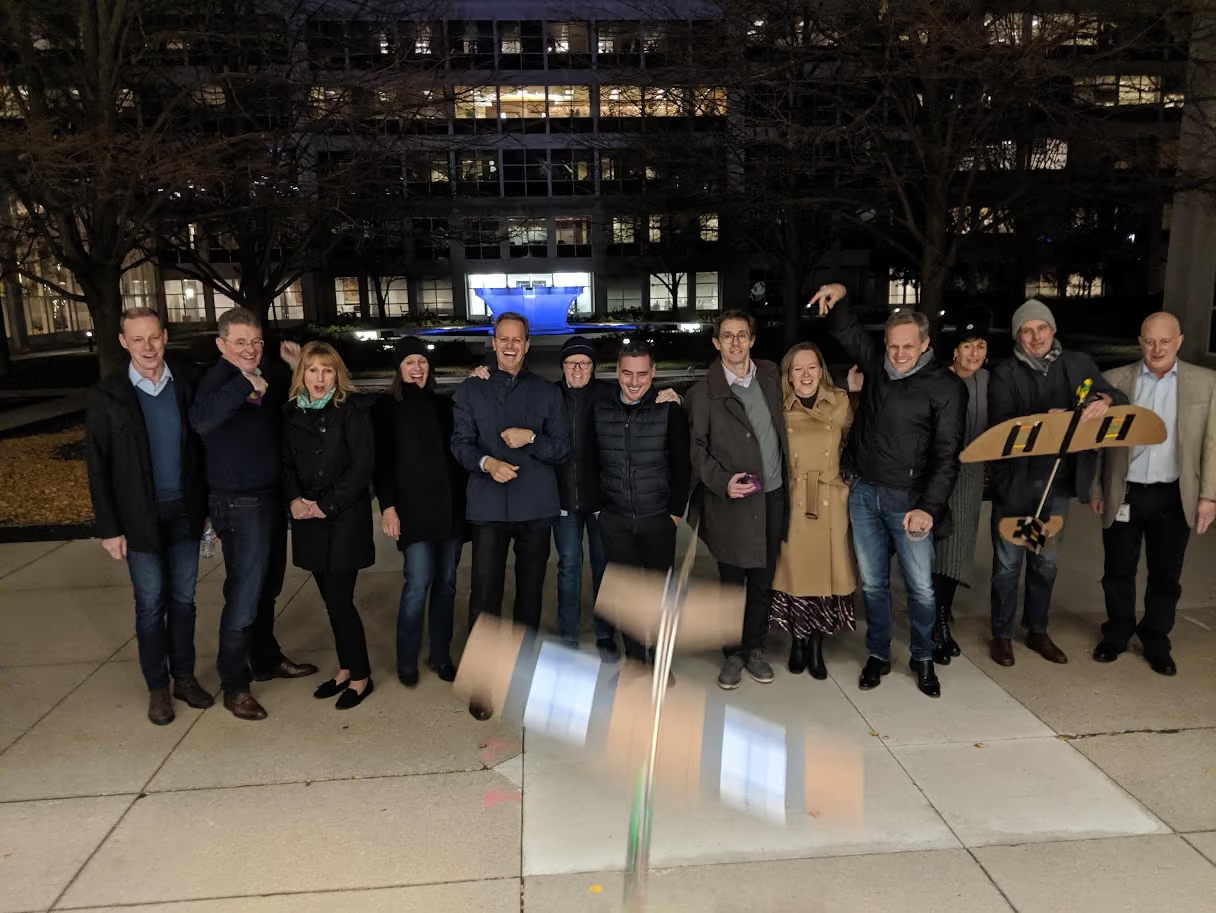
Sales teams are the easiest audience in team building — and the easiest to get catastrophically wrong. Here's the complete playbook: the competitive formats that match sales DNA, the sales-calendar strategy from SKO to Q4, remote and field-team tactics, the recognition science behind events that actually move pipeline culture, the VP's playbook, and the ROI math that makes the CFO nod.
Ask any corporate event facilitator which audience they'd choose to run an event for, and most will say the same thing: give me the sales team. Salespeople arrive competitive, loud, coachable, and constitutionally incapable of letting another team win without a fight. Hand them a bracket, a stopwatch, and a trophy, and the energy takes care of itself. No other function turns a Tuesday afternoon game show into a playoff atmosphere quite like the people who spend their lives chasing numbers.
And yet — sales teams are also where team building goes wrong in the most expensive ways. The same competitive wiring that makes the events electric makes the failure modes brutal: the "fun afternoon" scheduled the week a team missed quota that lands like an insult; the event that crowns the same top performer who wins everything else, teaching the bottom half of the leaderboard that even the party belongs to the president's club; the trust-fall retreat that a room full of closers openly mocks; the virtual happy hour that field reps in four time zones simply decline. Sales culture amplifies everything — great events become legend, mediocre ones become material for the group chat.
The stakes are real, too. Sales consistently runs among the highest-turnover functions in the company — industry surveys regularly put annual sales attrition far above company averages, and every departing rep takes ramped-up product knowledge, territory relationships, and pipeline with them. Meanwhile Gallup's meta-analysis ties top-quartile engagement to roughly 18% higher sales productivity — the one engagement statistic that names your function specifically. For a revenue org, team connection isn't a soft investment; it's quota infrastructure.
This guide is the complete manual for getting it right: how sales team building differs from every other kind, the format rankings by what sales rooms actually respond to, the sales-calendar playbook (because in sales, when matters as much as what), strategies for remote, field, and hybrid revenue teams, the recognition mechanics that make events compound, and the leader's playbook for building team culture inside a quota culture without pretending the quota isn't there.
Why sales teams need different team building than everyone else
Most team building advice treats the audience as interchangeable. For sales teams, that assumption fails in three specific ways:
1. Competition is the native language — and the trap
You never have to convince a sales team to compete. Announce a bracket and watch a room of account executives start scouting opponents before the rules are finished. This is the gift: formats that need heavy facilitation to energize an engineering or finance group run themselves with sales. (For contrast, see how differently the analytical crowd is wired in team building for engineers — same company, opposite operating system.)
The trap hides inside the gift. Sales teams already have a competition — it's called the leaderboard, it runs 365 days a year, and everyone knows their rank. An event that simply reproduces it (individual contests, skill-based games that reward the same confidence and quickness that closes deals) doesn't build the team; it re-crowns the champions in front of everyone else. The reps in the bottom half — the very people connection and belonging would retain — experience the "team event" as one more afternoon of watching the same people win. Great sales team building uses the competitive engine while deliberately scrambling who gets to win: mixed teams, chaos-and-luck elements, roles that reward organization and creativity as much as swagger.
2. The scoreboard shapes the psyche
Salespeople live measured. Every day ends with a number, every month with a rank, every year with a W or an L that everyone can see. That produces the profession's trademark resilience — and its trademark burnout: sales consistently posts some of the highest turnover in the corporate world, and the emotional whiplash of quota life is a leading reason. What the scoreboard economy starves is lateral connection: reps bond with their manager and their number, less often with each other, because the structure quietly frames peers as rivals. Team events are one of the only tools that rebuild the lateral ties — the rep-to-rep relationships that make people share talk tracks, cover territories, celebrate each other's closes, and stay when a recruiter calls. The retention research behind that mechanism is stacked in the statistics library; the sales-specific headline is Gallup's finding that engaged business units run roughly 18% higher sales productivity than disengaged ones.
3. The calendar is unforgiving
No other function's mood swings on the calendar like sales. The same event that electrifies a kickoff in January reads as an insult in the last week of a quarter ("we're behind the number and leadership scheduled games?"). Timing isn't a detail of sales team building — it's half the design, which is why this guide dedicates an entire section to the sales year.
The five design principles for sales rooms
1. Compete in teams, never as individuals. The whole point is converting rivals into teammates. Every format should be team-scored, with rosters engineered to mix territories, tenure bands, and — crucially — performance tiers, so the struggling SDR and the president's-club AE are suddenly on the same side, high-fiving. (Self-sorted teams reproduce the org chart and the clique map; assigned rosters are non-negotiable.)
2. Inject luck and chaos. The great equalizer. Formats with dice rolls, mystery constraints, absurd physical challenges, and momentum swings guarantee the event's winners aren't predetermined by the quota board. When the ops coordinator's team beats the top closer's team because of a heroic cup-stack, the room learns something the leaderboard can't teach: everyone here can win.
3. Build the recognition engine in. Sales runs on recognition — it's the currency of the culture. Every sales event should end with an awards ceremony that goes beyond first place: best comeback, best strategy, best trash talk, best team name, MVP votes by peers. This is where events do their most durable work, because it's the one stage where recognition reaches people the revenue reports skip. (Recognition's link to retention and engagement is one of the most replicated findings in the workplace literature — Gallup and Workhuman have documented it for a decade.)
4. Match the energy, then aim it. Sales events should be loud — an emcee with real presence, music, a bracket on the wall, escalating stakes. But energy without arc just burns out; professional facilitation shapes it toward a finale everyone experiences together, then lands the plane with recognition and (yes, even for sales) a two-minute reflection that names what the room just proved about itself. The craft difference is exactly the subject of what great facilitators do.
5. Never schedule fun as consolation. The tone-deaf classic: the team misses the number, morale dips, and someone books a "morale event." Sales teams smell it instantly, and it reads as leadership treating a performance problem with pizza. The fix is rhythm — events tied to the calendar (kickoff, mid-year, post-quarter) rather than to mood, so they arrive as structure, not as apology. Cadence evidence: how often to do team building.
The format rankings: what sales teams actually respond to
Tier 1 — Game-show tournaments (the home game)
Minute to Win It is the single most reliable sales-team format in existence: bracket structure (sales teams understand brackets on a cellular level), sixty-second challenges where composure beats skill, an emcee stoking the rivalry, and a trophy that will sit on someone's desk generating trash talk until the rematch. The chaos factor is perfectly calibrated — top performers get no built-in edge at stacking cups or bouncing balls, so upsets are constant and the whole room stays in it. For a wilder variant, Spuds of Thunder brings the same competitive architecture outdoors with potato-fortress warfare — the format that turns regional sales meetings into legend.
Tier 2 — Races and challenge gauntlets
Sales teams love a finish line. The Amazing Race format — clue chains, checkpoints, strategy-versus-speed decisions across a campus or downtown — plays directly to prospecting instincts: read the situation, pick your route, hustle. App-run scavenger hunts scale the same energy to hundreds of participants at a conference, and the Pit Stop Challenge adds the perfect sales metaphor — teams optimizing a process against the clock, then watching the leaderboard reshuffle with every heat. Beach Olympics is the full-day version for offsites and club-qualifier events: multi-station, wave-scored, sunburn optional.
Tier 3 — Build competitions (competition with a monument)
Build formats give sales teams something rare: a win you can photograph. The Cardboard Boat Build is peak sales energy — design bravado, construction shortcuts, and then the gloriously public accountability of the launch (every sales team contains at least one boat that was "definitely going to be fine"). Elevated Raceway runs design-and-race dynamics indoors. And the Domino Effect Challenge deserves special mention for revenue orgs: every team owns a segment, every segment must connect, and the finale only works if everyone's work holds — the pipeline metaphor writes itself, and the collective held breath at the chain reaction is the single best shared moment in corporate events (why chain reactions outperform everything). Many SKOs run it as the closing event precisely because the metaphor lands so hard: one team, one number, every handoff matters.
Tier 4 — Culinary battles (the club-dinner upgrade)
Sales culture already worships the steak dinner; culinary competition upgrades it from consumption to combat. An Iron Chef Challenge gives teams a kitchen, a mystery constraint, and judges — and then the competition food becomes the meal, merging event and celebration into one evening. A Divine Wine Experience plays the sophisticated version for enterprise teams and executive-heavy rooms. Both shine at QBRs and president's-club-adjacent events where the audience expects premium.
Tier 5 — Charity builds with a leaderboard (the format that surprises sales leaders)
Here's the counterintuitive one: charity events land harder on sales teams than almost any other audience — because the format finally points the competitive engine at something unambiguously good. Teams compete through challenges to earn bike parts in the Bicycle Build Challenge (the full anatomy: the charity bike build guide), race to stock food banks in the End Hunger Games, or assemble care kits at conference scale — and then the handover moment does what no incentive trip ever has: it makes a room of closers go quiet. For teams whose entire year is measured in dollars, an afternoon measured in donated bikes is unexpectedly profound. Full landscape: the charity guide.
What to skip for sales teams
Trust falls and feelings-first circles (the mockery writes itself), unstructured happy hours (the clique map just relocates to a bar — the structural case against them is in why experiences replaced icebreakers), individual-scored contests (see principle #1), and small-room venue outings for big teams — an escape room caps around ten people per room, which fragments a 60-rep org into unsynchronized splinters (the honest escape-room analysis).
The sales-calendar playbook: right event, right moment
January — the SKO (the season opener)
The sales kickoff is the biggest team-building moment of the revenue year — the one time the entire org is in one room with fresh quotas and fresh hope. The strategic mistake most SKOs make is programming wall-to-wall content and treating the team event as filler; the fix — and the full architecture of a kickoff people actually remember — is the dedicated playbook: SKO team building. The short version: the day-2 afternoon energy block is sacred, the closing event should be the shared-finale kind (a chain reaction, a tournament final, a charity handover), and the connection engineered at SKO is what the February pipeline reviews spend down. Planning note that surprises first-time organizers: January SKO events book in September–November — venue-adjacent delivery capacity for kickoff season sells out with the conference hotels (why fall books first).
Quarter rhythm — QBRs and quarter-launches
Quarterly business reviews are the natural cadence anchor: the org is already gathered, the numbers session drains the room, and a 90-minute competitive block afterward refills it — this is the conference team building pattern applied inside your own walls, and it rides free on logistics already paid for. Companies running this as standing rhythm typically buy it as an annual program — four dates held, formats rotated, and (the underrated benefit) the same facilitation crew returning each quarter, remembering the rivalries and running callbacks that make each event feel like a season, not an episode.
Mid-year — the slump breaker
Every sales year has a dead zone — usually mid-Q3, when SKO energy is a memory and the year's number looks either safe (complacency) or scary (dread). A mid-year reset event, run as scheduled rhythm rather than emergency morale surgery, is the highest-leverage slot on the calendar precisely because nothing else is fighting for it. The half-day format is purpose-built for this: an afternoon, at your office (the office playbook — no venue cost, no travel objections), reps back on the phones by four with something to talk about besides the gap to goal.
Q4 — fuel, carefully
Q4 events walk the line from principle #5: the team is grinding, and anything that smells like distraction gets resented. What works: short, high-energy formats framed as fuel (a 90-minute tournament, not a day away), scheduled early in the quarter rather than during the December close, and — the elegant move — the celebration held in reserve: book the blowout for when the number lands, announce it in October, and let the event itself become a team incentive. If the celebration doubles as the holiday party, the two-act architecture in the holiday party guide is the template — and if the year ends in a photo-finish and you need something magnificent on two weeks' notice, that's a solved problem too (the short-notice playbook).
The wins themselves — celebrate like you mean it
Record quarter, whale closed, club qualified: sales culture's celebration instinct usually produces a dinner, and dinners evaporate. Converting win-celebrations into shared experiences — the boat build after the record Q2, the charity build when the team hits club — turns the win into an artifact and the celebration into another layer of the story the team tells about itself. This is also where recognition compounds: the celebration event is the natural stage for the peer-voted awards the quota report will never give.
Remote, field, and hybrid sales teams
Revenue orgs went distributed in three directions at once — inside sales working remote, field reps who were never in the office to begin with, and hybrid HQ teams — and the connection cost lands hardest here, because sales already skews transactional in its internal relationships. The playbook:
• Make the gathers count double. Distributed sales teams typically assemble two to four times a year (SKO, mid-year, QBR fly-ins). Those days carry the entire year's in-person connection budget — programming them as pure content is spending the budget on slides. The gather-day design rules live in the hybrid playbook; the sales-specific addendum: the event block is what makes reps want to fly in, and attendance at optional gathers is itself a leading indicator worth tracking.
• Between gathers, structure beats spontaneity. Weekly ritual slots inside existing calls — a two-minute would-you-rather vote to open the forecast call, a rotating "deal story of the week," monthly team trivia with real brackets — keep lateral ties alive at near-zero cost. The toolkit: micro-moments and the icebreaker hub. What doesn't work is the unstructured virtual happy hour — attendance decays to the same five people by week three (the failure modes, documented).
• Onboard new reps into the team, not just the territory. Sales onboarding obsesses over product and process and routinely skips belonging — then wonders why first-year attrition is brutal. Timing new-hire cohorts to land inside a gather quarter, and giving them real roles in the event (not "watch and learn"), is the cheapest ramp-retention lever available (the new-hire integration playbook).
• Field teams: regionalize the rhythm. For territory-scattered field orgs, run regional half-day events in hub cities on a rotating basis rather than waiting for the annual national. A provider that delivers the same event standard in every metro makes this trivially bookable (how the delivered model works in any city).
By team type: SDRs, AEs, and the full revenue org
• SDR/BDR teams: the youngest, highest-churn, most burnout-exposed population in the org — and the most responsive to team building of anyone in the building. High-frequency, high-energy, low-cost: monthly game blocks, tournament ladders with standings that persist between events, celebration rituals for the unglamorous grind metrics (most demos set, best save of a dead sequence). For SDR teams, cadence matters more than production value; this is where the retention-focused activity set earns its keep.
• AE teams: smaller, prouder, more status-conscious — the population most at risk of the re-crowning trap. Mixed-team formats with luck elements are essential, premium formats (culinary battles, builds) match the self-image, and peer-voted recognition lands harder than manager-granted. For enterprise AE and leadership rooms, the executive tier applies.
• The full revenue org (sales + SDR + CS + marketing + RevOps): the highest-value mixing there is, because the handoff seams between these teams are where deals die — and the classic cross-functional dysfunction research (~75% of cross-functional teams failing on core criteria) describes revenue orgs painfully well (why cross-functional teams fail). Rosters that force sales-CS-marketing blending, formats where no function has home-field advantage, and scale operations for the headcount (the large-group mechanics — a full revenue org is routinely 100–500 people, the tier where operational competence is the whole purchase).
• Sales managers themselves: the layer everyone forgets. Front-line sales managers carry the culture (Gallup pegs ~70% of team-engagement variance to the manager) and typically got promoted for closing, not for team-building — the gap documented in the manager training gap. Manager-cohort events plus the weekly-ritual toolkit turn them from event consumers into culture operators.
The sales leader's playbook (VP edition)
1. Announce it like a competition, not an HR initiative. "Bracket drops Friday. Teams are assigned. The trophy is real." Sales teams RSVP to stakes.
2. Rig the rosters, own the rigging. Mix territories, tiers, and tenure on purpose and say so — "you're teamed with people you don't talk to enough" is a perfectly good sentence from a VP.
3. Play, don't preside. A VP competing (and losing publicly at cup-stacking) does more for culture than a VP watching from the back with a phone. The event is the rare stage where leadership gets to be human at zero cost.
4. Protect the event from the pipeline. Ninety minutes means ninety minutes — no "quick huddle" hijack, no forecast talk from the mic. An event that becomes a meeting in costume burns trust in every future event.
5. Spend the recognition budget at the ceremony. Come with awards beyond the podium — categories the CRM can't see. Write them down beforehand; improvised recognition always goes to the usual suspects.
6. Close the loop Monday. One message: the photos, the standings, the rematch date. The event's half-life doubles when leadership treats it as a season, not a one-off.
7. Buy the rhythm, not the rescue. Book the year's four anchors in one decision (the annual partner model — better pricing, held dates through peak seasons, compounding facilitation) and delegate the logistics wholesale to a turnkey provider. Your ops manager has a pipeline to run; the vetting shortcut is what team building companies actually do.
The ROI math for revenue orgs
Sales leaders get to run the strongest version of the team-building business case in the company, because the function's economics are the most brutal and the most measured. The short form (full worksheet and pitch template: the ROI business case):
• Turnover is the whole argument. Rep replacement costs run one-half to two times salary in the standard HR math — but sales adds what other functions don't: ramp time (quarters of sub-quota production), territory relationship loss, and pipeline that leaves in a departing rep's follow-up list. A revenue org's true per-departure cost sits at the top of every range, which drops the breakeven to almost nothing: a quarterly program funds itself if it contributes to keeping one rep every couple of years.
• The productivity correlation names you specifically. Gallup's ~18% sales-productivity gap between top- and bottom-quartile engagement is the rare engagement stat denominated in your own KPI. You don't need to claim the program captures the whole gap; you need one point of it to dwarf the program cost.
• The spend is a rounding error against the incentive budget. Professionally run events price at $25–$150 per person (the 2026 cost guide) — most sales orgs spend more on one club trip's airfare than on a full year of team connection for everyone, including the 80% who never qualify for club. That asymmetry, said out loud, usually ends the budget conversation.
• Measure like a sales org. Baseline and track: voluntary rep turnover, ramp-to-quota time for cohorts onboarded with versus without gather-quarter timing, eNPS/pulse on team connection, and optional-event attendance. Report it in the QBR like any other pipeline metric — it is one.
The bottom line
Sales teams don't need convincing to compete — they need somewhere better to point it. Build events in their native language: brackets and finish lines and trophies, on teams the leaderboard would never assemble, with chaos enough that anyone can win and recognition generous enough that everyone's seen. Run it on the calendar's rhythm — kickoff, quarters, the mid-year dead zone, the celebration the number earns — and the same competitive wiring that makes sales cultures brittle becomes the thing that binds them. The quota is individual. The season is shared. Great sales team building is how a room full of rivals figures that out.
FullTilt runs high-energy competitive events for sales teams and full revenue orgs — SKO energy blocks, quarterly tournaments, build challenges, and charity showdowns, fully managed at your office, offsite, or conference venue anywhere in North America. Tell us your team size and your slot on the sales calendar — exact pricing in 15 minutes.